You’ve probably witnessed this subtle moment: a harmless comment is made in a group, and one person suddenly stiffens. Their tone changes. Their body language shifts. No one has accused them, yet they act as if they’ve been singled out.
Why does this happen? Why do some people expose themselves without a single finger being pointed at them? An old Hebrew saying explains this psychological truth with remarkable precision.
Hebrew proverb of the day: ‘The hat burns atop the thief’s head’
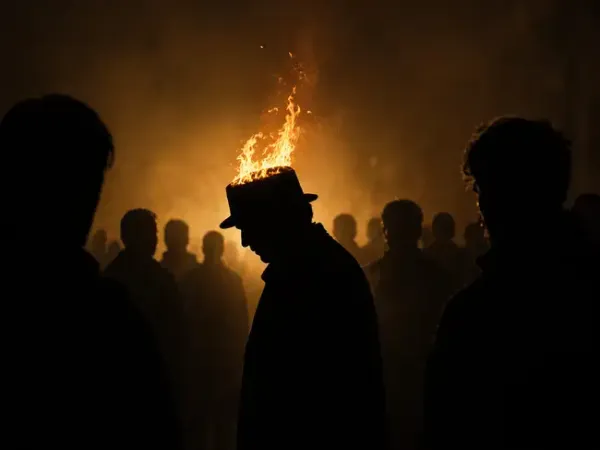
The Hebrew proverb ‘Al rosh ha-ganav bo’er ha-kova’ literally paints a vivid image: a thief stands in a crowd, but the hat on his head is on fire. No one may know he is the thief, yet the burning hat makes him visible to everyone.
The deeper message lies in human psychology. Guilt is difficult to hide. A person who has done wrong often carries an inner discomfort that shows itself through behavior. They may become defensive at neutral remarks, overly eager to explain themselves, or unusually reactive in situations where calm would suffice. The proverb suggests that conscience acts like the fire on the hat, it exposes the wrongdoer without any external accusation.
This truth appears in everyday settings. In offices, a general review meeting can make the underperformer anxious before any feedback is given. In friendships or marriages, a simple question may trigger defensiveness from someone hiding the truth. In public life, people under suspicion sometimes reveal more through their reactions than through evidence.
The broader takeaway is powerful: people with a clear conscience tend to stay composed because they have nothing to fear. Those carrying guilt often reveal themselves through their own unease. The proverb reminds us that truth has a way of surfacing, not always through investigation, but through human behavior itself.
The above proverb and its translation is sourced from Hebrewpod101.
Why does this happen? Why do some people expose themselves without a single finger being pointed at them? An old Hebrew saying explains this psychological truth with remarkable precision.
Hebrew proverb of the day: ‘The hat burns atop the thief’s head’
What this proverb means
The Hebrew proverb ‘Al rosh ha-ganav bo’er ha-kova’ literally paints a vivid image: a thief stands in a crowd, but the hat on his head is on fire. No one may know he is the thief, yet the burning hat makes him visible to everyone.
The deeper message lies in human psychology. Guilt is difficult to hide. A person who has done wrong often carries an inner discomfort that shows itself through behavior. They may become defensive at neutral remarks, overly eager to explain themselves, or unusually reactive in situations where calm would suffice. The proverb suggests that conscience acts like the fire on the hat, it exposes the wrongdoer without any external accusation.
Significance of the proverb in real life
This truth appears in everyday settings. In offices, a general review meeting can make the underperformer anxious before any feedback is given. In friendships or marriages, a simple question may trigger defensiveness from someone hiding the truth. In public life, people under suspicion sometimes reveal more through their reactions than through evidence.
The broader takeaway is powerful: people with a clear conscience tend to stay composed because they have nothing to fear. Those carrying guilt often reveal themselves through their own unease. The proverb reminds us that truth has a way of surfacing, not always through investigation, but through human behavior itself.
The above proverb and its translation is sourced from Hebrewpod101.