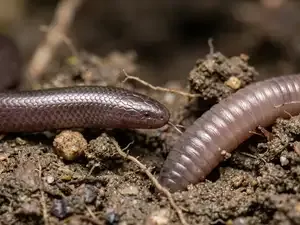
Small animals similar to threads found within the soil are usually considered worms, although this is not always accurate. Within many states in America, particularly areas characterized by high levels of moisture, individuals come across a type of snake referred to as the earthworm blind snake.
The United States Department of Fish and Wildlife Services confirms that the earthworm blind snake is actually a reptile despite its similarity to worms in terms of body size and shape. These snakes have a life cycle underground, where they spend most of their time, making it hard for an individual to differentiate between the two creatures.
The United States Department of Fish and Wildlife Services confirms that the earthworm blind snake is actually a reptile despite its similarity to worms in terms of body size and shape. These snakes have a life cycle underground, where they spend most of their time, making it hard for an individual to differentiate between the two creatures.
Movement Can Be Misleading
One cause of confusion lies in the movement. Extension research conducted by Michigan State University Extension proves that some worms that are categorized as invasive and are also called jumping worms move in a manner that resembles the movement of snakes. As a result, individuals assume what they are observing is a snake, not a worm. The reverse case also occurs, in which a blind snake is considered to be a worm due to its small size. It is important to focus on physical characteristics as opposed to movement since the two creatures differ greatly physically.The advice from the University of Maryland Extension points out that while worms have segmented bodies and a visible band, snakes are distinguished by having smooth skin without a bandImage Credit: Gemini