Tehran: The coffin of Iran’s late Supreme Leader, Ayatollah Ali Khamenei, arrived at the Imam Khomeini Hussainiyah in Tehran on Friday, July 3, as mass mourning began across the country ahead of six days of funeral ceremonies expected to draw millions of people.
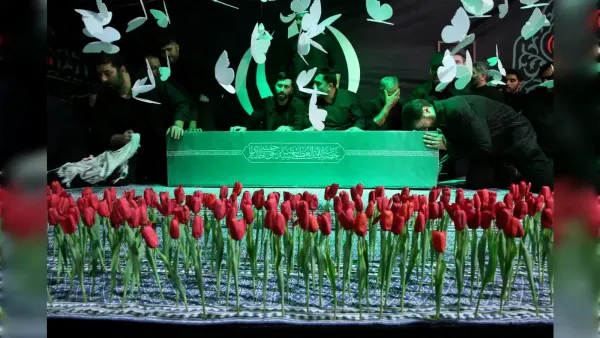
Khamenei was assassinated in a joint US-Israeli attack on February 28, an event that triggered weeks of conflict across the Middle East. Ahead of the official programme, Iran’s state broadcaster, Islamic Republic of Iran Broadcasting (IRIB), aired footage showing his flower-covered coffin being brought to the site of the attack during a private ceremony.
The footage showed mourners accompanying the coffin through a densely packed crowd, with white dove-shaped decorations, red tulips and green ceremonial displays surrounding the procession. Images released later by Iranian state media showed the coffin placed on a stage beneath butterfly-themed decorations, while Press TV published a photograph showing a flag from the Imam Reza shrine draped above it.

Grand Mosalla prepared for funeral
Preparations continued at Tehran’s Grand Mosalla, where black mourning flags, red banners, large portraits of Khamenei and floral arrangements decorated the sprawling religious complex.
According to AFP, security was reinforced around the venue before the ceremonies, with vehicles searched at checkpoints and entry limited to visitors carrying special permits.
Multi-day funeral schedule announced
The official funeral programme will continue in Tehran on July 4 and 5 before the main funeral procession on July 6. The ceremonies will then move to Qom on July 7, followed by memorial events in Baghdad, Najaf and Karbala on July 8. The final funeral and burial are scheduled for July 9 at the Imam Reza shrine in Mashhad.
Iranian media said leaders and officials from more than 30 countries, including Russia, China, Pakistan, India, Tajikistan, Georgia and Cuba, are expected to attend the memorial ceremony.
Officials estimate that between 15 and 20 million people could attend the ceremonies, potentially making them the largest state funeral in Iran’s history.
Ghalibaf urges public participation
Meanwhile, Parliament Speaker Mohammad Bagher Ghalibaf urged Iranians to attend in large numbers, saying the gathering should send a message demanding “vengeance for his blood”. He called on citizens to “write a glorious page in the history of Islamic Iran through your presence”, adding that “the nation’s call for vengeance must ring in the ears of the whole world”.
Iran-US talks continue
Separately, mediators said Iran and the United States concluded another round of indirect talks in Doha on Thursday as diplomatic efforts continued to lower tensions. A memorandum of understanding signed in June, brokered by Pakistan and Qatar, established a 60-day ceasefire, reopened the Strait of Hormuz and created a framework for negotiations on reconstruction and Iran’s nuclear programme.
-
Arsenal eye Aston Villa and England star Ezri Konsa amid growing transfer speculation
-
Nottingham Forest respond after unexpected exit of manager Vitor Pereira

-
Hyderabad madrasa teacher jailed 20 yrs for sodomising minor

-
Concerns Rise Over Elephant Poaching and Human-Elephant Conflict in Assam
-
Venezuela: Security guard rescued alive 8 days after powerful quakes, asks rescuers not to tell his wife he's alive