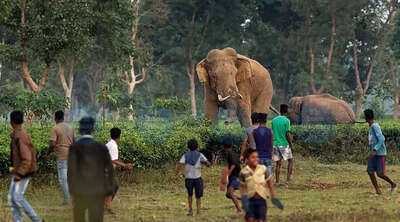
A file image of man-elephant conflict in Assam (Photo: AT)
Amingaon, July 3: The alarming rise in elephant poaching has been identified as a significant factor driving wild elephants into populated areas.
Dinesh Das, a resident of Rani with a strong environmental awareness, pointed out that food shortages and diminishing habitats are now compounded by poaching, which is pushing elephants into the plains.
“Elephants are facing starvation, their living spaces are vanishing, and they no longer feel safe in their natural environment,” Das stated.
As the secretary of the Sangrami Krisak Shramik Sangha, Das accused organized poaching gangs, equipped with advanced weaponry, of operating within the forests. “Elephants are hunted for their tusks and meat. The illegal trade in elephant products is thriving, leading to the displacement of these animals. After being killed, the meat is dried in the forest before being moved,” he claimed.
Focusing on the Rani Forest Range, Das expressed concern that forest officials are not addressing the poaching issue adequately. He emphasized that without tackling this problem, the department will struggle to manage the escalating human-elephant conflicts.
He further criticized the prioritization of sand, timber, and stone extraction over the conservation of already degraded forests. Deforestation in elephant habitats has created a severe food shortage for these herbivores, driving them into human settlements in search of sustenance.
When questioned about the poaching threat and its implications for human-elephant interactions, Ashok Dev Choudhury, the Divisional Forest Officer of the East Kamrup Forest Division, acknowledged that poaching, particularly from the Meghalaya region for elephant meat, remains a significant concern.
“Recognizing the seriousness of the situation, we are in discussions with the Wildlife Crime Control Bureau (WCCB) and have shared intelligence regarding elephant poaching,” Choudhury noted.
Internationally recognized wildlife expert Dharani Dhar Boro suggested that the Assam Forest Department should collaborate with its Meghalaya counterpart to conduct joint patrols along the border.
Boro recalled successful joint patrols with Bhutanese forest officials during his time at the Manas World Heritage Site, stating that such initiatives could effectively reduce poaching. He also highlighted the necessity for awareness programs to educate local communities and suggested that forest personnel should establish camps within the forests if necessary.
Boro emphasized that forest officials must rise to the occasion to address the growing crisis. They should identify and safeguard elephant corridors and maintain vigilant monitoring to prevent herds from entering human habitats. “By closely observing these corridors, they can help keep the herds from straying into populated areas, providing some relief to the residents,” he explained, adding that merely driving elephants away has proven ineffective as they tend to return.
Meanwhile, with elephants straying from the Rani Forest almost daily, anxiety has spread across various regions within the Kamrup West and East Kamrup forest divisions. Residents are calling for immediate and effective measures to avert any tragic incidents.
Some locals from Majkuchi claimed that if forest personnel were more vigilant along the forest boundaries, the frequency of elephant incursions into villages and the resulting crop damage could be significantly reduced. They also attributed the alarming rise in human-elephant conflict to departmental negligence.
Kanak Kalita from Majkuchi expressed that local residents are suffering from unprecedented elephant-related damage. He reminisced about earlier times when encounters with wild elephants were rare, but now they wander through villages as if they were domestic animals.
“Our efforts are in vain as the elephants destroy everything – from paddy and vegetables to coconuts. Even paddy seedbeds are ruined as the herds trample them. What is crucial now are effective measures to resolve this issue permanently so that farming can proceed without disruption,” stated Kalita, a retired Field Development Officer of the Agriculture Department.
Kiran Kalita, a retired teacher, remarked that both humans and elephants are facing increasing challenges. “The poaching threat must be addressed decisively, and long-term strategies such as habitat restoration through planting should be implemented to provide lasting relief for both elephants and affected villagers,” he concluded.
-
Will Cristiano Ronaldo Retire After the World Cup? His International Future Explained

-
Swiss Advance to Round of 16

-
As heat waves loom, scientists wonder how humans will adapt

-
Review: 'Baby Do Die Do' has trouble keeping up with its killer title and killer heroine

-
Electric Scooter Care in Monsoon: 5 Important Tips to Protect Your EV Battery