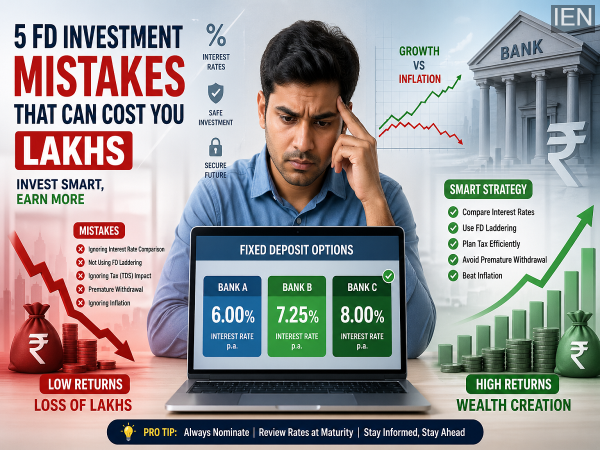
Fixed Deposits (FDs) are often considered one of the safest investment options in India. For decades, they have been the go-to choice for risk-averse investors seeking stable and guaranteed returns. However, while FDs may seem simple and secure, a lack of planning or awareness can significantly reduce your overall earnings. Even a small mistake—such as ignoring a 1% difference in interest rates—can translate into a loss of lakhs over time.
If you want your money to grow efficiently and not just sit idle, it is essential to understand the common pitfalls associated with FD investments. Here’s a detailed look at five major mistakes investors often make—and how you can avoid them.
1. Ignoring Interest Rate Comparisons Can Reduce Your Earnings
One of the most common mistakes people make is investing in an FD with their existing bank without comparing interest rates. While public sector banks are trusted institutions, they often offer lower interest rates compared to small finance banks and some private lenders.
The difference may appear minimal—typically between 0.50% and 1.5%—but over a long investment horizon, this gap can significantly impact your returns. For example, on an FD of ₹10 lakh for five years, even a 1% higher interest rate can generate substantially more income.
Tip: Always compare FD rates across banks before investing. A few extra minutes of research can result in better long-term gains.
2. Not Using the FD Laddering Strategy
Many investors prefer putting their entire savings into a single long-term FD. While this may seem convenient, it limits flexibility and reduces the opportunity to benefit from changing interest rates.
A smarter approach is to use a strategy called FD laddering. This involves splitting your investment into multiple FDs with different tenures—such as 1 year, 2 years, and 3 years.
This way, one FD matures each year, giving you the option to reinvest at potentially higher rates or use the funds if needed. It also ensures better liquidity and risk management.
Tip: Diversify your FD tenures instead of locking all your money into one long-term deposit.
3. Overlooking Tax Implications (TDS on Interest)
Many investors mistakenly believe that FD returns are tax-free. In reality, the interest earned on FDs is fully taxable as per your income slab.
Banks deduct Tax Deducted at Source (TDS) at 10% if the interest exceeds the prescribed threshold. This can reduce your actual earnings if you’re not prepared.
However, if your total income falls below the taxable limit, you can avoid TDS by submitting Form 15G (for individuals below 60) or Form 15H (for senior citizens).
Tip: Stay updated on tax rules and submit the required forms on time to prevent unnecessary deductions.
4. Premature Withdrawal Can Lead to Losses
Breaking an FD before its maturity may seem like an easy solution during financial emergencies, but it comes at a cost. Most banks impose a penalty ranging from 0.5% to 1% on premature withdrawals. Additionally, the interest rate applicable may be lower than initially promised.
This can significantly reduce your returns and defeat the purpose of long-term investing.
Tip: Only invest surplus funds that you won’t need in the short term. Alternatively, opt for a sweep-in FD facility, which allows partial withdrawals without breaking the entire deposit.
5. Ignoring Inflation Can Erode Real Returns
While FDs offer fixed returns, they may not always beat inflation. For instance, if your FD earns 7% annually and inflation stands at 6%, your real return is just 1%.
This means your purchasing power is barely increasing, even though your money appears to be growing.
Tip: Always evaluate FD returns in relation to inflation. For long-term goals, consider diversifying into other instruments like mutual funds or bonds for better real returns.
Smart Investment Tip to Boost Your Returns
In addition to avoiding these mistakes, there are a few best practices every investor should follow. Always nominate a beneficiary for your FD to ensure smooth transfer in case of unforeseen events. Also, avoid blindly opting for auto-renewal at maturity. Instead, review current interest rates and reinvest accordingly for better returns.
Final Thoughts
Fixed Deposits remain a reliable and low-risk investment tool, but maximizing their benefits requires careful planning and informed decisions. By avoiding these common mistakes and adopting smarter strategies, you can ensure that your money works harder for you.
A small step today—like comparing rates or planning your tenure wisely—can make a big difference in your financial future.
-
India's Path to Becoming a Developed Nation by 2047, According to Economist Jeffrey D. Sachs

-
Weather Update: Relief from Heat in Delhi-NCR with Rain Forecast

-
Harbhajan Singh Challenges Security Withdrawal in Court

-
Sacred Heart School Celebrates Outstanding ICSE and ISC Exam Results

-
Sunshine Infinity Walada Housing Society Scam: FIR Lodged Against Nikhil Topani, Vallabh Shah at RAk Police Station