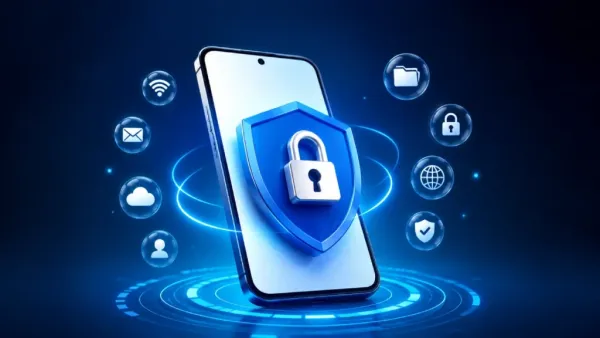
Mobile app security has become increasingly important as mobile applications handle payments, personal information, authentication credentials, photos, location data, health information, and other sensitive information. The original article identifies four core areas of modern mobile app security: secure storage, API protection, app permissions, and tamper risks.
At the same time, mobile applications are becoming more complex. They connect to cloud services, third-party APIs, payment systems, analytics platforms, and external software libraries. This creates more opportunities for attackers to exploit weaknesses.
It can be said that security for mobile applications is not all about password protection. The developers should consider issues such as data storage, communications between the app and server, permissions sought by the application, and what may happen if one attempts to modify the application.
This article looks at four important areas of modern mobile app security: secure storage, API protection, app permissions, and tamper risks, followed by some of the major security trends influencing mobile development today.
Mobile App Security: Protecting Data on the Device
Mobile applications can store confidential data locally. This could be in the form of authentication credentials, personal data, cached data, encryption keys, configurations, and possibly even payment- information. If the above information is stored in an insecure manner, then an attacker with access to the device or application environment can steal it.
A mobile application often stores sensitive information on the device. Such information may include authentication tokens, personal information, cache files, keys, configuration details, and even payment information. In case the information is stored in an insecure manner, the attacker who accesses the mobile device or application can steal it.
An example of a modern security strategy is minimizing the amount of information stored locally. Passwords or secrets should never be stored when there is no need to do so. In situations where storage is necessary for sensitive data, it is better to rely on secure methods provided by the platform.
On Android, developers can use the platform’s cryptographic and secure-storage capabilities, including the Android Keystore system. The Android Keystore is designed to make cryptographic keys more difficult to extract and can keep key material non-exportable. On Apple platforms, Keychain provides encrypted storage for passwords, cryptographic keys, and other sensitive information. Access to individual keychain items can also be restricted according to device state and user authentication.
Another important trend is hardware-backed security. In modern mobile platforms, secure hardware can help protect cryptographic keys. This way, even if an attacker gets access to some part of the operating system or application, extracting protected key material can be more difficult. Android Keystore and Apple security architecture both provide hardware- protections for cryptographic material on supported devices.
Another aspect to take into account is data leakage via screenshots, logs, backup, clipboard, crash logs, and analytics. The point here is that securing an application involves much more than just encrypting a database.
API Protection: Securing the Backend Connection
Most modern mobile applications are not standalone programs. They communicate with backend servers through APIs to authenticate users, retrieve data, process payments, upload files, and perform transactions.
This implies that a secure mobile application can be insecure if its APIs are poorly secured. This explains why OWASP has a separate Top 10 for API security because APIs often expose critical business operations and sensitive data. OWASP’s API Security Top 10 specifically highlights authorization and authentication weaknesses among major API risks.
The key principle is never to trust the mobile client. All the information in the mobile app may be manipulated or even reverse-engineered. This means that security decisions like authorization, transaction limits, account ownership, etc., should always be done at the backend side.
Traffic for the API should be transported using HTTPS/TLS to help protect data during transit between the application and the server. Modern and well-managed mechanisms should be used for authentication, whereas tokens should have suitable lifetimes and scope. Rate limiting, input validation, authorization, monitoring, and secure error handling should be implemented by developers.
The API should verify not only who the user is but also what the user is allowed to do. For example, changing a user’s profile may require authentication, but accessing another user’s profile must additionally require authorization. This distinction is particularly important because OWASP identifies broken object-level and function-level authorization among major API security risks.
A growing trend is combining conventional authentication with risk and device signals. For example, on Android, Google’s Play Integrity API can provide an integrity verdict that a backend can use when deciding how to handle a protected action or request. Google recommends binding integrity checks to relevant requests to help reduce tampering and replay- risks.
However, integrity services should not become the only security mechanism. Google presents Play Integrity as a signal that a backend can use when deciding how to proceed, rather than as a complete replacement for other security controls.
App Permissions: Security Through Least Privilege
Mobile applications may require access to extremely private resources, including camera, microphone, contact list, location, photos, Bluetooth devices, and health data. The more permissions an application requires, the more carefully its security and privacy implications should be assessed.
Today, the least privilege rule is a widely used security principle. Developers should ask for the minimum permissions required by the app, only when those functionalities require such permissions.
For example, a shopping application that needs the camera to scan a barcode does not necessarily need continuous access to the microphone or contacts. Asking for unnecessary permissions can reduce user trust and increase the consequences of a compromised application.
More modern operating systems provide users with greater control over permissions. For instance, Android provides mechanisms for automatically resetting sensitive runtime permissions for unused applications in supported versions. Users can also review and revoke application access to camera, microphone, contacts, photos, Bluetooth, and location- information.
Developers should therefore explain why a permission is required, request it at the appropriate point in the user journey, and gracefully handle denial. It is better to combine security with the user experience, not perceive permission requests as something preventing.
Also, privacy becomes a crucial aspect of application security. More and more often, developers apply the privacy-by-design approach and collect less data, keep it for shorter periods, and give users greater control over it.
Tamper Risks: What Happens When Someone Modifies the App?
One important distinction between mobile applications and server-side software applications is that the application is distributed to the user’s machine.
If an application is already installed on a machine, then an attacker can attempt to look at the code, reverse-engineer the code, or modify the application. This is known as tampering.
Why would someone do this?
There may be many reasons. An attacker might try to bypass a payment system, remove restrictions, manipulate a game, steal authentication information, automate fraudulent activity, or change the way the application communicates with its backend.
There are a number of approaches that developers can apply to make attacks harder. These include code signing, obfuscation, runtime protection, safe release, and application integrity checking.
Google’s Play Integrity API can help developers identify potentially untrusted application or device environments. The developer can utilize the signals provided by it when making decisions on how to deal with a sensitive request.
Apple provides App Attest, which allows developers to establish a stronger relationship between their server and legitimate instances of their application. The security documentation explains that App Attest creates a cryptographic key in the device’s Secure Enclave on supported devices and allows the server to validate assertions from the app.
It must be noted, however, that no client-side protection is flawless. An attacker can control parts of the environment where an application runs. It means that important security decisions should still be made by the backend.
In other words, anti-tampering technology should make attacks harder and more expensive, but it should not be the application’s only line of defense.
Important Trends in Mobile App Security
Mobile security evolves together with application development practices. The concept of security is now applied throughout the development process, and not as a separate task to be completed before release.
One major trend is the move toward stronger authentication. Passwords are still widely used, but passkeys and biometric authentication are increasingly supported across modern platforms. Passkeys use public-key cryptography rather than traditional passwords and can reduce risks associated with password reuse and phishing.
Another significant trend is software supply chain security. Contemporary applications do not depend on code written solely by the development team. Applications use third-party libraries, SDKs, frameworks, analytics services, and many other pieces of software. A single insecure dependency could make the application itself vulnerable.

Developers therefore need to know what third-party components their applications use and keep those components updated.
Testing for security is getting to be more and more continuous as well. While testing used to take place at the end of the development process, it is now happening more continuously with automated scans, dependency checks, code analysis, penetration testing, and monitoring throughout the development process.
There is also a growing focus on adaptive security. Rather than treating every user and device the same, modern systems can consider factors such as authentication status, device integrity, unusual behavior, transaction value, and request patterns when assessing risk.
This is particularly important for banking, e-commerce, gaming, and other applications where security and fraud risks can have significant consequences.
Conclusion
Security of mobile applications has undergone significant evolution since smartphones have become an integral part of people’s lives today. Modern applications are capable of doing much more than displaying content. Such apps manage payments, personal information, authentication credentials, location information, photos, and communications.
This is why developers have to consider security on various levels.
A secure storage solution would help protect information stored on the device. API security would secure interaction between the app and the back-end system and ensure that users have access to only the things they are supposed to have access to. Permissions management would minimize excessive access to sensitive resources of the device.
Developers should minimize the amount of sensitive information they store, use secure platform features, protect APIs, follow the principle of least privilege, monitor third-party dependencies, use strong authentication, and continuously test their applications.
When developing a mobile application, developers should reduce the amount of sensitive data that needs to be stored, apply platform security, protect APIs, rely on the principle of least privilege, control third-party services, employ reliable authentication, and test the application constantly.
Mobile technologies continue evolving, and hence security will remain an important part of future application development. In terms of effectiveness, the integration of security measures into the application during the development phase is significantly better than addressing the issues after the release of the application.
In general, a secure mobile application is not only a more resilient one, but an application that was developed from scratch to protect its users and avoid all unnecessary risks.
-
Manchester City strike £65 million agreement to sign Iliman Ndiaye from Everton

-
Sugar Stock Limit Cut To 2,000 Quintals From September 15: Check New Rules

-
From tough comparisons to a place among the all-time greats: Messi says goodbye to Argentina without the perfect ending

-
Think It’s Acidity? These Signs Could Point To Something Else

-
Delhi HC Seeks WFI Response As Vinesh Phogat Challenges Two Show-Cause Notices And Disciplinary Action