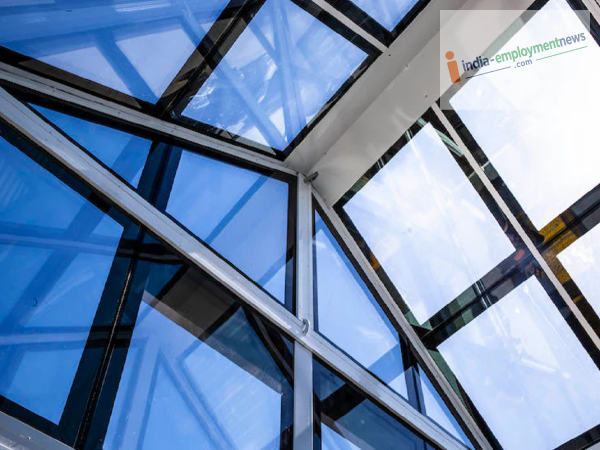
Transparent Solar Panels: Transparent solar panels perform two functions simultaneously: they convert sunlight into electricity while also allowing sunlight to pass through them. Their low efficiency remains a major challenge.
Transparent Solar Panels: Transparent solar panels are also known as invisible or clear solar panels. They represent a new type of photovoltaic (PV) technology that allows sunlight to pass through while simultaneously generating electricity. Unlike regular solar panels, which block sunlight, these panels absorb ultraviolet and infrared light while letting visible light pass through. Such panels were first developed by researchers at Michigan State University in 2014.
Transparent solar panels have not yet been commercialized to the same extent as regular panels, and work on them is ongoing. Their efficiency ranges from 4% to 12%, which is significantly lower than that of silicon panels; this is the reason they are not yet being used on a large scale. Fully transparent panels have an efficiency of 5–8%, whereas translucent panels made from organic PV and perovskite materials achieve efficiencies of 7–12%.
Researchers and companies are continuously striving to increase their efficiency through experiments involving various technologies and materials. This effort has led to the development of several types of panels, including transparent luminescent solar concentrators, organic photovoltaic cells, perovskite solar cells, and transparent conductive films, each utilizing different technologies and materials.
Regarding how transparent solar panels function, they incorporate a luminescent material that absorbs ultraviolet (UV) and infrared light. Next, indium tin oxide and silver nanowires carry this electricity across the panel. An anti-reflective coating reduces glare and prevents light from bouncing off the surface. Finally, a light-guiding layer comes into play, directing light to the solar cells positioned at the edges; these cells convert the sunlight into electricity.
Transparent solar panels come in various types. Depending on their configuration, they are made from different materials and offer varying levels of transparency. Fully transparent panels provide maximum clarity. Semi-transparent panels are also available, typically offering an efficiency of 7–12 percent. Tinted versions exist as well, which help reduce heat. Additionally, flexible transparent films are available for curved surfaces.
Regarding applications, transparent solar panels can be used in building windows and facades; car windows, windshields, and sunroofs; greenhouse agriculture; skylights in malls, airports, and offices; consumer electronics; public transport infrastructure like bus stops and train stations; and digital billboards.
Low efficiency is the biggest drawback of transparent solar panels, which has hindered their popularity. While standard panels have reached efficiency levels of up to 27 percent, these panels have not managed to exceed 12 percent. Other factors working against them include higher costs, limited availability, and a shorter lifespan.
The future of transparent solar panels depends on whether they can match traditional silicon panels in terms of efficiency and lifespan. Transparent solar panel technology is very promising, and if the challenges are overcome, its popularity could grow rapidly.
-
7 Ways AI Is Changing Everyday Life In 2026

-
Premier League: Semenyo backs Maresca to succeed as Man City enters post-Guardiola era

-
UP T20 League 2026: Kanpur Superstars complete their preparations

-
First the Bronco Test, then the 2KM Run! Indian athletes’ fitness tests will now be even more rigorous. Could the risk of burnout increase?

-
Heavy rains in Rishikesh have raised the water level of the Ganga River, and the administration is on alert.