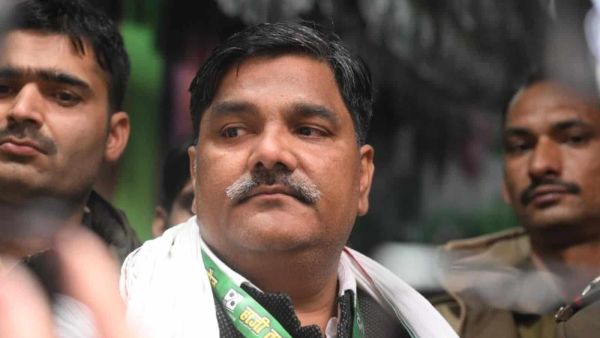
New Delhi: The Delhi Police urged a court here on Monday to sentence former AAP councillor Tahir Hussain and four others to death in the murder case of IB officer Ankit Sharma during the 2020 Delhi riots, saying “they fell to the level of being animals” while relentlessly assaulting him.
The submissions were made before Additional Sessions Judge Praveen Singh who was also informed that Sharma was abducted, relentlessly assaulted and then killed by convicted persons.
The court reserved its order for July 31 after hearing arguments from both prosecution and defence counsels of all five convicts.

Special public prosecutor Madhukar Pandey submitted that Sharma was brutally killed and was not shown any mercy by the convicts, so they should not be given any leniency.
“Those who are asking for mercy today should have shown mercy themselves. No mercy was shown from anyone’s side. No one even took Ankit to the hospital. They are asking for mercy after committing such a brutal murder,” Pandey said.
They kept torturing him even after he died, he said.
“Ankit Sharma was abducted and relentlessly assaulted before he was killed. A total of 51 wounds were found on his body; 18 of those were inflicted with sharp weapons. The nature of the weapons used shows the intent and diabolical nature of the crime. They fell to the level of being animals. Even after the victim died, they continued the assault,” he said.
Pandey also asserted that the nature of the crime was heinous and brutal, and the convicts should be handed the death sentence.
“This was a cold-blooded murder. These people turned into butchers during the crime. There was not even a single cloth except underwear on Sharma’s body. These people should be kept behind bars, (and) given the death sentence,” he said.
“The manner of this killing is not to be seen in isolation, but with the 53 people killed in the riots. So, the context also became relevant, the context in which the riots took place,” he added.
It was also submitted that the deceased never provoked anyone, but the convicts themselves got involved in the murder.
“My humble submission is that the commission of this offence, and the conduct of the convicts, was such that no leniency should be shown to the convicts. There was no provocation in this case. They deliberately got involved in a cold-blooded murder. In this case, the balance of sentencing policy should be shifted towards the death sentence,” Pandey said.
“Those who did not show mercy to people during the riots should not be entitled to seek mercy,” he added.
Representing Hussain, advocates Rajiv Mohan and Tara Narula opposed the state’s contention and argued that no specific role had been attributed to their client and it should also be considered that out of the 11 accused, six were acquitted in the case.
“Every convicted person should not be given the death sentence. Aggravating circumstances should be considered first and then the mitigating circumstances. Of conviction, out of the 11 accused, six have been acquitted,” advocate Mohan said.
He contended that the death penalty is only given in the rarest of rare cases, and in this case, the judgement only mentions the presence of a mob at the crime scene, but not about the specific role of the convicts.
“The punishment of death cannot be determined merely based on the injuries sustained. His (Hussain) conduct was good in jail during custody. The court had recorded the statements of 91 witnesses, after which only five out of the 11 accused were convicted by the court,” he said.
Hussain’s counsel also said that throughout the trial, no evidence of criminal conspiracy (under IPC Section 120B) was presented before the court.
“Police themselves were unable to control the violent mob, and in such a situation, a single individual cannot be held responsible for the murder. He should be given a chance to reform,” Mohan argued.
Advocate Narula contended that Hussain is the sole breadwinner of his family and has a wife and three children.
“All three (children) were minors when he surrendered. Though his application was rejected in the Rouse Avenue court due to non-jurisdiction of the court, it should be considered that he came out to surrender. His guidance must be required as his daughter grows up,” she argued.
On July 13, the court convicted Hussain and four others for the murder of Sharma, who was attacked by a mob during the 2020 Delhi riots. His body was later found in a drain.
In its verdict, the court held that Hussain was a member of a heavily armed mob that assembled with animus against Hindus to commit rioting, arson and loot, and murdered Sharma in a “savage and relentless assault”.
The court said the prosecution had proved that the members of the unlawful assembly knew that, in pursuing their common object, “death could (be the) result and someone could be killed”.
Hussain was convicted under IPC sections 302 (murder), 365 (kidnapping or abducting with intent secretly and wrongfully to confine a person), 147 (rioting), 148 (rioting armed with a deadly weapon), 153A (promoting enmity) and 188 (disobedience to an order duly promulgated by a public servant), read with Section 149 (unlawful assembly).
-
Manchester United sign Welsh youngster Kit Margetson

-
Journalist claims 'agreement in principle' reached between Liverpool and wing wizard Bradley Barcola

-
If you are troubled by hair fall during monsoon then adopt Javed Habib’s special remedies, hair strength will increase.

-
The taste and health benefits of chocolate! Homemade High Protein Chocolate Bars For Kids Read Easy Recipe

-
Xiaomi, Redmi smartphone prices likely to rise; There will be a direct impact on users, additional money to be paid