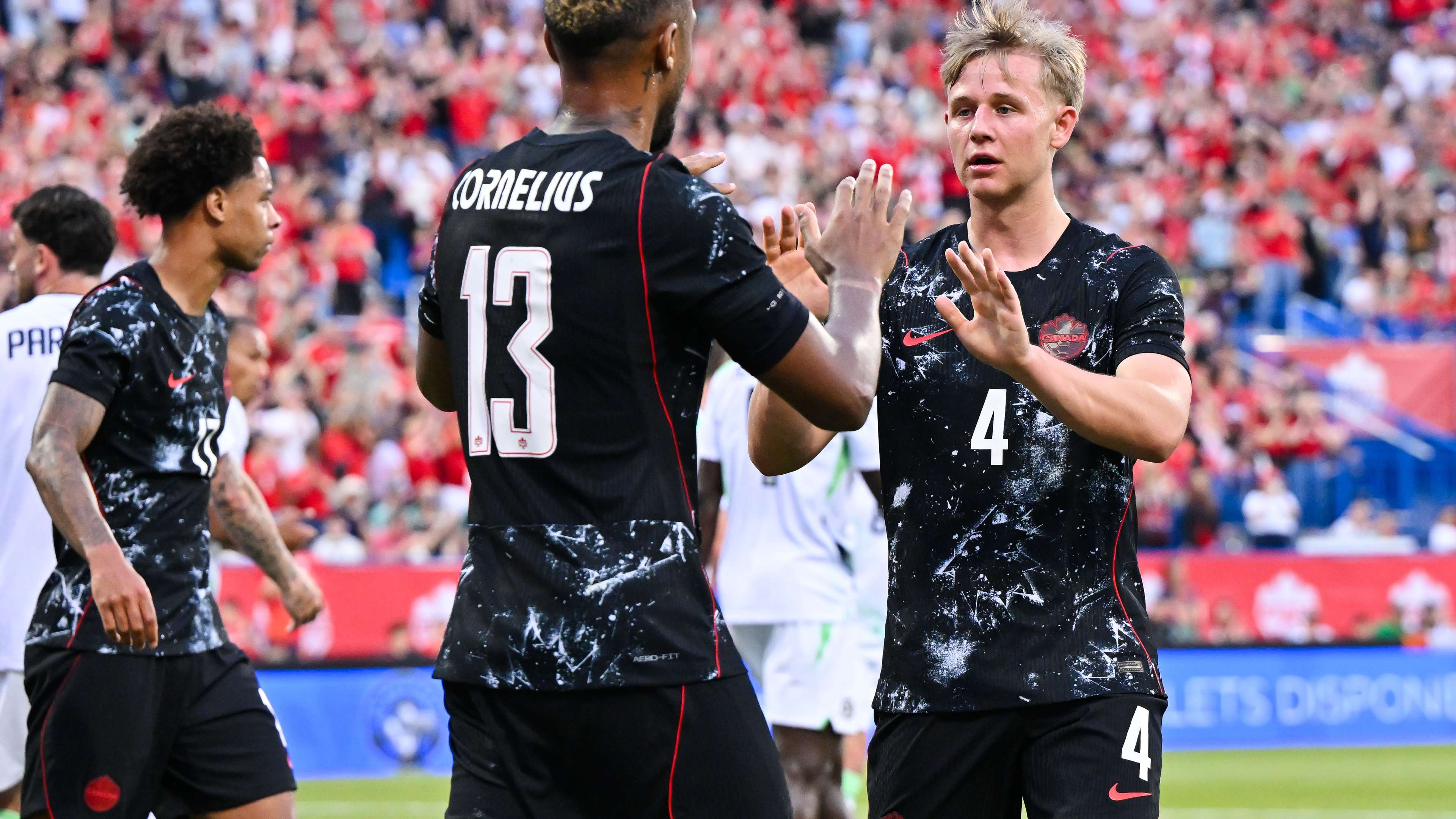
Canada’s final World Cup warm-up matches brought both optimism and anxiety, with Luc de Fougerolles stepping up, Ismaël Koné impressing, and Cyle Larin’s scoring drought continuing.
MONTRÉAL -- After Canada’s 1-1 draw with Ireland, head coach Jesse Marsch wasn’t in the mood for negativity.
The Canadian manager, known for his upbeat nature but also his high standards, chose his words carefully following the team’s last preparatory game before the World Cup.
“I’m going to stay positive,” he told reporters in Montréal. “I’m not here to entertain a bunch of negative questions. If you ask me negative questions, I’ll just move on. This group is strong, committed, fit, and ready to push… yes, we need to score goals, but we will.”
That statement may have frustrated some supporters. Canada had just failed to beat a weakened Irish side, and their attacking issues were hard to ignore. Still, Marsch’s composure made sense. As the man leading Canada into their first-ever World Cup as hosts, projecting calm so close to kickoff was crucial.
Canada’s last pre-World Cup fixtures gave plenty for the coaching staff to evaluate. They defeated World Cup-bound Uzbekistan 2-0 before over 43,000 fans in rain-soaked Edmonton, and then drew Ireland at a sold-out Stade Saputo in Montréal.
Now, the focus turns to fine-tuning. Canada have tested their squad depth, enjoyed strong home support, and gauged their readiness. The question remains: where do they stand heading into Group B clashes against Bosnia and Herzegovina, Switzerland, and Qatar?
The general mood within the camp is stable — neither anxious nor overly excited. The team appears focused. After two weeks centred around fitness and heat acclimatisation, the coming days will likely emphasise tactical refinement, set-piece precision, and attention to small details that could decide World Cup matches.
“With this opportunity in front of us,” Marsch said, “our main goal is to seize it through performances, victories, and success. We want to give our country something to truly be proud of.”
With the warm-up games done, here are GOAL’s winners and losers from Canada’s final pre-World Cup preparations.
WINNER: Luc de Fougerolles
Luc de Fougerolles first caught attention as an 18-year-old against Uruguay at the Copa América two years ago. Now 20, he has played himself into contention to start Canada’s World Cup opener in Toronto — a remarkable rise.
De Fougerolles joined the Canadian setup while still in Fulham’s academy and then secured a loan to Belgium’s FCV Dender last season to gain regular senior minutes. That experience has paid off handsomely.
With Moïse Bombito still recovering from a leg injury, de Fougerolles logged a total of 150 minutes across the two friendlies. His full 90-minute outing against Ireland — his first since March 1 — showed maturity and confidence.
He kept Troy Parrott and Ireland’s physical front line under control, showing composure in duels, smart positioning, and the proactive defensive movement Marsch demands from his centre-backs.
While not the fastest defender, his ability to read danger stands out. On one Irish counter, he tracked Parrott perfectly to halt a promising move before it became dangerous.
In possession, de Fougerolles displays the creativity of a midfielder in a defender’s role. He is comfortable advancing with the ball and threading passes through tight spaces. His calmness under pressure is well beyond his years.
“When I’m on the ball, I look for cues as I step forward,” he told GOAL. “I try to free up a teammate, and if defenders anticipate that, I might just keep going myself.
“Playing regularly this season helped me recognise different situations. When you’ve seen them before, problem-solving on the pitch becomes more natural.”
Canada needed someone to step up at centre-back before the tournament — de Fougerolles may have done even more than that. He could have secured himself a starting spot.
LOSER: Derek Cornelius
De Fougerolles’ emergence complicates matters for Derek Cornelius.
The Rangers defender completed all 90 minutes against Ireland — his first full match since November 2 and only his fourth appearance of 2026, all for Canada. His lack of consistent club action was evident.
Cornelius’ loan at Rangers has not gone as planned, and that inconsistency has crept into his national-team play. Against Uzbekistan, a collision with Bombito while tracking a long ball nearly gifted Eldor Shomurodov a goal. Versus Ireland, several small errors could have been costly against stronger opposition.
Still, his aerial dominance, set-piece threat, and ability on direct free-kicks remain valuable. Marsch clearly trusts him, and he’s still in contention to start alongside Bombito or de Fougerolles in the opener.
However, these were not confidence-boosting performances. If Bombito regains full fitness and de Fougerolles maintains his upward curve, Canada may soon have a new first-choice duo at centre-back.
For now, Cornelius’ main challenge is regaining match sharpness — something Canada need urgently.
WINNER: Ismaël Koné
Ismaël Koné has long been one of Canada’s most exciting prospects — and one of the hardest to define.
Marsch has always believed in his potential, and against Ireland, the midfielder showed exactly why. Koné was dynamic, elusive, and progressive in possession while also contributing defensively.
Playing in his hometown, the Montréal-born midfielder looked at ease. He registered a game-high 90 touches, completing 70 of 76 passes, and nearly scored from a set-piece strike — a skill he’s been refining at Sassuolo.
“He was winning duels, winning headers, collecting loose balls, and driving forward,” Marsch said after the match. “Tonight was what I’ve envisioned for him — an intense player with a unique ability to glide with the ball that’s tough to plan against. He’s an X-factor for us.”
That “X-factor” is exactly what Canada need. Few players in their squad can shift tempo and unlock defences like Koné. If he performs this way in the World Cup, he could add the creative unpredictability that Marsch’s system requires.
LOSER: Cyle Larin
Before the Ireland game, Cyle Larin’s club future was settled as Southampton finalised his permanent transfer from RCD Mallorca following a productive loan spell where he scored eight goals.
It seemed like Larin was regaining form, and he arrived at camp with momentum.
Then came the friendlies.
Larin started both matches but could not end his national-team scoring drought, which now stands at 14 games since 2024. His best chance came from a tight angle against Ireland, comfortably saved by Mark Travers. Beyond that, he offered little threat in front of goal.
To be fair, none of Canada’s forwards scored during the warm-ups — Jonathan David’s last goals came from penalties in March against Iceland. Still, Larin’s struggles were noticeable. He looked disconnected from his teammates and failed to provide the penalty-box presence Canada rely on.
He was also involved in the high-boot incident that led to Ireland’s penalty and the rebound that cost Canada victory.
The goal-scoring concern is legitimate. Canada are creating moments but not converting enough of them. When chances do come, the finishing has lacked sharpness.
For now, Larin is still expected to start the World Cup opener alongside David, ahead of Tani Oluwaseyi and Promise David. But how long will his place be secure? Time is running short, and patience is wearing thin.
With the warm-ups done, the countdown to Canada’s World Cup debut as hosts begins — and the margin for error is shrinking fast.
-
Anthony Martial and Rayados mutually end contract

-
Sandro Tonali: How Much Manchester United Are Ready to Pay to Secure Newcastle Midfielder

-
Matthijs de Ligt’s Unusual Managerial Pattern Continues at Manchester United

-
Portugal Player Ratings vs Chile: Bruno Fernandes Shines as Portugal Beat Chile 2-1 in Lisbon Friendly After Rafael Leao’s Red Card and Goncalo Guedes Outperforms Ronaldo
-
Exploring the Stadiums of the 2026 FIFA World Cup 🏟️