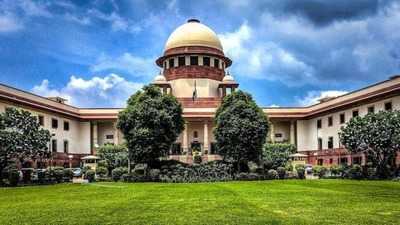
SC upholds ECI's right to conduct special electoral roll revision
27 May 2026
The Supreme Court has upheld the Election Commission of India's (ECI) authority to conduct Special Intensive Revision (SIR) of electoral rolls.
The decision came after a bench led by Chief Justice Surya Kant and Justice Joymalya Bagchi heard writ petitions challenging the ECI's notification for SIR in Bihar last June.
The court ruled that SIR is linked to ensuring free and fair elections under Article 324 of the Constitution and the Representation of the People Act, 1950.
ECI can conduct special revisions as per statutory provisions
Legal authority
Chief Justice Kant said, "When the statute itself authorizes a special revision at any time for reasons to be recorded and in such manner as the Election Commission may deem fit...the impugned exercise cannot be invalidated merely because it does not conform in every respect to ordinary modalities contemplated for routine revision."
"The impugned SIR does not supplant the Representation of the People Act....Rather, it breathes life into the constitutional mandate under Article 324," the court held.
Reasons recorded by ECI for SIR valid, SC
SC
The court was examining if the ECI has powers under Article 324 and the Representation of the People Act, 1950, to carry out SIR.
It also said that the reasons recorded by the commission, namely the passage of more than four decades since the last intensive revision; large-scale additions and deletions over the years; rapid urbanization; migration; and the resulting "possibility of repetition and inaccuracies in the electoral rolls, are clearly directed toward preserving that foundational integrity."
Petitioners' arguments in court
Legal challenge
The petitioners, including the Association of Democratic Reforms and political activists and leaders like Mahua Moitra and Supriya Sule, argued that SIR changes the electoral roll revision framework.
They claimed it makes ECI a citizenship adjudicator and violates legal principles by shifting the proof burden to voters.
According to them, electoral registration law does not allow the commission to demand citizens already on the rolls to reestablish their citizenship through documentary verification.
Exercise creates a state of 'suspended citizenship'
Arguments
A concern highlighted was that the exercise creates a state of "suspended citizenship."
The counsel argued that if a person's name is removed, pending verification, that person is effectively denied a fundamental democratic right without any formal citizenship determination by a competent body.
The petitioners also raised concerns about the process's statutory basis. They argued that enumeration forms used for verification have no clear support under the Representation Act or relevant electoral laws, rendering the method legally vulnerable.
ECI's stand on petitioners' claims
Defense argument
Defending the exercise, the ECI argued that SIR is an electoral verification exercise, not a citizenship adjudication mechanism.
It said the exercise aims to ensure eligible citizens remain on voter rolls and employs a "liberal" verification model.
The commission emphasized that the Constitution envisages a citizen-based franchise; hence, it is constitutionally required to safeguard electoral purity by eliminating non-citizens from voter records.
-
List of Rule Changes to Take Effect at the 2026 FIFA World Cup

-
Ousmane Dembele: PSG and France Star Shining Ahead of the 2026 World Cup

-
Official Algeria National Team Squad for the 2026 World Cup: Players from Man City, Dortmund, and Al-Ahli Included

-
Live Streaming Link: Indonesia U-19 National Team vs Myanmar in ASEAN U-19 Championship—Kick-off Tonight

-
Karnataka leaders hail RCB’s back-to-back IPL glory; DK Shivakumar, Siddaramaia