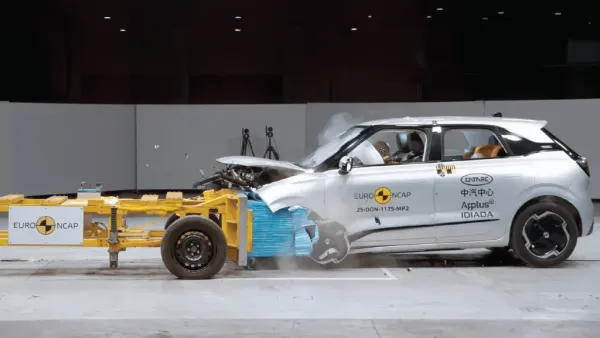
Europe’s leading vehicle safety organisation has revealed that some car manufacturers are intentionally avoiding five-star crash safety ratings in order to keep vehicle prices affordable for buyers.
Speaking to Australian and New Zealand media, Euro NCAP technical director Richard Schram explained that several budget-focused brands are deliberately choosing not to include expensive safety technologies as standard equipment.
According to Schram, the move is not because manufacturers are unable to meet stricter safety standards. Instead, it is a commercial decision designed to maintain aggressive pricing in highly competitive entry-level markets.
“One example is Dacia,” Schram said. “They clearly don’t aim for five stars. They want to remain at the budget level, but they still target around three stars.”
Budget Cars Still Meet Legal Safety Standards
Schram stressed that modern homologation rules in Europe ensure all vehicles meet a minimum safety benchmark before they can be sold. That means even lower-rated vehicles are significantly safer than older cars from a decade ago.
However, Euro NCAP’s five-star system goes beyond mandatory regulations and rewards manufacturers that include advanced driver assistance systems and crash prevention technology as standard.
Features such as adaptive cruise control, lane-keeping assist, driver monitoring systems, autonomous emergency braking, and rear occupant protection all contribute heavily toward achieving maximum scores.
“What you will see is that these cars are still significantly better than regulation,” Schram explained. “But manufacturers are making clear choices not to include certain systems because they are expensive.”
Dacia Highlighted as a Key Example
While the Dacia brand is not officially sold in Australia, one of its popular models is available locally under the Renault badge as the Renault Duster.
The SUV recently received a three-star Euro NCAP safety rating, despite being positioned as an affordable offering with pricing starting below many mainstream rivals.
Interestingly, several similarly priced vehicles in global markets have managed to achieve full five-star ratings, showing that affordability and high safety scores are not always mutually exclusive.
Still, Dacia’s reputation in Europe has long been built around simplicity, low ownership costs, and value-focused motoring rather than premium safety technology.
Dual Ratings Give Buyers More Transparency
Euro NCAP also highlighted the growing use of “dual ratings,” where certain vehicles achieve different safety scores depending on the trim level or optional safety packages fitted.
This system allows consumers to clearly understand which versions of a vehicle offer higher levels of protection.
Schram noted that some automakers deliberately reserve advanced safety equipment for higher variants to keep entry-level prices attractive.
Honda, Kia, and Volkswagen were mentioned as examples of manufacturers moving toward this approach, particularly for smaller and more affordable vehicles.
The Honda HR-V and CR-V only achieved five-star scores in higher-spec configurations, while the Kia K4 received a four-star rating in its base form.
As safety technology becomes more advanced and increasingly expensive, the gap between affordability and maximum safety ratings may continue to grow. For buyers, that means checking not just the badge on the car, but also the exact variant and safety equipment included before making a purchase decision.
-
DU PG Admission 2026: Registration for PG Admissions at Delhi University Begins; Apply by This Date..

-
UPSC Prelims Exam 2026: When is the UPSC Prelims Exam? These documents must be carried along with the Admit Card..

-
Admit Card: RUHS CUET 2026 Exam Admit Cards Released—Here's How to Download..

-
Karuppu Crosses Rs 120 Cr, Bhooth Bangla Nears Rs 200 Cr Club, Dhurandhar 2 Stays Below Rs 1 Cr On Sunday

-
'Dangerous Escalation': India Condemns Attack On UAE’s Barakah Nuclear Power Plant