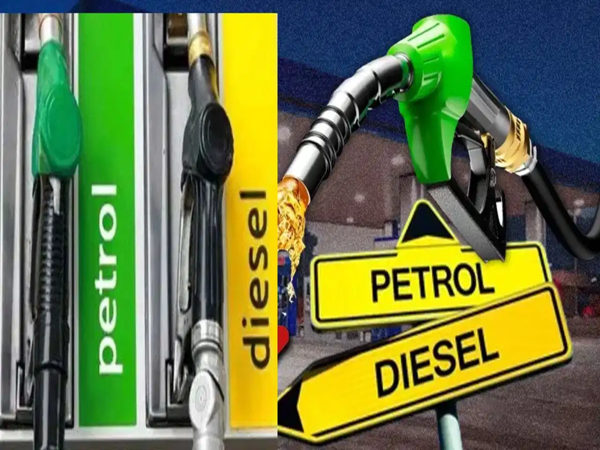
Amidst rising crude oil prices, the government has hiked the prices of petrol and diesel by ₹3 per liter each. While the rates have increased differently across the country's major metropolitan cities, a question often arises in people's minds: why, exactly, do petrol and diesel prices vary across different states? The primary reason for this is VAT—or Value Added Tax. What exactly is this tax? How does it generate revenue? Let's take a closer look.
The Central Government levies an excise duty, whereas State Governments collect VAT; it is this specific tax that creates significant disparities in fuel prices across different states. VAT is a tax that State Governments determine at their own discretion. This is why petrol and diesel appear more expensive in certain states, while the VAT is lower in some Union Territories. Many states impose VAT on a percentage basis, while others add a fixed tax per liter, along with additional cesses.
**What is VAT?**
VAT—or Value Added Tax—is a tax levied at every stage where value (or price) is added to a commodity or service. Simply put, as value is progressively added to a product, the government collects a tax on that incremental value. Ultimately, the entire burden of this tax falls upon the ordinary consumer, as they are the ones who pay the final retail price.
This is precisely why petrol and diesel prices appear different across various states. In states where the VAT rate is high, fuel becomes more expensive; conversely, in states with lower VAT rates, consumers enjoy some relief. For State Governments, VAT also serves as a major source of revenue. The sale of petrol and diesel generates thousands of crores of rupees in revenue for the states—funds that are subsequently utilized for infrastructure development (roads, electricity, and water supply) and various other government welfare schemes.
**Petrol and Diesel Remain Outside the Ambit of GST**
Currently, petrol and diesel fall outside the purview of the Goods and Services Tax (GST). Consequently, these fuels are subject to separate levies, including the Central Excise Duty, State VAT, Road Cess, and Dealer Commission. If petrol and diesel were to be brought under the GST framework, consumers could potentially experience some relief in prices; however, such a move would inevitably impact the tax revenue earnings of the State Governments. This is the reason why state governments remain cautious about reducing VAT.
Disclaimer: This content has been sourced and edited from TV9. While we have made modifications for clarity and presentation, the original content belongs to its respective authors and website. We do not claim ownership of the content.
-
Abu Dhabi-developed cryptographic AI goes global after US acquisition

-
Pet essentials banned from recycling bins under England's new rules

-
CJI clarifies 'cockroach' remark after backlash, says comments targeted fake degree holders

-
Amit Shah on a two-day visit to Gujarat to attend the inauguration of Madhur Dairy's new plant and IT Park

-
Shocking NEET-UG 2026 Paper Leak: Biology Lecturer Arrested