Indian startups must avoid “recency bias” while building for an AI-first world and focus on solving problems that will crop up down the line, said OpenAI’s head of strategy and global affairs Pragya Misra, during an event in Gurugram.
“A recency bias you cannot have. Indian founders should look at resolving problems that will be faced say six months or a year from now,” Misra said.
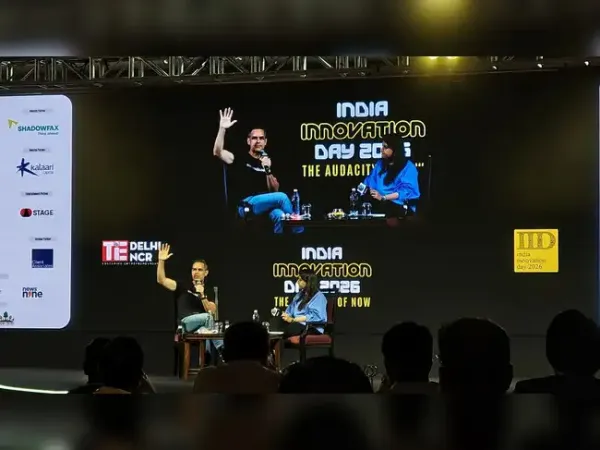
Speaking at the TiE Delhi NCR India Innovation Day – 2026 in a fireside chat with entrepreneur Ankur Warikoo, Misra said startups cannot afford to build only for immediate survival in a rapidly evolving AI landscape.
Responding to a question on businesses that could disappear in the next three years, Misra indicated that companies offering simple customer service operations may face disruption from AI.
A report by Z47, OpenAI, and Zinnov released earlier this week found that nearly 90% of mature AI adopters in India have reduced expenditure on some form of business process outsourcing.
Misra added that startups must focus not only on AI models, but also on the workflows, context, and integrations around them that make AI useful in real-world settings.
Warikoo added that many startups today are becoming layers built on top of AI infrastructure, and businesses that fail to adapt quickly risk becoming irrelevant. Misra, however, said that while speed can provide startups with a short-term advantage, this may not prove to be a durable competitive advantage or moat in the long run.
India, a testing ground
The OpenAI head of strategy revealed that the company had sent researchers from San Francisco to study how Indian students use its AI models, insights that later informed its global launch of Study Mode. She said the exercise reflected how OpenAI increasingly sees India as a testing ground for new AI features and user behaviour trends.
“If you build for India, you know how to scale for the world,” Misra added, pointing to India’s ability to create products for large-scale, diverse user bases.
OpenAI currently has 100 million weekly active users in India. According to its February report, Indian users use Codex at three times the global median, while users aged 18 to 24 account for nearly half of all ChatGPT messages in the country. CEO Sam Altman had earlier said at the AI Impact Summit in New Delhi that more than a third of India's weekly active users for its AI assistant ChatGPT are students.
Misra added that technical depth will remain critical in the AI era, dismissing the idea that coding or engineering knowledge would become irrelevant.
In February, the company partnered with six institutions, including Indian Institute of Technology – Delhi, and Indian Institute of Management – Ahmedabad, to integrate AI across higher education and train 1 lakh students, faculty members, and researchers.
“A recency bias you cannot have. Indian founders should look at resolving problems that will be faced say six months or a year from now,” Misra said.
Speaking at the TiE Delhi NCR India Innovation Day – 2026 in a fireside chat with entrepreneur Ankur Warikoo, Misra said startups cannot afford to build only for immediate survival in a rapidly evolving AI landscape.
Responding to a question on businesses that could disappear in the next three years, Misra indicated that companies offering simple customer service operations may face disruption from AI.
A report by Z47, OpenAI, and Zinnov released earlier this week found that nearly 90% of mature AI adopters in India have reduced expenditure on some form of business process outsourcing.
Misra added that startups must focus not only on AI models, but also on the workflows, context, and integrations around them that make AI useful in real-world settings.
Warikoo added that many startups today are becoming layers built on top of AI infrastructure, and businesses that fail to adapt quickly risk becoming irrelevant. Misra, however, said that while speed can provide startups with a short-term advantage, this may not prove to be a durable competitive advantage or moat in the long run.
India, a testing ground
The OpenAI head of strategy revealed that the company had sent researchers from San Francisco to study how Indian students use its AI models, insights that later informed its global launch of Study Mode. She said the exercise reflected how OpenAI increasingly sees India as a testing ground for new AI features and user behaviour trends.
“If you build for India, you know how to scale for the world,” Misra added, pointing to India’s ability to create products for large-scale, diverse user bases.
OpenAI currently has 100 million weekly active users in India. According to its February report, Indian users use Codex at three times the global median, while users aged 18 to 24 account for nearly half of all ChatGPT messages in the country. CEO Sam Altman had earlier said at the AI Impact Summit in New Delhi that more than a third of India's weekly active users for its AI assistant ChatGPT are students.
Misra added that technical depth will remain critical in the AI era, dismissing the idea that coding or engineering knowledge would become irrelevant.
In February, the company partnered with six institutions, including Indian Institute of Technology – Delhi, and Indian Institute of Management – Ahmedabad, to integrate AI across higher education and train 1 lakh students, faculty members, and researchers.