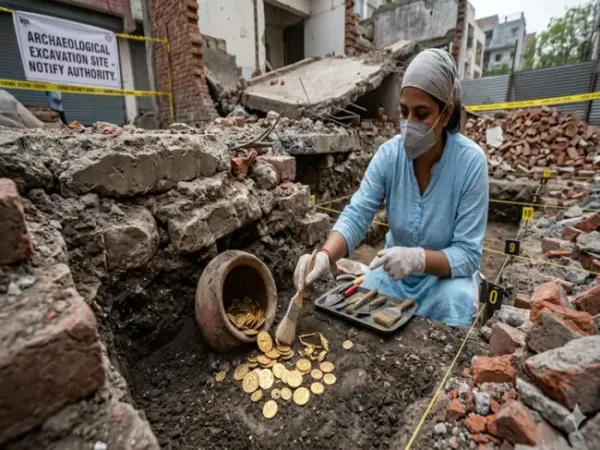
In a stunning discovery, a stash of 409 gold coins has been found beneath a house in Russia's Torzhok where it had been hidden for over a century. The coins were discovered last year during the rescue operations by the Institute of Archaeology of the Russian Academy of Sciences. The discovery of gold coins had added to the mystery that existed a hundred years ago about the wealth and survival.
ALSO READ: Coinbase layoffs: What is the severance package US' largest crypto exchange will give to Indian employees on work visas?
The coins were found buried beneath stone foundations. The excavation was carried out on Sadovaya Street, one of the oldest areas of the city. While dismantling part of the structure, archaeologists uncovered fragments of a ceramic container hidden under the stones.
“Gold coins spilled from the broken pot during foundation removal work. The pot was a clay jar with a handle and a brown-yellow glaze, known as a kandyushka according to ethnographic sources," read a translated statement from the Institute of Archaeology of the Russian Academy of Sciences.
“The total value of the coins in the treasure amounts to 4,070 gold rubles. The hoard was likely hidden during or after the revolutionary events of 1917. Apparently, its owner never came back to retrieve it,” the researchers said.
The hoard includes 409 gold coins minted between 1848 and 1911, spanning the reigns of Nicholas I to Nicholas II. Most are 10-ruble coins, widely used in the final decades of the Russian Empire. The report noted that the treasure contains 10 coins of 5 rubles, 2 coins of 7.5 rubles, 387 coins of 10 rubles, and 10 coins of 15 rubles. The newest coin is from 1911 and the time timeline suggests the treasure was buried only a few years before the 1917 Revolution. In that period, many people hid their savings to protect them from theft or confiscation.
Researchers classify the discovery as a “return hoard,” indicating it was buried with the intention of being recovered later. Due to the turmoil of the time, that likely never happened. After conservation and analysis, the coins are expected to be exhibited at the All-Russian Historical and Ethnographic Museum in Torzhok.
(With TOI inputs)
ALSO READ: Coinbase layoffs: What is the severance package US' largest crypto exchange will give to Indian employees on work visas?
When were the gold coins found?
According to reports, the discovery of gold coins took place in the Tver region during rescue excavations carried out ahead of a construction project. Hidden in a 'kandyushka', these coins dated from 1848 to 1911 and were mainly minted during the 1897 monetary reform.The coins were found buried beneath stone foundations. The excavation was carried out on Sadovaya Street, one of the oldest areas of the city. While dismantling part of the structure, archaeologists uncovered fragments of a ceramic container hidden under the stones.
“Gold coins spilled from the broken pot during foundation removal work. The pot was a clay jar with a handle and a brown-yellow glaze, known as a kandyushka according to ethnographic sources," read a translated statement from the Institute of Archaeology of the Russian Academy of Sciences.
Who owns these gold coins?
The coins were discovered in a broken pot beneath the stone foundation of a wooden house destroyed during World War II and later rebuilt. According to a Times of India report, experts believe that these coins were hidden during the turmoil of the 1917 Russian revolution. Though historians analysed tax registers and parish records of the 24 families that once lived nearby, no one knows who owned this immense fortune.What was in the pot?
As reported by Archaeology Magazine, the collection has a total face value of 4,070 rubles. In 1917, this was a big substantial sum, equivalent to over $530,000 in today’s gold value based on its raw weight.“The total value of the coins in the treasure amounts to 4,070 gold rubles. The hoard was likely hidden during or after the revolutionary events of 1917. Apparently, its owner never came back to retrieve it,” the researchers said.
The hoard includes 409 gold coins minted between 1848 and 1911, spanning the reigns of Nicholas I to Nicholas II. Most are 10-ruble coins, widely used in the final decades of the Russian Empire. The report noted that the treasure contains 10 coins of 5 rubles, 2 coins of 7.5 rubles, 387 coins of 10 rubles, and 10 coins of 15 rubles. The newest coin is from 1911 and the time timeline suggests the treasure was buried only a few years before the 1917 Revolution. In that period, many people hid their savings to protect them from theft or confiscation.
Mystery rooted in incomplete records
The owner’s identity remains unknown. Records show that between 1914 and 1921, the street housed 24 families, including priests, merchants, craftsmen, and clerks. However, matching those records to present-day locations is difficult, limiting further leads.Researchers classify the discovery as a “return hoard,” indicating it was buried with the intention of being recovered later. Due to the turmoil of the time, that likely never happened. After conservation and analysis, the coins are expected to be exhibited at the All-Russian Historical and Ethnographic Museum in Torzhok.
(With TOI inputs)