
Listen to this article in summarized format
Loading...
××
Subscribe to

Unlock AI Briefing and Premium Content
New Year Offer 24 Hours Left
Subscribe NowAlready a member? Sign In
What's Included
- Exclusive Stories
- Daily ePaper Access
- Smart Market Tools
- Curated Investment Ideas
- Ad-lite Experience
Subscription

Kolkata: A sharp rise in commercial LPG prices is squeezing India's textile exporters, raising costs for units in Tiruppur and Noida at a time when global buyers are pushing for lower product prices.
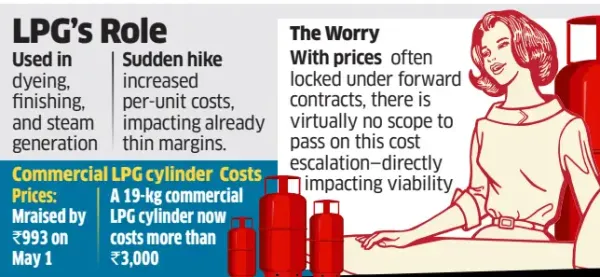
The industry relies heavily on LPG for dyeing, finishing, and steam generation. The sudden hike has increased per-unit costs, impacting already thin margins.
"For export-oriented units, the situation is more severe," said K.M. Subramanian, president of the Tiruppur Exporters Association. "With prices often locked under forward contracts, there is virtually no scope to pass on this cost escalation-directly impacting viability."
Commercial LPG cylinder prices were raised by ₹993 on May 1 in line with high international rates. The increase happened just two days after completion of assembly polls in five states. A 19-kg commercial LPG cylinder now costs more than ₹3,000.
Subramanian said exporter margins have been hit further by the sudden increase in commercial LPG rates. In addition, "global buyers are also not putting orders aggressively because of the current geopolitical situation," he said. "The added cost is making us less competitive to Vietnam and Bangladesh."
Tiruppur exports ₹35,000-40,000 crore worth of knitwear annually across 2,000 garment exporting units. Indian manufacturers compete with countries like Vietnam and Bangladesh, where energy costs are more stable. Rising input costs risk diverting export orders for Indian companies, eroding market shares and foreign exchange earnings.
For Noida-based apparel exporters, the rise in LPG prices has come as a double blow. "This shock compounds an already difficult cost environment," said Kapi Sadh, managing director of S.K. Overseas, a garment exporting firm in Noida. "Industry is still adjusting to steep and uneven increases in minimum wage rates in Uttar Pradesh, which have raised labour costs without parallel productivity gains. The combined pressure of energy and wages is pushing many units towards an unsustainable threshold."
The Uttar Pradesh government had on April 13 announced an interim increase in minimum wage from ₹11,313 to ₹13,690 for unskilled workers, from ₹12,445 to ₹15,059 for semi-skilled workers and from ₹13,940 to ₹16,868 for skilled workers with effect from April 1.
Sadh said most garment manufacturing units are relatively small enterprises having limited financial buffers. "Unlike larger players, they cannot absorb such abrupt cost increases or quickly shift to alternatives like piped natural gas (PNG)," he said.
Assembly Elections 2026
Election Results 2026 Live Updates: Who's ahead in which state
West Bengal Election Results 2026 Live Updates
TN Election Result 2026 Live Updates
"For export-oriented units, the situation is more severe," said K.M. Subramanian, president of the Tiruppur Exporters Association. "With prices often locked under forward contracts, there is virtually no scope to pass on this cost escalation-directly impacting viability."
Commercial LPG cylinder prices were raised by ₹993 on May 1 in line with high international rates. The increase happened just two days after completion of assembly polls in five states. A 19-kg commercial LPG cylinder now costs more than ₹3,000.
Subramanian said exporter margins have been hit further by the sudden increase in commercial LPG rates. In addition, "global buyers are also not putting orders aggressively because of the current geopolitical situation," he said. "The added cost is making us less competitive to Vietnam and Bangladesh."
Tiruppur exports ₹35,000-40,000 crore worth of knitwear annually across 2,000 garment exporting units. Indian manufacturers compete with countries like Vietnam and Bangladesh, where energy costs are more stable. Rising input costs risk diverting export orders for Indian companies, eroding market shares and foreign exchange earnings.
For Noida-based apparel exporters, the rise in LPG prices has come as a double blow. "This shock compounds an already difficult cost environment," said Kapi Sadh, managing director of S.K. Overseas, a garment exporting firm in Noida. "Industry is still adjusting to steep and uneven increases in minimum wage rates in Uttar Pradesh, which have raised labour costs without parallel productivity gains. The combined pressure of energy and wages is pushing many units towards an unsustainable threshold."
The Uttar Pradesh government had on April 13 announced an interim increase in minimum wage from ₹11,313 to ₹13,690 for unskilled workers, from ₹12,445 to ₹15,059 for semi-skilled workers and from ₹13,940 to ₹16,868 for skilled workers with effect from April 1.
Sadh said most garment manufacturing units are relatively small enterprises having limited financial buffers. "Unlike larger players, they cannot absorb such abrupt cost increases or quickly shift to alternatives like piped natural gas (PNG)," he said.