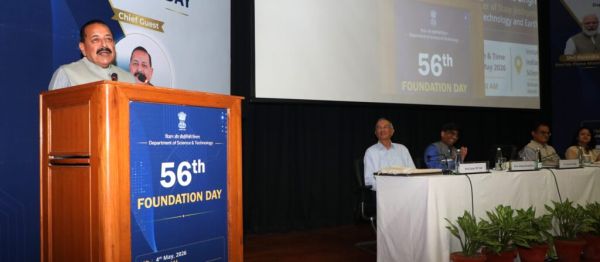
New Delhi, 5 May 2026: Union Minister of State (Independent Charge) for Science and Technology, Earth Sciences and PMO, Employees, Public Grievances, Pension, Atomic Energy and Space, Dr. Jitendra Singh today said technology-based innovation driven by the Department of Science and Technology (DST) over the past decade is the key to India’s economic revival, whose contribution spans from research to industry, startups and national development. The minister said science must now move “from laboratories to markets, from ideas to impact”, reflecting a new policy direction that links research to economic outcomes.
Dr. Jitendra Singh was addressing the 56th Foundation Day of the Department of Science and Technology at the Indian National Science Academy (IMSA) Auditorium in New Delhi. In this program, Chief Scientific Advisor to the Government of India, Prof. Ajay Kumar Sood, DST Secretary Prof. Leading scientists, academicians and members of the scientific community were present along with Abhay Karandikar.
The Minister said that India’s science and technology sector has witnessed significant transformation in the last decade, which has been supported by policy decisions to open up sectors like space and nuclear energy to private participation. He said that these steps have opened up new opportunities for startups and industries, enabling India to take advantage of its vast human resources and strengthen its place in the global innovation ecosystem.
Referring to the rapid expansion of the space sector, Dr. Jitendra Singh said that within a few years of being opened up to private players, India is seeing a surge in startup-driven innovation, with new capabilities emerging in areas such as satellite technology, which contribute to both economic growth and national preparedness. He added that similar momentum is being seen in emerging technology domains also.
The Minister said that no country can make progress in science in isolation from industry and the private sector and called for deeper collaboration between the government, academic institutions and industry. He also stressed the importance of indigenous research and noted that India is developing its own technology in various sectors, including complex areas like pharmaceuticals.
Dr. Jitendra Singh said that India’s global scientific position has also strengthened significantly, with the share of highly cited research publications increasing, reflecting both quality and impact. He pointed to the expansion of India’s startup ecosystem, which has grown from just a few hundred startups a decade ago to more than two lakh today, which is evidence of a rapidly maturing innovation landscape.
The Minister stressed that scientific institutions should actively publicize their achievements and communicate with stakeholders. He noted that visibility and outreach are essential to attract participation and ensure broader social impact. He said that innovators should be encouraged, but it is equally important to create a transparent and merit-based ecosystem that guides young talents with clarity and reality.
He also mentioned the ongoing administrative reforms aimed at improving efficiency and bringing institutions into line with modern technological requirements, including restructuring of legacy systems and greater decentralization of decision making.
Earlier, Chief Scientific Advisor Prof. Ajay Kumar Soode spoke about the need to link research with technology development and commercialization, while DST Secretary Prof. Abhay Karandikar highlighted key initiatives like Anusandhaan National Research Foundation, RDI Fund and National Quantum Mission to strengthen India’s science and innovation ecosystem.
Dr. Jitendra Singh expressed confidence that with sustained reforms, strong institutional framework and active participation of all stakeholders, India’s science and technology ecosystem will play a decisive role in shaping the country’s economic growth and global leadership in the years to come.
-
Chennai Super Kings Revive IPL 2026 Playoff Hopes

-
Major car company commences restructure - almost 1,000 jobs loss

-
Bear Attack Injures Hikers at Yellowstone National Park

-
Jonathan Tiersten dead: Beloved actor dies aged 60 as devastated fans pay tribute

-
Ongoing Investigation into Nancy Guthrie's Disappearance: New Insights and Theories