New Delhi: Surging power demand drove prices higher in India’s high-price day-ahead power market (HP-DAM) in the second half of April, with tariffs hitting the regulatory ceiling of ₹20 per unit in non-solar hours on multiple days. The Indian Energy Exchange (IEX) data showed electricity was traded at higher prices during non-solar hours.
The HP-DAM is a segment on the IEX where costlier electricity, such as from imported coal-based units, gas-fired plants and renewables paired with battery storage, is traded among generators and distribution companies.
Also Read: India's total power consumption grows by 4 per cent to 154 billion units in April
Data for April showed that trading in the HP-DAM picked up in the second half of the month, with market clearing prices touching ₹20 per unit on multiple days in parts of the session, a shift from the first half of the month, when there was virtually no trading.
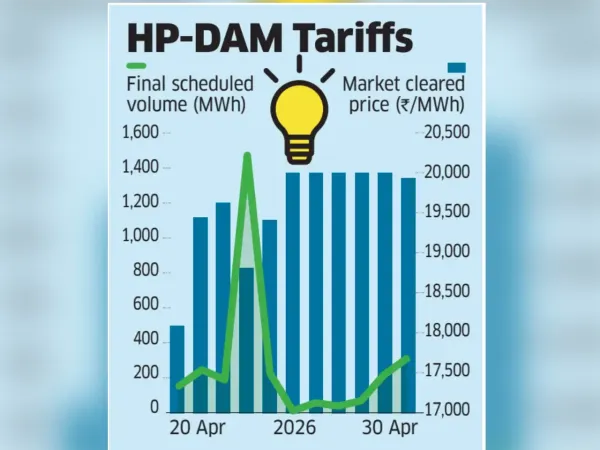
The average daily price for April in the HP-DAM was ₹19.6 per unit, as against ₹15.3 a year ago.
In contrast, the average daily price in the day-ahead segment, where the ceiling is ₹10, was ₹5.3 per unit. This was because of lower prices in trading in solar hours with sufficient power supply. In April last year, the volume traded in the HP-DAM segment was higher but the prices reached a maximum of ₹17 per unit.
Power demand rose in April as several parts of the country reeled under severe heatwave conditions and higher maximum temperature. Peak power demand touched a record 256 GW on April 25. “April 2026 saw peak power demand reach 256 GW alongside a sustained rise in electricity consumption, putting pressure on available supply,” Rohit Bajaj, joint managing director, IEX, told ET.
Also Read: India in the hot seat as blackout risks rise with temperature
The existing price cap of ₹10 per unit on power exchanges limits participation from higher-cost generators such as imported coal, gas and battery energy storage. The HP-DAM addresses this gap by enabling such generators to offer additional capacity to meet incremental demand.
Energy storage capacities have played a key role in the trade, with some merchant projects being able to sell in the high demand period in non-solar hours apart from imported coal-based power plants, said an industry expert.
The HP-DAM is a segment on the IEX where costlier electricity, such as from imported coal-based units, gas-fired plants and renewables paired with battery storage, is traded among generators and distribution companies.
Also Read: India's total power consumption grows by 4 per cent to 154 billion units in April
Data for April showed that trading in the HP-DAM picked up in the second half of the month, with market clearing prices touching ₹20 per unit on multiple days in parts of the session, a shift from the first half of the month, when there was virtually no trading.
HP-DAM tariffs India in April
The average daily price for April in the HP-DAM was ₹19.6 per unit, as against ₹15.3 a year ago.
In contrast, the average daily price in the day-ahead segment, where the ceiling is ₹10, was ₹5.3 per unit. This was because of lower prices in trading in solar hours with sufficient power supply. In April last year, the volume traded in the HP-DAM segment was higher but the prices reached a maximum of ₹17 per unit.
Power demand rose in April as several parts of the country reeled under severe heatwave conditions and higher maximum temperature. Peak power demand touched a record 256 GW on April 25. “April 2026 saw peak power demand reach 256 GW alongside a sustained rise in electricity consumption, putting pressure on available supply,” Rohit Bajaj, joint managing director, IEX, told ET.
Also Read: India in the hot seat as blackout risks rise with temperature
The existing price cap of ₹10 per unit on power exchanges limits participation from higher-cost generators such as imported coal, gas and battery energy storage. The HP-DAM addresses this gap by enabling such generators to offer additional capacity to meet incremental demand.
Energy storage capacities have played a key role in the trade, with some merchant projects being able to sell in the high demand period in non-solar hours apart from imported coal-based power plants, said an industry expert.