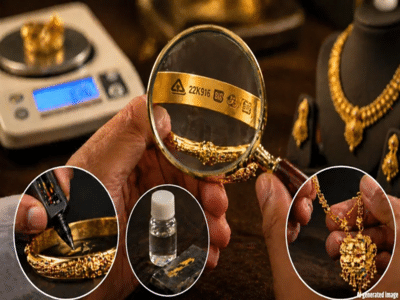
Buying gold is nothing short of a major financial investment. After saving every penny for years to purchase a piece of jewelry, the greatest fear that haunts us is regarding its purity. There was a time when a jeweler's word was synonymous with trust. Subsequently, the rule of hallmarking was introduced, offering customers a measure of legal and psychological relief. However, cunning fraudsters have now managed to breach even this security perimeter.
Counterfeit-hallmarked gold is now being sold rampantly in the market. For a customer, discerning the subtle difference between a genuine and a fake stamp is nearly impossible. The realization of this massive fraud strikes only when the time comes to sell or exchange that very jewelry—when gold purchased at the price of 22 carats turns out, upon inspection, to be merely 18 or even just 14 carats.
**What is the 'Fake Stamp' Scam?**
In today's digital age, fraudsters are blatantly misusing technology. Many unauthorized dealers and small traders use laser printing to affix stamps on jewelry that look exactly like genuine hallmarks. It is extremely difficult to determine with the naked eye whether the mark engraved on a piece of jewelry meets official standards or is merely a sham. To safeguard your hard-earned money against such fraud, it is essential to know how you can verify the authenticity yourself.
**The HUID Code: The True 'Identity' of Your Jewelry**
To ensure customer safety and transparency, the government has made it mandatory to engrave a HUID (Hallmark Unique Identification) number on every new piece of jewelry. This is a six-digit alphanumeric code (for example: AZ1234). This unique code serves as the true identity of your gold. To verify it, first download the 'BIS Care App' on your smartphone. Upon opening the app, you will see an option labeled 'Verify HUID'. Enter the six-digit code engraved on your jewelry into the designated field. As soon as you do so, complete details regarding that specific piece of jewelry will appear on your screen. If no data regarding the jewelry appears on the app, it is a clear indication that you have been handed counterfeit gold.
**Test with a Magnet**
Although precise scientific analysis—such as that conducted in a laboratory—is not possible at home, certain basic and simple methods can still save you from significant financial loss. According to metallurgy, gold is a "non-magnetic" metal. This simply means that it is not attracted to a magnet. If your jewelry sticks to a magnet when brought close to it, it indicates heavy adulteration with cheaper metals such as iron or nickel.
**Identification via Density**
Furthermore, a density test is a classic yet highly reliable method. Gold possesses a significantly higher density compared to many other metals. You can gauge this at home using a glass of water and a precise weighing scale. The weight of pure gold aligns perfectly with a specific calculation based on the volume of water it displaces. If the jewelry feels lighter than expected when submerged in water, it raises grounds for suspicion.
**A Ceramic Plate Makes It Easy**
Another extremely simple method involves using a ceramic plate. Try gently rubbing the jewelry against a ceramic plate. If it leaves behind a golden streak, the gold is genuine. Conversely, if the streak appears black or dark-colored, it serves as definitive proof of adulteration.
Disclaimer: This content has been sourced and edited from TV9. While we have made modifications for clarity and presentation, the original content belongs to its respective authors and website. We do not claim ownership of the content.
-
Gujarat AAP's general secretary quits ahead of local poll results

-
Bengal polls: EC asks police to conduct special drive after explosives seized ahead of second phase

-
Rajya Sabha: BJP tally rises to 113 as chairperson accepts AAP legislature party merger

-
UK transport company plunges into administration - lorries delivering goods since 1974

-
DC vs RCB IPL 2026: KL Rahul's Red-Hot Form Faces RCB's Team Strength