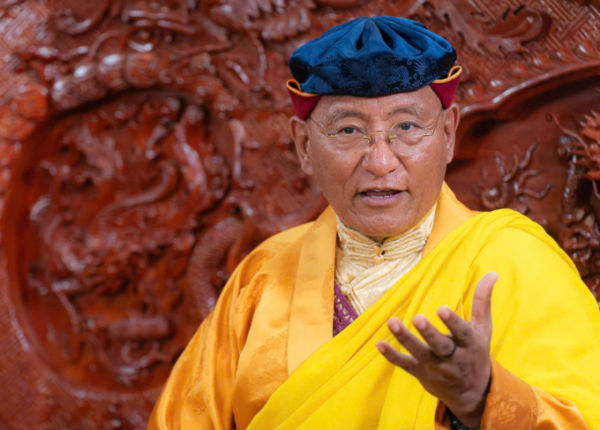
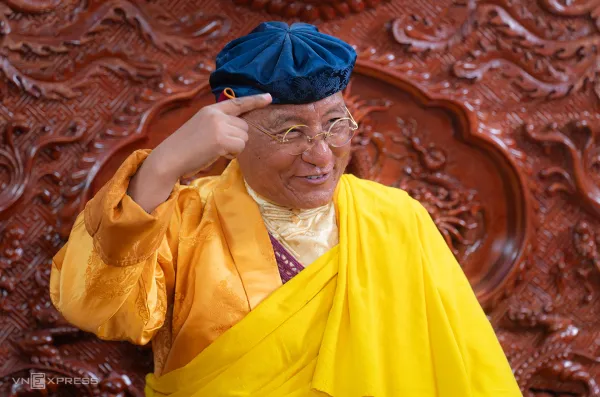
With his belief in the power of spiritual practices and the positive energy every human possesses, His Holiness Gyalwang Drukpa says inner transformation is a sustainable way to contribute to changing the community and world.
The 12th head of the Drukpa Lineage of Tibetan Buddhism recently visited Vietnam for a 13th time on the occasion of the Hung Kings’ Commemoration Day.
During the Dharma Assembly held for national peace and prosperity at the Tay Thien Mandala Stupa, Read asked him about his spiritual perspective on world changes and how to help humans achieve inner peace.
In a world facing numerous upheavals such as war, conflict, energy crises and social divisions, how do you perceive these challenges?
It is sad that the world is experiencing so much upheaval and chaos. However, each person still needs to maintain a positive attitude and cultivate compassion. Even though today is difficult, tomorrow we must still seek positive things to strengthen our inner selves. Sadness is not helpful; if despair persists, people will sink deeper, and that is not a healthy way of living.
Practice, spiritual energy, and compassion can help people overcome crises. When each individual transforms in a positive direction, the world will gradually change as well.
From the ancestral land of the Hung Kings to the
sacred site of the Mother Goddess Tay Thien, all offer very positive energy
fields. We just made a pilgrimage to Hung Temple. Walking up hundreds of stone
steps from the foot of the mountain to the Upper Temple was not easy at all.
Normally, climbing the steps is quite strenuous, but this time I felt a very
special energy. Not just me, everyone can overcome this journey. I believe
Vietnamese people receive a great deal of positive energy from this ancestral land.
Can someone living in a chaotic world achieve true peace of mind and body simply through prayer and practice?
Buddhism, like many other religions, both indigenous and global, may differ in traditions, but most aim for good and virtuous values. The problem lies in the fact that people haven’t practiced enough or correctly, and thus fail to achieve spiritual fulfillment and inner peace. Just like climbing a mountain, the path is inherently steep; without continuous effort, progress is impossible. Or like considering reading hundreds of pages of Buddhist scriptures but flipping through a few before stopping. Insufficiently deep spiritual practice is the reason why people haven’t been able to transform themselves.
Another reason is that in some places, the approach and practice of religion remain rigid and closed, failing to truly help people open their hearts and delve into the deeper aspects. What is needed is sincerity, openness, and willingness.
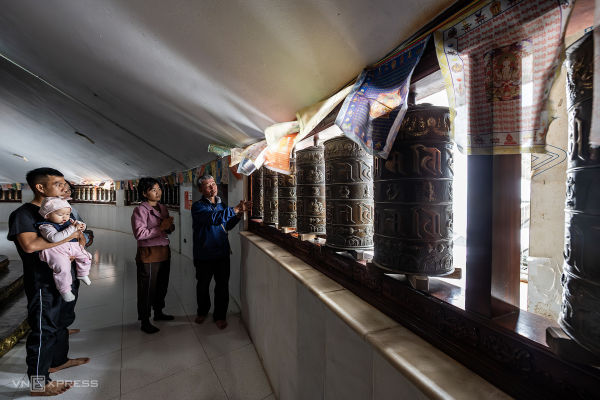
Paying homage to the Buddha, burning incense, circumambulating stupas… these are all good practices but not enough. What is important is transforming the Dharma into a lived experience, putting it into practice in daily life to transform the inner self and move towards a peaceful life. Buddhism particularly emphasizes developing inner strength and inner peace.
Temples and monasteries exist in many places, but they cannot directly guide people. That role belongs to living masters who teach the Dharma and lead people on the path of genuine spiritual practice.
How can personal practice play a role in creating broader changes in the world, such as influencing the decisions of leaders?
As I said from the beginning, the more turbulent the world becomes, the more people need to maintain a positive attitude from within. When each person sincerely strives to pray, practice, and teach to the community, Dharma will gradually spread. Masters can teach thousands, even tens of thousands of people, and as those teachings spread widely, many people will experience positive transformations from within.
Who knows, one day these teachings may reach anyone, including world leaders. This sounds optimistic, but the deeper meaning is that all change begins with spreading positive awareness in society.
Vajrayana Buddhism believes that prayer can transmit positive energy and be felt. Therefore, prayer is an important part of the practice. Every evening, if I’m not too tired, I dedicate at least an hour to praying for world peace, sending messages of goodwill with sincerity from the bottom of my heart, hoping to bring positive energy to the community and the world.
Many people, especially young people with a scientific mindset, wonder whether prayer or spiritual practices truly bring about change or merely serve as a form of mental therapy. How do you view this?
In my understanding, prayer also has a scientific aspect, but it’s a very subtle form of science, to the point of being almost “mystical.” Even scientists sometimes find it difficult to observe with ordinary tools, and it’s even harder for people in general to recognize; not everyone can understand it immediately.
However, when the practice and prayer truly
work, the person experiencing it will realize it and be able to verify it for
themselves. Then they will ask themselves: “Wow, this really works, why is
that?”
Many people still confuse spirituality with superstition. How can we distinguish between them and follow the right path?
For me, spirituality is sincerity and belief that has been experienced and verified. Belief truly forms only when you directly witness or experience something yourself. For example, when I practice the practices of the Buddhas and deities, cultivating compassion and loving-kindness, I feel the results, the impact, and the positive energy from the practice. I call that spirituality.
Conversely, superstition is something that people cannot clearly see but only speculate about. It is based on chance, sometimes right, sometimes wrong. For example, some people believe that at night, you shouldn’t leave an empty cup right side up because a spirit will reside inside; it should be upside down. That’s superstition because you cannot determine right or wrong; it is just an unfounded hypothesis.
Meanwhile, spirituality is something that can be perceived through practice. At the sacred Swayambhunath stupa in Nepal, I heard stories of infertile people who had children through prayer, chanting mantras, and spiritual practice. Initially, without knowing the truth, one might consider it superstition. But after witnessing this firsthand with my disciples, I understood that it was no longer superstition, but a genuine spiritual experience.
One of the distinguishing features of the Drukpa lineage is that people can attain enlightenment in this lifetime through practice, without having to wait for another. Through your teachings and experiences, how do you share this?
I don’t know if that’s completely different from other Buddhist lineages or traditions. But I can say with certainty that enlightenment in one lifetime is entirely possible.
If the teachings are practiced clearly, correctly, and with single-minded devotion, it will certainly lead to enlightenment. A practitioner can become Amitabha, Avalokiteshvara, achieving complete enlightenment. However, the problem is that most practices are still insufficient.
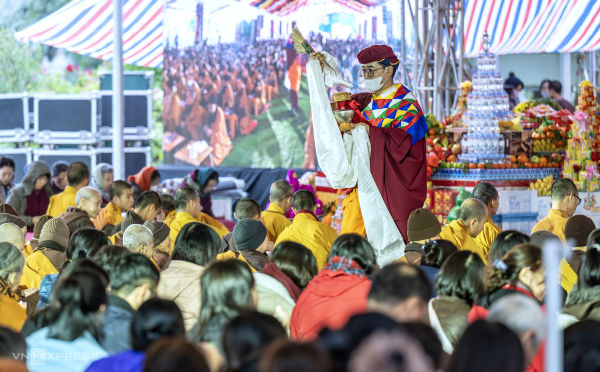
During the three-day Dharma Assembly for national peace and prosperity, His Holiness will open the meditation scriptures and ring the bell to pray for world peace. How can first-time attendees truly engage in practice, rather than simply being attendees?
Most importantly, you should be open to listening and receiving the Dharma, so that after leaving this place you are full of inspiration and carry a positive mindset to transform your life.
I feel fortunate to have the opportunity to contribute my time, effort, and prayers. It is even more meaningful that the Dharma Assembly takes place at the same time as the Vietnamese people commemorate the Hung Kings’ Ancestral Anniversary and then celebrate the day of reunification and complete peace.
In less than two decades, I have visited Vietnam 13 times. It is a profound karmic connection. Each time I return, I feel joyful and inspired.
Honestly, there were times when I thought I didn’t necessarily have to come back. Last year has passed, and this year I could have dedicated time to other schedules around the world. But in the end I still returned to Vietnam as if it were the most natural thing in the world.
It is safe to say there is a particularly deep connection between me and Vietnam.
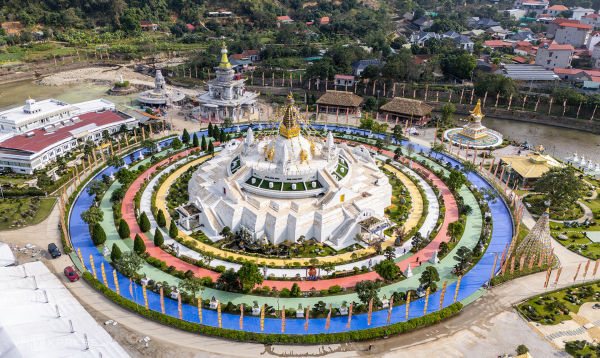
During those nearly two decades of connection, what led you to choose Vietnam to build the Tay Thien Mandala Stupa, a project that is now 15 years old and bears your strong imprint?
15 years is certainly not a short time. Looking back, I still feel moved and full of inspiration. The karmic connections in life always operate in their own way, sometimes preordained from many past lives, even though we sometimes don’t realize the reason.
I first met Venerable Thich Minh Giac, the current abbess of the Tay Thien Mandala Stupa, in 2004 when she presided over the Six Ornaments of Naropa in Ladakh, India – a major event held only once every 12 years. At that time, she invited me to Vietnam.
Perhaps a special karmic connection from the past led me to Tay Thien, a land imbued with a powerful maternal energy. Today, this energy source plays a vital role in fostering hope for world peace.
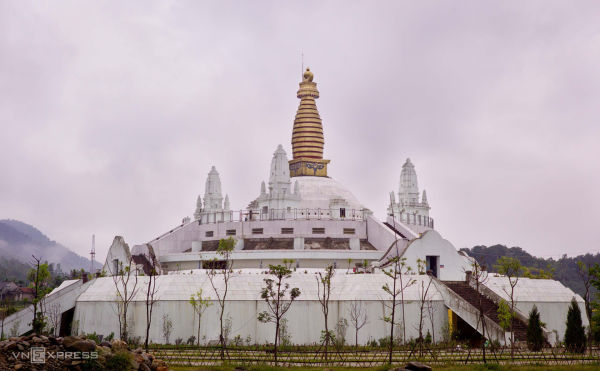
I harbored a strong aspiration and vision for the construction of the great stupa. Years later, I still vividly remember the moment the first stone was laid, the blessings were given, and the groundbreaking rituals were performed. There was a lot of work then, and it feels like it only happened a few weeks ago. Time has flown by incredibly quickly.
Over the past 15 years, the nuns, monks, the community, and the local government have devoted much effort to building this spiritual structure. All efforts have been directed toward the benefit of all beings and this land, and for no other purpose. It has been 15 years of effort, prayer, and sincere devotion—a truly commendable achievement.
From that initial aspiration to building the great stupa, that energy has spread, bringing positive changes to the community, to this land, and in many other aspects. That is something I clearly feel.
We have laid a foundation that future generations can inherit and develop, not just for a few decades, but potentially for hundreds of years to come.
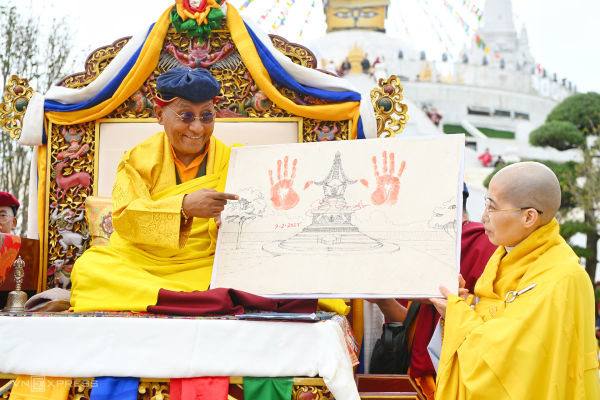
His Holiness Gyalwang Drukpa hands over a painting with handprints to Venerable Nun Thich Minh Giac, Abbess of the Great Mandala Stupa of Tay Thien, during the consecration ceremony of the Namgyelma Stupa, a structure within the Tay Thien Mandala complex, in 2025. Photo by Giang Huy
The Drukpa lineage recognizes you as the reincarnation of the 11th Gyalwang Drukpa and the 12th spiritual leader. Reincarnation is something that science finds difficult to explain. Can you tell us more about your story?
The concept of reincarnation is both inspiring and easily misunderstood. Many parents today bring their children to me and say, “My child is a special being; please confirm this.” They say they’ve had dreams and believe their child is a special reincarnation. I often have to tell them I cannot confirm that. But many people still come with the same request.
My story is different. Being recognized as a reincarnation did not stem from a personal desire, but rather from a simultaneous recognition by many great spiritual masters.
My father, Bairo Rinpoche, was an enlightened master, the 36th reincarnation of the great translator Vajrochana, one of the 25 great accomplished masters of Padmasambhava. He did not want me to become a reincarnation or take on a spiritual leadership role, believing that it would bring too much pressure, and advised me to live a peaceful life.
But then many masters came to implore my parents insisting that I was an incarnation. To put it jokingly, it was like being “kidnapped,” but I was very happy to go with them. The story is long, but eventually they found me, took me away, and enthroned me as the 12th Gyalwang Drukpa. Masters and many leaders of various lineages also confirmed this.
I was only four years old at the time. A few days before they arrived, I told my parents I was leaving, repeatedly saying goodbye, which made my mother cry. I liked wearing red and gold robes – the colors of a monk’s attire. When my father was away, I would often try on all of his robes to look like a master. When he found out, my father was very worried, because he understood that if that happened, my later life would be very busy and full of challenges.
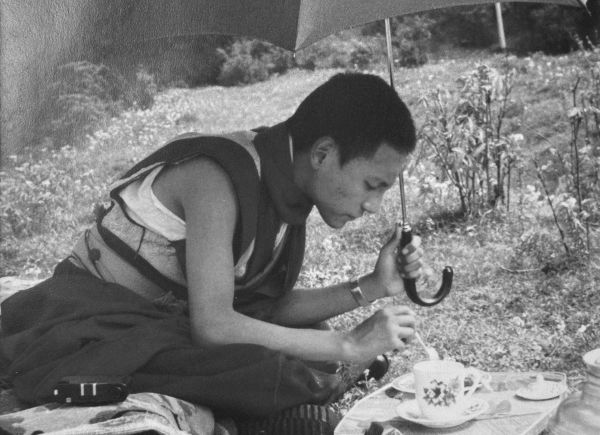
How did accepting the responsibility of a 1,000-year-old lineage at such a young age, especially with a childhood marked by rigorous instruction in Buddhist teachings, affect you, and how do you perceive it?
Looking back, I think it did. It was truly a very arduous journey. For eight years, I had to memorize almost all the scriptures and books; by the age of 13, I had memorized most of them. After that, I continued to study philosophy under the guidance of many very strict traditional masters.
At the age of 17, the lineage’s Root Master passed away, and all responsibility was transferred to me, from major to minor tasks. There were times when I needed support, but I still had to strive to shoulder my role. Although I completed my studies at the age of 25, the path of spiritual practice did not stop there, but continues until enlightenment is attained. Only then can the cultivation of my spirituality be considered complete.
It has been a challenging journey, one that continues to this day. I don’t usually talk about it much, because if I did, I might break down in tears.
The Buddha taught that one should not lie. But to adapt and survive in a life full of calculations and schemes, it is difficult for people to follow this precept. What advice does he have?
I think the Buddha understood what people are going through. When you lie without harming anyone, perhaps he would smile rather than get angry.
However, the path of spiritual practice always aims at sincerity and honesty, avoiding lies. Therefore, each person needs to strive to change themselves, limiting the repetition of this as much as possible. That is the path the Buddha taught.
Phong Linh
* Editor’s notes: The Drukpa lineage holds a special place in the Himalayas, is the state religion of the Kingdom of Bhutan, and has a profound influence in Ladakh, India. Known as a lineage of practice, Drukpa emphasizes a mindful lifestyle and a spirit of committed service to the community.
-
The Neighbourhood fans 'immediately' distracted by same detail in ITV show

-
Wendy Duffy's family breaks silence as Brit mum ends her life at Swiss clinic
-
Mumbai Rape Case: Shocking Allegations Against Auto Driver
-
IKEA announces major change to UK stores after 25 years

-
Testaments episode 5: Who is Garth's dad?