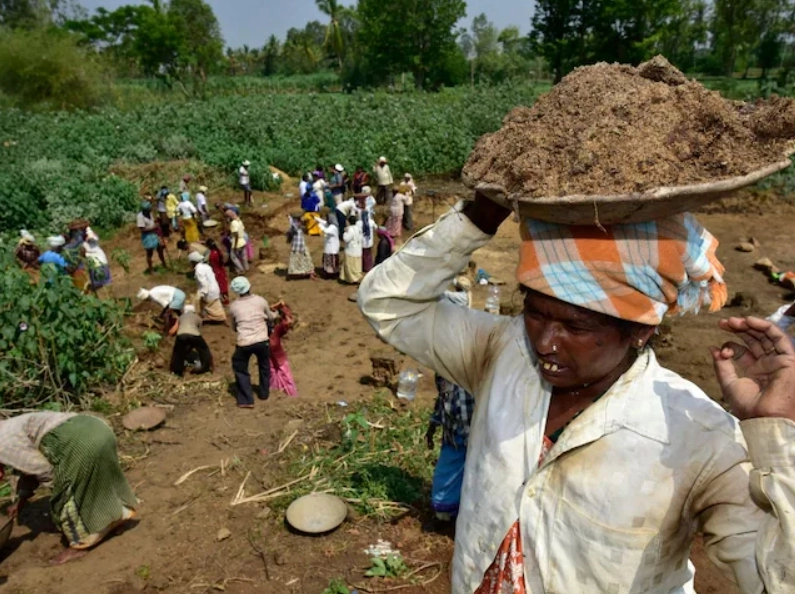
Nearly 1,182 cases of farmer suicide have been reported from Karnataka in 15 months, according to the figures given by the state revenue department. The grim data has evoked reactions, with BJP MP and former Union minister Rajeev Chandrasekhar blaming the Siddaramaiah government in the state for the deaths.
“Meanwhile, people in Karnataka die due to Rahul’s Congress Economic mismanagement and Loot,” he said.
As per the revenue department’s data, most of the farmer suicides in Karnataka took place in three districts Belagavi, Haveri and Dharwad, with 122, 120 and 101 cases respectively.
Chikkamagalur reported 89 farmer suicides, Kalaburgi reported 69 and Yadagiri saw 68 such instances during the same period.
The farmer's suicide was attributed to various factors such as severe drought, crop loss and overwhelming debt, as per the revenue department.
Out of the 27 districts in Karnataka, only six reported farmer suicide cases in single digits while the remaining 21 districts witnessed 30 farmer suicide cases or more.
WHAT ARE THE REASONS BEHIND FARMER SUICIDE?
Farm Loans
Karnataka had already declared 223 of the 236 taluks as drought-hit. Of these, 196 taluks are categorised as severe drought-hit and 27 as drought-hit. As many as 22.59 lakh farmers have taken medium-term and short-term loans from cooperative institutions to the tune of Rs 17,534 crore till January 31, 2024, and 8.5 lakh have secured loans from nationalised banks to the tune of Rs 1,7424 crore till December 31, 2023. The data further revealed that only 238 farmers have repaid their loans in cooperative institutions.
While the finance department is collating data to make provisions for the interest waiver, the total outstanding crop loans amount to Rs 535.43 crore (as of December 2023) at the Karnataka State Cooperative Agriculture and Rural Development Bank Limited (KSCARD) alone. This includes Rs 229.32 crore principal and Rs 306.11 crore interest. The interest waiver will also apply to loans at the Karnataka State Cooperative Apex Bank, District Cooperative Central Banks and so on, a report by The Deccan Herald said.
Climate Change
Researchers Ritu Bharadwaj, N Karthikeyan and Ira Deulgaonkar examined year-on-year data from Chhattisgarh, Karnataka, Madhya Pradesh, Maharashtra and Telangana to understand the linkage between farmer suicide and climate change. Data covering 2014-15 to 2020-21 showed a negative correlation for all five states — indicating that the suicide rate is consistently higher in years with a rainfall deficit, as mentioned in a report by Down To Earth.
The states, which report the highest suicide rates, have farmers more heavily engaged in cotton cultivation, which requires significant investment in seed, pesticide and insecticide, forcing farmers to borrow money, as per a report by Down To Earth.
According to a report by the Asia-Pacific Foundation of Canada, in Karnataka, one of the world’s most water-stressed regions, the Congress-led government instituted a policy in 2016-17 protecting drought-impacted farmers from loan recovery. However, by 2020, the new government led by the BJP withdrew that protection.
WHO GOT RELIEF?
The Karnataka government provided drought relief to 38.78 lakh farmers during 2023-24, according to Revenue Minister Krishna Byra Gowda. So far, Rs 4,047 crore has been spent on compensation in the state.
The previous highest number of farmers receiving compensation was 23.42 lakh. In the last four years, 14.41 lakh farmers received drought relief. Farmers who have seen 33% of their crops getting damaged have received compensation, the minister said.
Gowda also said the government for the first time spent Rs 531 crore to pay compensation for the loss of livelihood that benefitted 17.8 lakh farmers’ families.
WHAT CAN GOVT DO MORE?
Experts suggest that the government should implement policies that incentivise farmers to move away from water-intensive crops such as cotton, sugarcane, and areca nuts to climate-suited crops such as millets and legumes.
According to the paper ‘Urgent preventative action for climate-related suicides in rural India’, published by the International Institute for Environment and Development in May 2023, social programmes like Mahatma Gandhi National Rural Employment Guarantee Act (MGNREGA) could limit the effect of climate vulnerabilities. For instance, the number of farmers dying by suicide drops from 1,800 people per year to 398 people per year when the number of work days taken up from MGNREGA from 50 million-150 million.
According to an article by the Asia Pacific Foundation of Canada, in March 2021, the Karnataka government allocated Rs 25 crore to promote research on tackling yellow leaf disease. In late October 2022, the Ministry of Agriculture formed an expert committee of seven researchers to develop further strategies for the disease. Thus, knowledge sharing with other economies will be an area to watch in the coming years.
-
Arsenal make Gabriel Martinelli position clear after Galatasaray lodge huge bid for Brazilian winger

-
Ollie Watkins next? The eight English players who have featured in the Saudi Pro League

-
Madam Pang turns heads at Vietnam’s My Dinh Stadium during ASEAN Cup final with minimalist style

-
Make old brass and copper idols shine like this on Janmashtami, keep these things in mind before decorating Laddu Gopal

-
Love Horoscopes For August 28, 2026 During The Full Moon Lunar Eclipse