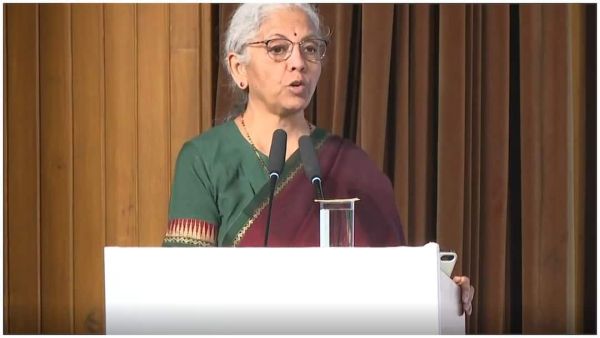
Union Finance Minister Nirmala Sitharaman on Saturday criticised what she described as the distortion and “whitewashing” of India’s history, arguing that historical narratives have been shaped by ideological dominance and, at times, institutional and state patronage.
Addressing the FIHCR Annual History Prize Awards Ceremony and the Dr SL Bhyrappa Memorial Lecture, in New Delhi, Sitharaman said colonial historiography had contributed to a distorted understanding of India’s past, but argued that the problem continued even after Independence.
She cited the example of Robert Clive and the Battle of Plassey, saying history is often presented simply as an Indian ruler being defeated by an English merchant, while the circumstances surrounding the defeat and the public response are overlooked.
“That doesn't make a virtue of Clive, but the fact remains. These are the ways in which history has been whitewashed,” Sitharaman said.
Sitharaman Cites Macaulay’s Remarks On Indian Knowledge
Sitharaman then referred to Thomas Babington Macaulay’s 1835 Minute on Indian Education, arguing that colonial assessments of Indian knowledge systems were made without adequately engaging with India’s intellectual traditions.
Quoting Macaulay, she said: “I have never found one among them who could deny that a single shelf of a good European library…”
She also referred to James Mill’s History of British India, arguing that Mill wrote about India without visiting the country or learning an Indian language.
Sitharaman said such examples illustrated how judgments about Indian civilisation were formed through colonial frameworks and subsequently influenced historical narratives.
Bhyrappa’s Account Cited On Alleged Historical Deletions
To support her argument about post-Independence historical documentation, Sitharaman cited Kannada writer S.L. Bhyrappa’s account published in Vijay Karnataka on October 8, 2006.
“I have sourced it from Bhyrappa’s own account in Vijay Karnataka, 8th October 2006,” Sitharaman said.
She recalled Bhyrappa’s account of his involvement with a national textbook committee headed by diplomat G. Parthasarathy. According to Sitharaman, Bhyrappa had objected to the deletion of certain historical references from the proposed textbook.
“Parthasarathy, the diplomat, privately conceded that the objections were academically valid, but maintained that state policy required the deletions,” she said.
Sitharaman used the episode to argue that state patronage played a major role in shaping historical narratives.
“And that's why, when I say patronage for the historians who distorted was huge and from the state itself,” she said.
According to the account cited by Sitharaman, Bhyrappa refused to retreat from his objections and, about a fortnight later, the committee was reconstituted without him. His place was subsequently given to historian Arjun Dev, she said, referring to Bhyrappa’s account.
Sitharaman said the episode demonstrated how political considerations could influence the presentation and documentation of history.
“Memory is very rarely managed in the name of dishonesty. It is almost always managed in the name of prudence. And that is precisely what makes it so hard to resist,” she said.
‘Political Independence Did Not Bring Intellectual Decolonisation’
Sitharaman argued that political independence in 1947 did not necessarily bring what she described as “intellectual decolonisation”.
She alleged that, in the decades after Independence, institutions including the Indian Council of Historical Research, NCERT, the Indian Council of Social Science Research and university departments became dominated by one ideological perspective.
According to Sitharaman, this affected the way Indian history was documented and taught, with several civilisational traditions receiving less attention while certain narratives became central to textbooks.
Sitharaman Calls For Fact-Based Historical Discourse
Sitharaman also invoked the Indian intellectual tradition of Purva Paksha, under which an opposing argument is first presented in its strongest form before being rebutted.
She said India’s intellectual space should allow competing ideas from the Left, Right and Centre to be debated openly rather than allowing one ideological group to dominate the discourse.
Using the metaphor of samudra manthan, Sitharaman said opposing sides must engage in intellectual “churning” for truth to emerge.
The Finance Minister argued that historical scholarship should be based on evidence, documentation and openness to competing interpretations rather than ideological preferences.
-
Suresh Raina backs Abhishek Sharma for Test cricket, questions IPL owners

-
Malappuram: House Goes Up in Flames, Family Devastated! Read Details
-
Owaisi condemns Saharanpur mosque demolition, questions religious freedom
-
PM Modi to attend SRCC centenary celebrations, lauds college’s legacy
-
Centre, MP govt’s sustained health response in Balaghat tribal areas