On a morning in early August, after more than two months of summer training, Ca Di watered the small garden in front of her house in Phuoc Vinh Commune. Her husband was on security duty at a school, so she sat with their eldest son, a second grader, reviewing lessons before the new school year.
|
Thach Thi Phat Ca Di weeds the garden in front of her house in Tay Ninh Province, southern Vietnam. Photo by Hoang Nam |
The youngest of four siblings, Ca Di grew up in a family of teachers. Her father and older sister were both teachers, and she developed an interest in teaching from an early age.
While studying Khmer Literature Pedagogy at Tra Vinh University, she often watched reports about volunteer teachers working in remote areas and told herself she would one day do the same.
In 2016, after graduating, she learned that Tan Bien District in Tay Ninh Province that borders Cambodia was recruiting primary school Khmer teachers. She took a bus more than 300 kilometers to submit her application.
“I just thought I’d try. If it didn’t work out, at least it would be an experience,” she recalls.
Three months after taking the exam, she received her assignment to Hoa Dong Primary School.
Her first days in the border region felt completely foreign, apart from the familiar curved roofs of Khmer temples among the sugar palm trees.
With no relatives nearby and no guesthouses in the area, she became discouraged until a kindergarten teacher who had applied in the same recruitment round offered her a place to stay temporarily. Three months later, the school arranged accommodation in the teachers’ quarters.
Once she had a place to live, another unexpected challenge emerged: the local dialect.
Although both communities spoke Khmer, the dialects used in her hometown Tra Vinh and Tay Ninh differed enough to make early conversations difficult.
“At first they couldn’t understand me, and I couldn’t understand them either,” Ca Di says with a laugh.
Some parents began to question the young teacher’s ability. Undeterred, she regularly talked with local residents to learn the area’s pronunciation and vocabulary.
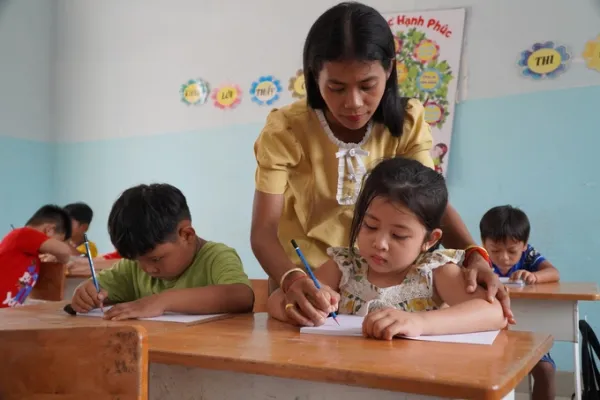
Only three schools in the province offer Khmer language classes, limiting opportunities for teachers to exchange experiences. At Hoa Dong Primary School, classes include both Kinh and Khmer students, so Khmer lessons are scheduled at the end of the school day. After regular classes, just over 10 students stay behind to study their mother tongue.
Teaching Khmer is not easy, Ca Di says. The Khmer script has 68 vowels and consonants, nearly three times as many as Vietnamese. Students need about a year and a half just to master the alphabet, followed by more time to learn how to form syllables. Becoming proficient in reading and writing usually takes about three years.
|
Thach Thi Phat Ca Di instructs her students during a writing assignment. Photo by Hoang Nam |
“Sometimes after finishing a new lesson, the students have already forgotten the previous one, so we have to start over. Without patience it’s easy to give up,” she says.
Khe Thi Sieng, now in 11th grade, still remembers her first days learning her mother tongue with Ca Di. Her parents worked as hired laborers and could not help with schoolwork, leaving Sieng self-conscious as she started from zero.
Ca Di used digital lesson plans, projected images and videos about Khmer culture to make the lessons easier. She also recorded difficult words in Vietnamese to help students remember them.
After nearly five years of steady effort, Sieng became fluent and one of Ca Di’s top students.
Around that time, Oc Xa Quan, a school security guard who lived nearby and was 13 years older than Ca Di, was still single. After colleagues introduced them, the two began getting to know each other.
“He’s the youngest of nine siblings, kind, hardworking and caring, so I felt drawn to him after a few meetings,” she recalls.
They married after two years and now have two sons.
Besides their salaries as a teacher and school security guard, the couple farms one hectare of rice and cassava that their parents gave them. The rice mainly meets their household needs, while cassava brings in about VND20 million (US$767) per harvest in good years.
Dang Cong Xuan, principal of Hoa Dong Primary School, describes Ca Di as a dedicated professional who has repeatedly completed outstanding work and received a certificate of merit from the provincial People’s Committee. She has also been recognized as a local emulation fighter and excellent teacher.
 |
|
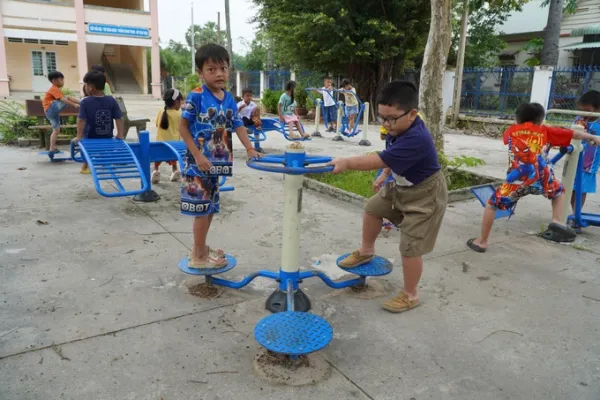
Break time in Hoa Hong Primary School. Photo by Hoang Nam |
“Ms. Ca Di often takes the initiative to use technology in her teaching and inspires students to love their ethnic language and script,” Xuan says.
According to the Tay Ninh Department of Education and Training, three primary schools in Phuoc Vinh, Tan Phu and Binh Minh wards currently offer Khmer classes to a total of 266 students. The classes are taught by only three teachers.
“Every child who learns to read and write Khmer helps preserve a piece of ethnic culture for the next generation,” Ca Di says.
Schools in the Tay Ninh border area continue to face shortages, while each school day gives children an opportunity to learn and preserve their cultural heritage. Readers can join Hope Foundation in improving learning conditions for students in disadvantaged areas.
-
OPINION | Nepal Seeks Compensation From India, China-This Is Time To Talk, Not Squabble

-
Leandro Paredes set to leave Argentina duty! Boca Juniors captain ready to step away after World Cup ban

-
Deepak Hooda Ends 2021 Dispute With Krunal Pandya, Set For Baroda Return After 5 Years

-
S J Poddar Academy Hosts Robotronix 2026; 170+ Students Showcase Robotics & Coding Skills
-
RRB NTPC 2026: Railway Board Approves 5,165 Vacancies For Graduate And Undergraduate Posts; Check Details Here