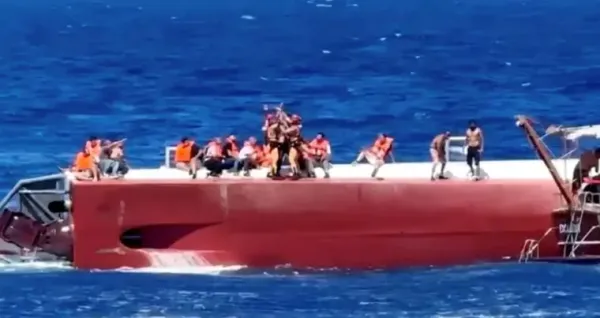
A passenger ferry bound for Turkey capsized in the sea off the coast of Kyrenia in northern Cyprus on Sunday. There were 267 people on board the ferry. Seven people died in the accident, 237 were rescued and 23 were reported missing.
Northern Cyprus: A major maritime accident occurred on Sunday when a passenger ferry bound for Turkey capsized near the coast of Northern Cyprus in the Mediterranean Sea. A total of 267 people were on board the ferry. According to preliminary official information, seven people died, while 237 passengers were rescued and 23 people were reported missing. After the accident, a large-scale search and rescue operation was conducted.
The ferry was going from Kyrenia to Tasuku
This ferry had left from Kyrenia port in Northern Cyprus for Tasuku port in Mersin province of Turkey. According to officials, the ship was carrying 259 passengers and eight crew members.
The ferry started filling with water sometime after departure around 12:30 pm on Sunday afternoon. After this, the ship lost its balance in the sea and overturned. The accident occurred about 6.5 to 7.5 kilometers off the coast of Kyrenia.
Initial reports included bad weather as possible circumstances of the accident. However, the actual reason for water entering the ferry is still unclear and investigation is ongoing.
Passengers saved their lives by climbing on top of the overturned ferry
In the videos and pictures that emerged after the accident, many passengers wearing life jackets were seen sitting or standing on top of the overturned ferry. Some people were also present in the sea, who were taken out by the rescue team with the help of boats and helicopters.
237 people were safely evacuated to the port of Kyrenia. From there the needy passengers were taken to the hospital. Civilian ships and helicopters along with coast guard boats were also involved in the rescue operation.
An operation was carried out across a large part of the ocean to search for the missing people. Officials said all available resources have been deployed in the search and rescue operation.
Investigation into the cause of the accident begins
An investigation has been started into the reasons behind the sudden filling of water and capsizing of the ferry. According to initial information, the ship ran into trouble shortly after leaving the port.
Later reports quoted some surviving passengers as saying that the ferry was rocking abnormally in the sea and that its bow was damaged after a strong shock. However, it would be premature to attribute responsibility to any one cause before the official investigation into the accident is completed.
According to reports, the ferry captain and crew members were also questioned after the accident. Authorities aim to find out why the ship took on water and whether all safety procedures were followed before sailing amid rough sea conditions.
The ferry was designed by catamaran
The ferry that was involved in the accident was of catamaran style. This type of boat has two parallel hulls, which generally gives it more stability than traditional single-hull boats.
However, even catamarans are not without risk in extremely rough sea conditions. Strong winds, high waves, sudden flooding or damage to the ship's structure can cause serious conditions.
In this accident too, the circumstances of the ferry suddenly taking on water and then overturning are being investigated. It is important for the authorities to ascertain whether the incident occurred due to technical failure, sea conditions, operational problems or some other reason.
Important sea route between Northern Cyprus and Turkey
The maritime connection between Kyrenia and Tasukou in Turkey is an important means of passenger traffic between Northern Cyprus and Turkey. Ferry services operate regularly on this route.
Kyrenia is the main tourist center of Northern Cyprus. Sea travel from here to the coastal cities of Turkey is useful for the local people as well as tourists.
The administration of Northern Cyprus is not widely recognized internationally and only Turkey recognizes it as an independent state. The island of Cyprus has been divided since 1974 and its northern part is under the control of the Turkish Cypriot Administration.
For this reason, the issue of security of this sea route is not limited to local administration only, but also becomes important in the broader regional context involving Turkey and Cyprus.
Risk of maritime accidents in the Mediterranean Sea
The Mediterranean Sea is one of the busiest maritime regions in the world. Passenger ships, cargo ships, tourist boats and other sea vessels run here every day.
Incidents, particularly involving small and overloaded boats carrying migrants, have been a long-standing concern in the region. However, such a capsizing of a regular passenger ferry carrying approximately 270 passengers and crew is a serious and unusual incident.
Accidents involving small boats have also been reported around Northern Cyprus before. But due to the large number of passengers in the current accident, the scale of the relief and rescue operation was also large.
Long history of ferry safety regulations
After major maritime accidents in the world, many important changes have been made in the safety system of passenger ferries. In 1987, 193 people died in the 'Herald of Free Enterprise' disaster near Belgium. After this accident, safety measures such as monitoring of ferry doors and information about their status from the bridge were strengthened.
Subsequently, the 'Estonia' ferry accident in the Baltic Sea in 1994 raised serious questions about the stability of the ship and the safety of passengers after filling with water. More than 850 people lost their lives in this accident. Subsequently, regulations relating to ferry stability, emergency communications and safe evacuation were strengthened.
Over time, security arrangements have also focused on ensuring that the ship's critical systems remain functional for some time following serious damage and that passengers can be evacuated safely.
Safety of domestic ferry is also a big concern
The International Maritime Organization (IMO) has also paid special attention to the safety of domestic passenger ferries. Safety checks, adequate crew strength, emergency communications, lifesaving equipment and rescue arrangements are considered extremely important for ships operating on domestic sea routes.
Due to the large number of passengers involved in ferry accidents, even a small technical or operational problem can turn into a major accident. This is why maritime safety experts consider regular inspections, weather monitoring and emergency drills important.
Many questions after the accident
This accident near Northern Cyprus has raised many questions regarding the safety of ferry operations. The most important question is what caused water to enter the ship and whether adequate assessment of the weather and the technical condition of the ship was made before departure.
Apart from this, it is also a matter of investigation how quickly the passengers were warned in case of emergency and what was the status of availability and use of other safety equipment including life jackets.
The answers to these questions will become clear only after the official investigation is completed.
The whole world's eyes are on the rescue operation.
After the accident, Turkish and Northern Cyprus authorities launched a large-scale relief and rescue operation. Coast guard ships, helicopters and civilian vessels were deployed in the operation.
In the initial phase, seven people were confirmed dead and 23 people were reported missing. Subsequent reports also revealed changes in the number of dead and missing. Therefore, the final figures will be clear only after the official investigation and rescue operations are completed.
At present, the main goal of the rescue team is to find the missing passengers and find out the real cause of the accident. The accident has once again drawn international attention to the safety of passenger ships in the Mediterranean Sea, weather- risks and emergency response arrangements.
-
Kessie’s agent: “He wanted Juventus and waited for them until the end of August, but perhaps the directors were not convinced. It was about dignity, not money”

-
Center expects investment of $200 billion in India's data center industry: Piyush Goyal

-
Can You Get Your Acura Serviced At A Honda Dealership?
-
Whirlpool introduced four door refrigerator, you will be stunned to see the features, know the price

-
HiddenLayer nabs $100M as enterprises rush to secure their AI deployments