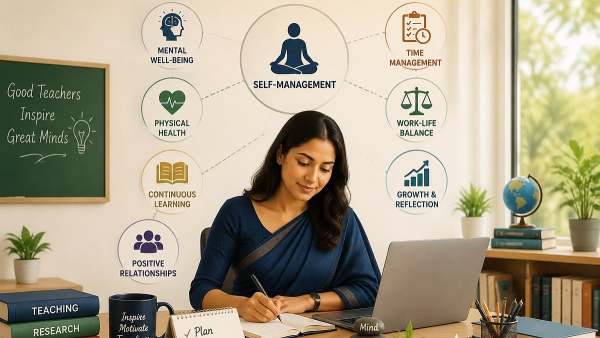
Self-management is essential for teachers to balance teaching, research, administration and personal well-being. Effective stress management, continuous learning, reflection, healthy habits and work-life balance can help educators sustain professional excellence.
Teaching is one of the most intellectually demanding and emotionally engaging professions. Faculty members are expected to teach effectively, mentor students, conduct research, undertake administrative responsibilities, participate in institutional development, contribute to accreditation processes, engage with the community, and continuously update their knowledge. In the era of the National Education Policy (NEP), digital learning, interdisciplinary education, and outcome-based education, the expectations from teachers have expanded significantly.
While institutions rightly focus on faculty development in pedagogy, technology, and research, equal attention must be paid to “self-management”. An educator who is physically healthy, emotionally balanced, intellectually curious, and mentally resilient is better equipped to inspire students and contribute meaningfully to institutional growth.
Self-management is not merely about time management; it is the ability to regulate one's emotions, energy, priorities, habits, and professional commitments to achieve sustainable excellence. It enables teachers to remain productive without sacrificing “personal well-being”.
What is Self-Management?
-
Hibiscus Face Pack: Are you troubled by dull complexion and dryness of your face? Prepare this easy face pack at home with hibiscus

-
Be careful with hot tea and coffee! Risk of food pipe cancer may increase, UK study reveals

-
Passive Smoking: More than 3 lakh deaths every year in India, know the danger of passive smoking

-
Magnesium deficiency can be expensive! Know why this nutrient is important for the body?

-
Ganesh Chaturthi 2026: Offer these 5 types of modak to Bappa on Ganesh Chaturthi, know the easy method.