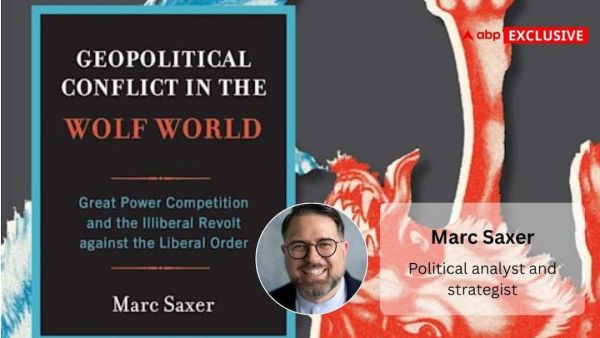
Marc Saxer, political economist and analyst, has come up with his new book – Geopolitical Conflict in the Wolf World: Great Power Competition and the Illiberal Revolt Against the Liberal Order – which talks about how the era of US dominance has ended, leaving the global order in a state of extreme volatility and uncertainty, even as Washington and Beijing will continue to play great power games. Saxer also discusses in his book how there will be primarily three theatres of conflict and how India has chosen not to get involved in the great power rivalry. Excerpts:
Why have you called the book ‘Wolf World’?
Well, it is basically a quote by Thomas Hobbes, who wrote his book in the 17th century during the English Civil War. And that was obviously a very dangerous, very violent situation, where there was anarchy, and the quote is that in a world where the law of the jungle rules, man is another man's wolf. So the 'Wolf World' basically takes this idea and looks at today's world, where you see an escalation, an explosion of violence and violent conflict around the world, and see very similar structures where order is breaking down, and that makes the international system very volatile, and countries just become very vulnerable.
Also, you talked about one fact that the nuclear threshold can be exceeded. Do you mean that will be done by both the US and China? You think that can be a consequence of all these conflicts that are going on?
Well, I do believe that there is still nuclear deterrence. I do believe that at this moment, I do not see any country actually going nuclear and using nuclear weapons on each other. The only theatre where I believe that the stakes are so high that this could happen is in East Asia, but I do not see that either China or the US want to use nuclear weapons on each other, which is why there is some hope that the East Asian Theatre will remain cold.
And also, the three theatres that you talked about- do you think this is going to probably set the next order, or is this going to disrupt the order forever?
What I mean is, the three theatres are basically areas for struggle. They are arenas for great-power involvement, for conflict, which is bad news for these three theatres, because as soon as great powers with their massive resources come in, that means the escalation of conflict is very difficult to contain. Europe and the Middle East are experiencing this right now. East Asia, luckily until now, has remained cold. I believe that the stakes for all the great powers are so high in these three theatres that they will remain the arenas for conflict and struggle. And so they will stay with us, unfortunately.
How do you explain the spheres of influence of the US and China? You say, in your book, there will be no order; what will happen to these spheres of influence then, and where does India lie in all these?
The question about the future order is still an open question, and I think what my book tries to do is to explore the different options, different scenarios. One scenario is that the great powers come to an understanding; great powers in this regard would be the US and China, maybe Russia, maybe others, like the European Union and India, and they would basically accept that these great powers have a sphere of influence, which would allow them to interfere in their neighbour's affairs and have, like, a security parameter. That is one scenario. But in the book, I am also exploring other scenarios - one of them is the Westphalian order, where basically every state is not only equal, but you also have sovereignty and non-interference, which shields them from external meddling.
And the third option is what I call a post-genomic, post-liberal order where sovereignty and non-interference are the basis, but we build a superstructure of international law and institutions, such as the United Nations, in a reform way, and that would basically then create more stability in international collaboration. So in the book, I do not make a prediction about which scenario will come to pass. I really feel that this is an open situation right now.
Where do you see the Great Power competition heading? We are seeing how global commons like the Strait of Hormuz can be weaponised in the event of a conflict.
I do not believe that the Great Power competition will end anytime soon. It will continue. I do not know, and it's very difficult to analyse if there's going to be direct confrontation between the Great Powers, because so far, it hasn't happened, and I have some hope it will not happen. But certainly they will fight it out. So I think volatility, violent conflict, uncertainty are going to be with us for some time.
Do you see the US and China as these two superpowers of the future - like a G2 of sorts? And how do you position India in all these?
Well, the US and China, I think, are set in a class of their own. If you want, you can call them superpowers. I believe that there will not be as dominant as the US and the Soviet Union were in the old Cold War, because there are so many other powers. You have a lot of regional powers from Brazil and Indonesia, Turkey, Saudi Arabia, Israel, Iran, and so many other powers, who were actually maybe even more relevant on the ground. And then there are three countries which I call continental-sized question marks because they could potentially grow into great powers and poles of a multipolar system, but it's not clear if that's going to happen. And these three powers are Russia, India, and the European Union. The question mark is, I mean, there's no doubt about it that, I mean, India, for instance, has the population size, does, at some point, will have the military muscle, will have the economy, etc. So I don't have a question about this. But of course, India has massive challenges when it comes to development and governance. India will grow to 1.6 billion people. You know, how will that look internally? That will all basically limit India's power in the world. So it's just an open question. It's a question mark, and we will see. But by sheer size, these three players are so much bigger than the others that they are a class of their own.
So, as you describe the world order in your book today or the shape it will take in the future, what role should India play in order to be considered a rising power? Should India play an active role in mitigating the conflicts?
India has chosen a strategy like many countries are choosing, which is called multi-alignment, which is hedging and balancing, which is strategic autonomy. So it does not want to get involved in this great power rivalry and instead wants to focus on concentrating on its own development. I think this is a very rational policy; I think it makes a lot of sense. The real question is whether this is a sustainable position, because India will also face limitations in its room for manoeuvre. And I think the first one that you can think of is technology. So, if the two superpowers - China and the United States are spending trillions and trillions of their currencies on the development of artificial intelligence, supercomputing, etc., it would be very difficult for the rest of us to keep up. And there may be a situation where you have to choose between a Chinese-led and an American-led technology world. Just as today you have to choose between Russian and American weapons. You cannot have both, right? And the more you have to choose for a system, maybe tech, maybe weapons, maybe finance, maybe currencies - the more your room for manoeuvre will shrink. So I would say if I were sitting in Delhi, I agree that multi-alignment and strategic autonomy are good approaches, but the question is whether it will be able to see that through.
But should India not play a bigger role in global geopolitics today? It is, after all, hoping to get a permanent seat at the UN Security Council.
I think India will definitely play a bigger role, and that is without a question. Coming to the Security Council question, it is a difficult one because you assume that there will be a Security Council in the future, and I'm not entirely sure about all of that. I mean, the whole point of my book is that this institutional set-up that the Americans created is crumbling down. I argue that we should safeguard it, that we should keep it, that we should reform it, for instance, by including India in the Security Council. That's one of the elements. But if this kind of paralysis, this kind of rivalry continues, it's like the entire house is breaking down.
You also say that there's going to be a massive financial crisis soon. How soon will it be, and how do you see that turning out compared to the previous depressions that we had?
I am certainly not giving any financial advice here, but I think if you observe the international system, if you see how massive the shock to the energy supply is, how much this will be driving fuel prices, food prices, etc. I think it's not that difficult to see that this will drive inflation. It's not that difficult to see that this will force central banks to react by raising interest rates, and then this will definitely have an impact on economic growth in the Global North and will put a lot of countries in the Global South in a difficult situation when it comes to sovereign debt, which is denominated in US Dollars.
Nayanima Basu is a senior independent journalist.
-
Zimbabwean Creator Says India “Destroyed His Life”, Lists 7 Things He Now Can’t Live Without
-
Kolkata SHOCKER: Cook Allegedly Tries to Rape Domestic Help, Attacks Her With Knife; Nabbed on Train
-
Who Is Rohullah Mehdi? Meet Deva Star ARRESTED With 28g MD In Mumbai Drug Case; Read Details
-
Kerala’s Kaziah Liz Mejo crowned Miss Universe India 2026 in Jaipur

-
Mild earthquake of magnitude 3.5 strikes Ladakh’s capital Leh