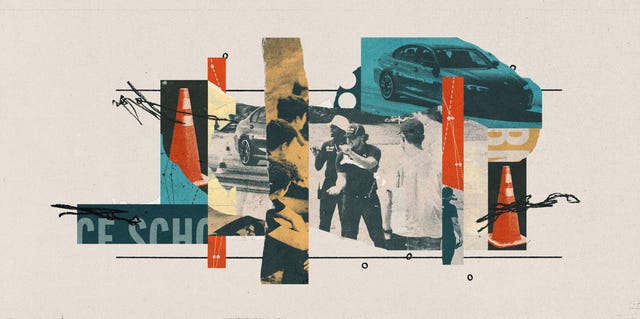
By lunchtime, the teenagers attending BMW’s one-day teen driving school had already gone through a wide range of exercises. The participants, all of whom either held a learner’s permit or had only recently got their licence, started the morning in a classroom session led by instructors who were former or current race-car drivers. There, they were taught correct seating position, where to look, how to hold the steering wheel, how to adjust mirrors properly, and the basic physics behind vehicle control. After that, they got behind the wheel of one of the facility’s M340i sedans, drove through a slalom, practised emergency lane-change manoeuvres, and carried out panic braking drills.
When I spoke to the teens after lunch, the hard, ABS-pulsing braking event was what most of them remembered most clearly. “It felt like the car was about to break,” said my 16-year-old nephew, who had flown in from Florida to take part in my reporting. “But I was shocked at how fast it slowed down.” Another participant described the day this way: “It was a lot more intense than when I was learning how to drive—in a good way. No dad yelling.”
BMW has been running this teen programme almost ever since its Performance Center opened in 1999 in Greer, South Carolina, close to its manufacturing plant. The initiative was created in part to address some troubling data.
“The highest lifetime risk of crashing happens in the first months after licensure,” says Flaura Koplin Winston, MD, PhD, founder and scientific director of the Center for Injury Research Prevention at the Children’s Hospital of Philadelphia, where she researches teen-driver crash prevention. “And car crashes are among the leading causes of mortality for this age group.”
The programme may appear more relevant now than ever. Driver’s education, once a regular part of public high school curricula, is no longer consistently available. In fact, roughly a dozen states do not require any formal training before the road test for licensing. “As a car company, we felt that need—I don’t want to say obligation—to provide driver training to the young folks who really haven’t gotten any,” says Dan Gubitosa, director of the BMW Performance Center.
According to Winston, about 75 percent of car crashes happen because of a few core factors: poor hazard awareness, such as not scanning properly or not looking far enough ahead for warning signs; driving too fast or following too closely; and failing to stay focused on the driving task. Teenagers are especially vulnerable to all of these issues because, although they have better reflexes, they do not yet have the real-world exposure to road problems that allows experienced drivers to respond instinctively and safely. “They have no muscle memory, no mental maps of what hazards are or how to respond to them,” Winston says.
She adds that the prefrontal cortex, the part of the brain responsible for focus, attention, decision-making, and impulse control, is still not fully developed in teens. “So, they’re very distractible, impulsive, and sensation seeking,” she says.
Winston says there are proven ways to reduce risk. One is comprehensive driver education with an instructor, particularly if it includes hazard-awareness training. Another is a structured teen driving plan that helps parents gradually expose their children to serious driving situations while explaining how to respond correctly. She also points to graduated driver licensing, which limits teens to lower-risk situations at first and then slowly expands their privileges—such as driving at night or carrying passengers—as they demonstrate competence. “Teens who have passengers do more risky things than teens who don’t,” Winston says.
That might suggest programmes like BMW’s should deliver clear benefits. But Winston says the evidence does not support that conclusion. “Rigorous studies tracking people for 550 days after trainings like these show absolutely no difference in crash risk,” Winston says. In fact, she notes that this kind of short-term exposure can actually create overconfidence. In that context, she points to a Montana study showing that adolescents who took a brief course of this kind received more traffic citations in their first year after getting licensed. “They started taking risks when they would have been more nervous,” she says.
There are other interventions that research does support. Winston says her lab has recently shown, in partnership with the Ohio Bureau of Motor Vehicles, that a validated virtual driving assessment can help predict crash risk. The self-guided programme takes participants through a route featuring the most common serious crash scenarios and evaluates how they scan for hazards and react to them. It then generates a detailed report, allowing teens to pursue additional instruction and improvement through any of 50 video-based lessons.
Some of the other recommendations may seem counterintuitive. “Kids should not get the clunker,” Winston says. “They should drive the newest car that has all the safety equipment.” In fact, research suggests they should not have a car of their own at all; studies show crashes are cut in half when teens share a vehicle, because of the extra oversight and the barriers to unrestricted use. Likewise, permissive parenting does not help. Parents who stay involved and set boundaries are also associated with half as many teen crashes.
Gubitosa says BMW has not carried out any formal research of its own on the teen schools. However, for nearly 10 years, the programme has worked with nearby Clemson University to provide a free teen driving initiative called “Guard Your Life.” Thousands of teenagers have taken part, and self-reported follow-up surveys found that more than two-thirds had used the skills taught in class, more than three-quarters had changed their driving behaviour as a result, and more than two-thirds had avoided crashes by applying what they learned.
Gubitosa also points to other anecdotal outcomes. “I get letters all the time from parents who tell me that their child survived an accident because of what they learned at our program,” he says. “It’s gratifying to have that experience.”
-
FIFA hands record combined 17-match ban to Argentina stars after ugly World Cup final clash

-
Liverpool delegation to visit Hyderabad in October for tie-up

-
Indian cricketer dies after collapsing during match in Oman
-
Koffee With Karan 9: Aamir to Samay, here’s expected full guest list

-
Chiranjeevi's 'Kaaka' Title Teaser OUT; Film To Hit Screens On Sankranthi 2027