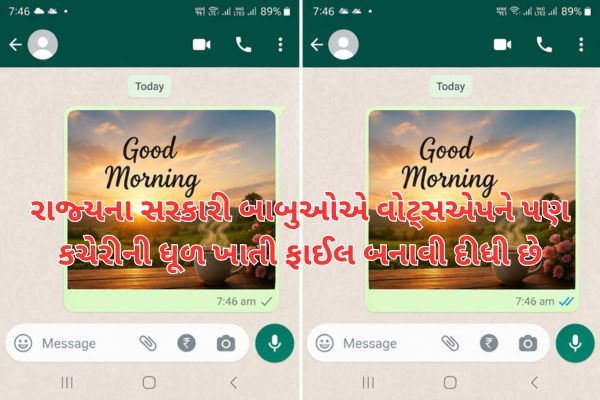
- Are government officials trying to shirk responsibility by turning off the blue tick on WhatsApp?
- Phones are government owned and recharge is done through public tax money, yet the attitude of government officials regarding their responsibility towards the public is worrying.
Hemant Parmar, Aravalli
On one hand, the state government makes tall claims of good governance, fast administration and Digital India, while on the other hand, the reality is that the state government officials have turned WhatsApp into a dusty file. For the convenience of citizens, messages are sent to the government WhatsApp numbers announced, but the officials have made such a magical setting that no blue tick is visible whether the message has been received or not. People send messages and wait for answers and government officials remain on silent mode and enjoy the salary and facilities received from public taxes.
Government should pay the bill, but when will the answer come?
The fact is that the mobile bills of most of the Taluka, District and State level officials are paid by the State Government i.e. from the tax money of the citizens. This facility is provided so that the common citizen can immediately contact the officials regarding his problems and complaints and get their solution. But the bitter truth is that about 87% of the state officials have turned off the read receipt i.e. blue tick in their WhatsApp. The remaining 13% officers have blue ticks on their WhatsApp, but only 1.5% of them show the decency to respond to citizens' messages.
Here the question arises that, are the state officials running away from their governmental and moral responsibilities? Do the officers respond only to those messages which show personal gain or selfishness? If mobile recharge is done with public money, then why are there so many fears about maintaining transparency on WhatsApp?
The push remains the same even in the digital age
Nowadays, in most of the departments including Taluka Office, District Office and Gandhinagar Secretariat, people are advised to “Submit on WhatsApp”. But this advice becomes a mountain of trouble for the citizens. Messages sent by various applications for very important issues remain pending for days.
Since the blue tick is off, the citizen does not even know whether the government official has seen the message or not. As a result, due to lack of digital services introduced to save time and money, citizens have to visit offices. Despite saving screenshots, sending repeated reminders and making phone calls, the result is zero. In the name of quick service, the common man is forced to suffer mental stress.
Is Santakukadi going on in the administration?
Are the officials playing Santakukdi by keeping the blue tick off in the government administration? If WhatsApp is used for official communication then why is there no transparency and accountability in it? Will digital governance remain limited to paper only? When the babus do not have time to respond to the messages sent for the public's use, then why use the public's money to pay their phone bills?
It is necessary for the government to make strict protocols
Experts and civil organizations clearly believe that WhatsApp is not a substitute for the official complaint portal, but if the officials themselves accept the submission through this medium, then at least a preliminary response should be given. Even a short message like “Message received, sent to the concerned branch” or “Contact the office” can increase the trust of the common man in the government system.
The question is:
Will the state government implement strict digital protocols in this regard?
Will it be made mandatory to keep blue tick (read receipt) on the WhatsApp numbers of all officers engaged in government work?
Will a clear rule be made to give primary reply to WhatsApp messages within a specific time limit?
Will WhatsApp integrate the system with the official grievance redressal portal?
Unless government officials feel a moral duty to read messages and respond to them, active digital governance will remain a mere facade. The true meaning of Digital Gujarat will be meaningful only when the message of the citizen, instead of remaining unread despite being read, gets a blue tick and brings a positive solution to his problem.
-
Transfer rumour round-up: Real Madrid stop midfield search after Rodri snub; Arsenal put £78m price tag on Martin Zubimendi

-
'Do You Wear Janeu?': Ram Temple CEO Candidates Face Questions On Religious Practices

-
‘More Than 90 Killed’: MEA Urges World To Hold Pakistan Accountable Over PoJK Violence

-
'When Will Trisha Be Deputy CM?': AIADMK's Udhayakumar Takes Dig At Vijay
-
Donald Trump backs Gianni Infantino as FIFA president faces 'deception' allegations