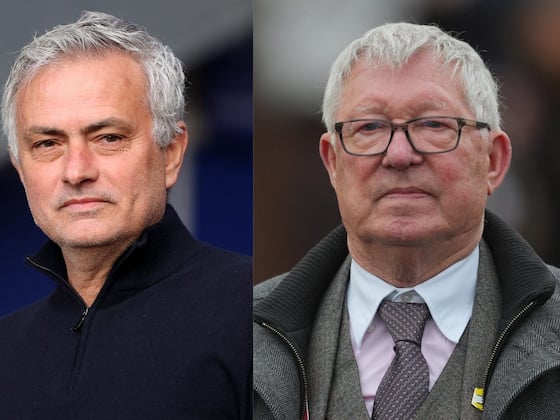
Jose Mourinho has disclosed that he had agreed to succeed Sir Alex Ferguson at Manchester United and had even signed a contract at Old Trafford before ultimately choosing to return to Chelsea.
In a new Netflix documentary on the Portuguese coach, Ferguson also says Mourinho rang him in tears to explain why he could not take over at United in 2013.
Mourinho did go on to join United in 2016, but his two-and-a-half-year tenure ended in dismissal, while United are still yet to win the Premier League since Ferguson left.
But just how different might the Premier League have looked if Mourinho had arrived at United three years earlier?
By 2013, the defining highlights of Mourinho’s managerial career — winning the Champions League with Porto, transforming Chelsea, and securing the Treble with Inter — had already happened, but could he have prolonged that golden period at Manchester United had he replaced Ferguson? That summer, Mourinho was coming off a turbulent and bruising spell at Real Madrid, though it is easy to overlook what he first accomplished at the Bernabeu. In 2011-12, he guided Madrid to a 100-point LaLiga season, with his team scoring 121 goals along the way. With the right players, he could have reached Old Trafford a year later and introduced the sort of football that would have built on Ferguson’s final campaign, when an experienced squad won the title.
Of course, David Moyes was never going to be the right fit at Manchester United — he was effectively doomed from the outset. But the most immediate difference Mourinho might have made, had he arrived in 2013, would have come in United’s first transfer window after Ferguson, a crucial period of transition that they badly mishandled. United were champions in 2011-12, but this was still a squad built around Ferguson-era veterans and it urgently needed refreshing. They had an agreement in place with midfielder Thiago Alcantara, only to pull back from that deal, before Moyes spent the summer desperately attempting to sign Cesc Fabregas. The window then closed with United making a late move for Moyes’s favourite, Marouane Fellaini, from his former club Everton.
Moyes — branded the ‘Chosen One’ — was never the right man to follow Ferguson.
Perhaps Mourinho accepts the opportunity to sign Thiago and also persuades Fabregas to leave Barcelona a year earlier — after all, he did bring the former Arsenal captain to Chelsea in 2014. Suddenly, United would have had the strongest midfield in the Premier League. Could Mourinho have extracted another top-class season from Robin van Persie? Mourinho did not get the best out of Wayne Rooney in their only season together in 2016, by which point the United captain’s powers were fading, but Rooney still scored 17 Premier League goals during Moyes’s ill-fated campaign and would still have had plenty to offer a side challenging for the title. Mourinho actually tried to sign Rooney after taking charge of Chelsea, so he clearly wanted him.
That season’s Premier League title was also there to be won. Manchester City, managed by Manuel Pellegrini and driven by Yaya Toure, Sergio Aguero and David Silva, took it with 86 points, and only after Brendan Rodgers’s Liverpool and Mourinho’s first-season Chelsea both let their chances slip while leading the three-way title race. And if 2013-14 had not been United’s year under Mourinho, then 2014-15 certainly might have been. With the Portuguese already at Old Trafford, Chelsea perhaps do not sign Diego Costa as well as Fabregas, nor have a magnetic manager like Mourinho leading their charge to the title, although they did possess Eden Hazard, who by then was the Premier League’s best player.
Above all, though, the one thing United required after losing Ferguson, the greatest manager of all time, was a personality strong enough to step into the shoes of a legend and drive the club on. Had United made some better calls away from the pitch, then Mourinho — with Ferguson’s backing and still with that spark in his eye — could quite easily have inspired United to at least one more Premier League title in the three years before Pep Guardiola’s arrival at Manchester City in 2016 ushered in a new era.
Mourinho won his third Premier League title with Chelsea in 2015, but could that success have come with United instead?
The strongest case against Mourinho ever thriving at Old Trafford is that he was never truly the right fit for Manchester United. At Porto, Chelsea and Inter, Mourinho was able to impose his personality and shape those clubs in his own image, but that proved far harder at Real Madrid, despite a successful second season in the Spanish capital, and later at United. There is clear evidence, after all, that from 2016 to 2018 the Mourinho-United partnership never fully worked; his extended 895-day stay at the Lowry Hotel was a telling symbol of the disconnect between Mourinho and Manchester, as well as between Mourinho and United’s history and traditions. Sir Bobby Charlton even said in 2012 that Mourinho “pontificates too much for my liking”.
So moving directly from Ferguson’s legendary reign to Mourinho might have been too jarring for everyone — perhaps a little like Brian Clough following Don Revie at Leeds. When it comes to David Moyes, the more sympathetic view is that anyone would have struggled to replace Ferguson — even Mourinho.
Particularly if Mourinho had already begun to lose some of his aura. His 2012-13 season at Real Madrid is often pointed to as the point when modern football started to move beyond him. He lost the dressing room, beginning a bitter feud with captain Iker Casillas that led to the club’s star players turning against him. Mourinho said Madrid’s stars were “spoiled”, but they had also grown tired of his confrontational style and tactics. With Real Madrid’s rivalry with Barcelona at its height and emotions running high, Mourinho left the Bernabeu drained, seeing threats everywhere.
Mourinho’s first spell at Real Madrid hinted at what was to come.
It was also the cycle that came to define the second half of his career: demanding more on arrival, achieving a degree of success in his second season, and then suffering a dramatic collapse in the third. It happened at Real Madrid from 2010 to 2013, at Chelsea from 2013 until their extraordinary implosion as Premier League champions in 2015, and then in his Manchester United spell from 2016 to 2018. Those cycles then became shorter and the peaks lower in his later jobs at Tottenham, Roma and Fenerbahce. Even at United, despite winning the Carabao Cup and Europa League in his first season, Mourinho memorably said that finishing second in 2017-18, his second campaign, was “one of his best achievements”.
Perhaps that was Mourinho acknowledging the difficulty of managing Manchester United in the post-Ferguson era, as well as the way the club have kept going in circles off the pitch ever since David Gill departed alongside Ferguson in 2013. It is a pattern that has also engulfed every other manager to take charge of United since Ferguson stepped down. Mourinho may well have inspired another Premier League title in either 2014 or 2015, but in the end those two patterns would probably have caught up with both Mourinho and United.
-
Arsenal in talks with West Ham over Reiss Nelson move as Mikel Arteta accelerates squad clear-out
-
Araujo set for Liverpool announcement as purchase option details emerge

-
Lewis Hall leaves Newcastle training camp as left-back returns home early amid Manchester United transfer interest
-
Manchester United open talks for Club Brugge option as alternative to Lewis Hall: report
-
The hidden mental toll of being a ‘superwoman’ wife