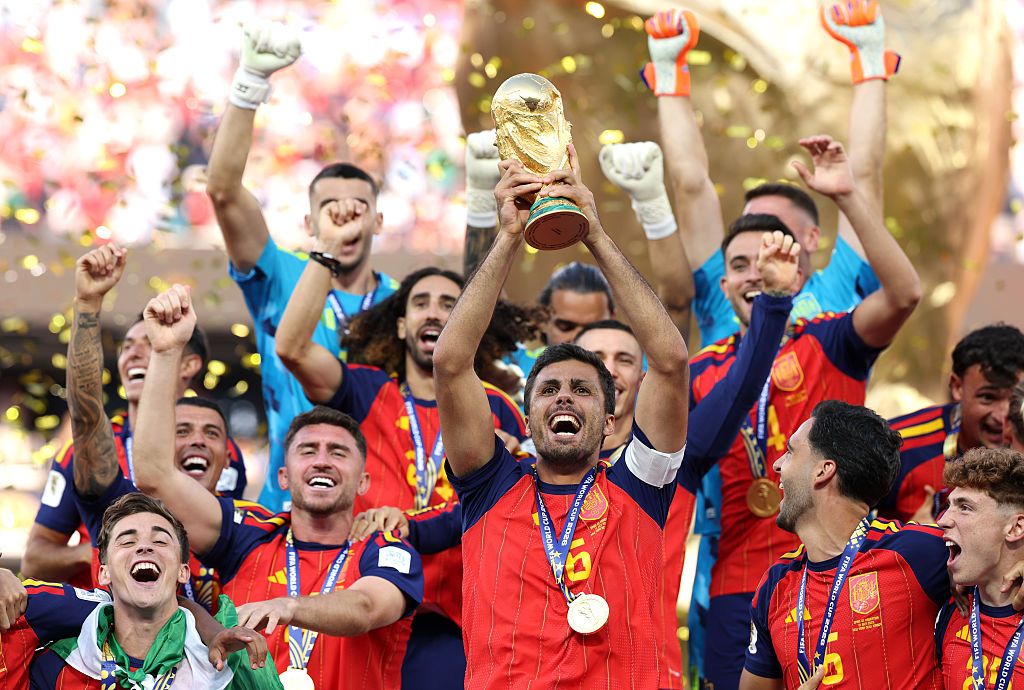
World Cup 2026 had its fair share of unpleasant moments, but the football itself was hugely entertaining - and the Premier League could take a few lessons from it.
There were definitely parts of this summer’s World Cup that plenty of us were happy to leave behind.
Hydration breaks, half-time shows and Argentina’s hatchet men did little to improve the spectacle, unless commercial breaks, the Super Bowl and borderline GBH are your thing.
Yet once you strip away the nonsense, World Cup 2026 delivered a gripping tournament on the pitch - and provided a welcome contrast to a Premier League season that many supporters found hard going. So what can England’s top division take from the Greatest Show on Earth? Here are five World Cup trends we would like to see continue in 2026/27 to make the Premier League fun again.
Everyone knows how costly it has become to watch football, but last season’s Premier League arguably gave supporters the poorest value for money in the competition’s history.
In March, Opta disclosed that the average ball-in-play time was only 55 minutes and 31 seconds per match, or 55.3 per cent, the second-lowest share since it began gathering that data in 2006. At the same time, the average delay before each restart climbed to a new high of 29.2 seconds, although waiting for VAR verdicts contributed to that figure.
That shifted at the World Cup after FIFA - under chief refereeing officer Pierluigi Collina - brought in a number of steps to reduce time-wasting. These included a five-second countdown when a player took too long over a goal-kick or throw-in, a maximum of 10 seconds for substituted players to leave the field, and a rule requiring players to remain off the pitch for at least one minute after treatment, up from 30 seconds.
That helped produce an average ball-in-play time of 59 minutes and 35 seconds, giving fans who had paid eye-wateringly expensive ticket prices a bit more value for their money.
Many of these measures are due to be introduced in the Premier League and the EFL, so if they are properly enforced, they should improve the product.
We have all seen it. Your team is chasing an equaliser and, during a stoppage, the opposition goalkeeper suddenly goes to ground before signalling to the bench for treatment.
While the physio carries out the treatment, players from both sides wander over to the technical area for tactical instructions. Then play restarts, the goalkeeper is somehow back on his feet, the trailing side’s momentum has disappeared and another couple of minutes have been used up.
These tactical time-outs appeared to become more frequent last season, with Leeds United manager Daniel Farke even publicly accusing Manchester City goalkeeper Gianluigi Donnarumma of pretending to be injured in order to "bend the rules" last November.
Football’s lawmakers made some progress on this during the World Cup by instructing referees to stop players from going to the technical area while a goalkeeper was receiving treatment. Now English football has gone a step further.
Under a trial being brought in for the new season, an outfield player must leave the pitch for at least one minute when a goalkeeper requires treatment, reducing the benefit for teams that use the tactic. It is a small rule, but it could have a major impact.
Arguably the standout trend of the 2025/26 Premier League season was the volume of goals scored from set-pieces.
Champions Arsenal were the leading exponents of that craft, scoring 25 goals from set-pieces, excluding penalties, and setting a new single-season record for goals from corners with 19.
It became a familiar image to see nearly all 22 players packed into the penalty area when a corner came in, with bodies toppling like skittles as players fought for position.
This was another issue FIFA tried to address at the World Cup, with referees instructed to clamp down on grappling, pushing and blocking goalkeepers. As a result, penalty areas were noticeably less congested when corners were delivered.
On an anecdotal level, it still seems that attacking players are punished more severely than defenders - Erling Haaland may well have escaped punishment for pushing Elliot Anderson in Norway’s quarter-final loss to England had he been in his own penalty area - but the issue will only disappear if referees keep penalising it.
One of the many enjoyable features of the World Cup was the comeback of the classic long-range screamer.
Altogether, 43 of the 308 goals at the tournament came from outside the box. That works out at 16 per cent, which is double the rate seen at Qatar 2022.
Chelsea midfielder Enzo Fernandez, Sunderland striker Wilson Isidor and Newcastle United forward Anthony Elanga were among the players to score from distance during the tournament, so do not be surprised if they have a few attempts in the opening weeks of the season.
The proportion of Premier League goals scored from outside the area has been declining for years, dropping from 22.3 per cent in 2006/07 to just over 13 per cent last season, although that was a slight rise on the campaign before. Let us hope this marks the beginning of a revival in screamers.
It would not be right to finish a FourFourTwo article without mentioning the formation that gave the publication its name.
4-4-2 was used extensively in the 1990s and early 2000s, but over the last two decades it has slipped out of fashion.
However, the system is gradually becoming popular again, a pattern that continued at the World Cup - and that is good news.
Brazil and Morocco were among several teams that lined up in a 4-4-2 shape out of possession, sitting in a mid-block rather than defending deep or pressing high. That created larger gaps between the lines, leaving more room for attacking teams to exploit and producing matches that were more open than many in last season’s Premier League.
That was one reason behind the rise in goals at this World Cup, where the average of 2.96 per game was the highest since Mexico 1970, which recorded 2.97.
We all enjoy a touch of nostalgia, so that alone is enough to make 4-4-2 appealing again, but if it also makes matches more exciting, then it is easy to get behind.
-
Placing a money plant in the wrong direction will have the opposite effect! Know the correct rules of Vastu to prevent extreme misfortune

-
Placing a money plant in the wrong direction will have the opposite effect! Know the correct rules of Vastu to prevent extreme misfortune

-
Which City Is Known As The Kachori Capital Of India?

-
Trisha Krishnan wears a sheet mask on a flight. Learn how safe it is to wear on an airplane and what precautions to take.

-
Why are bael leaves offered to Lord Shiva during the month of Sawan? This is why Mahadev loves this leaf.