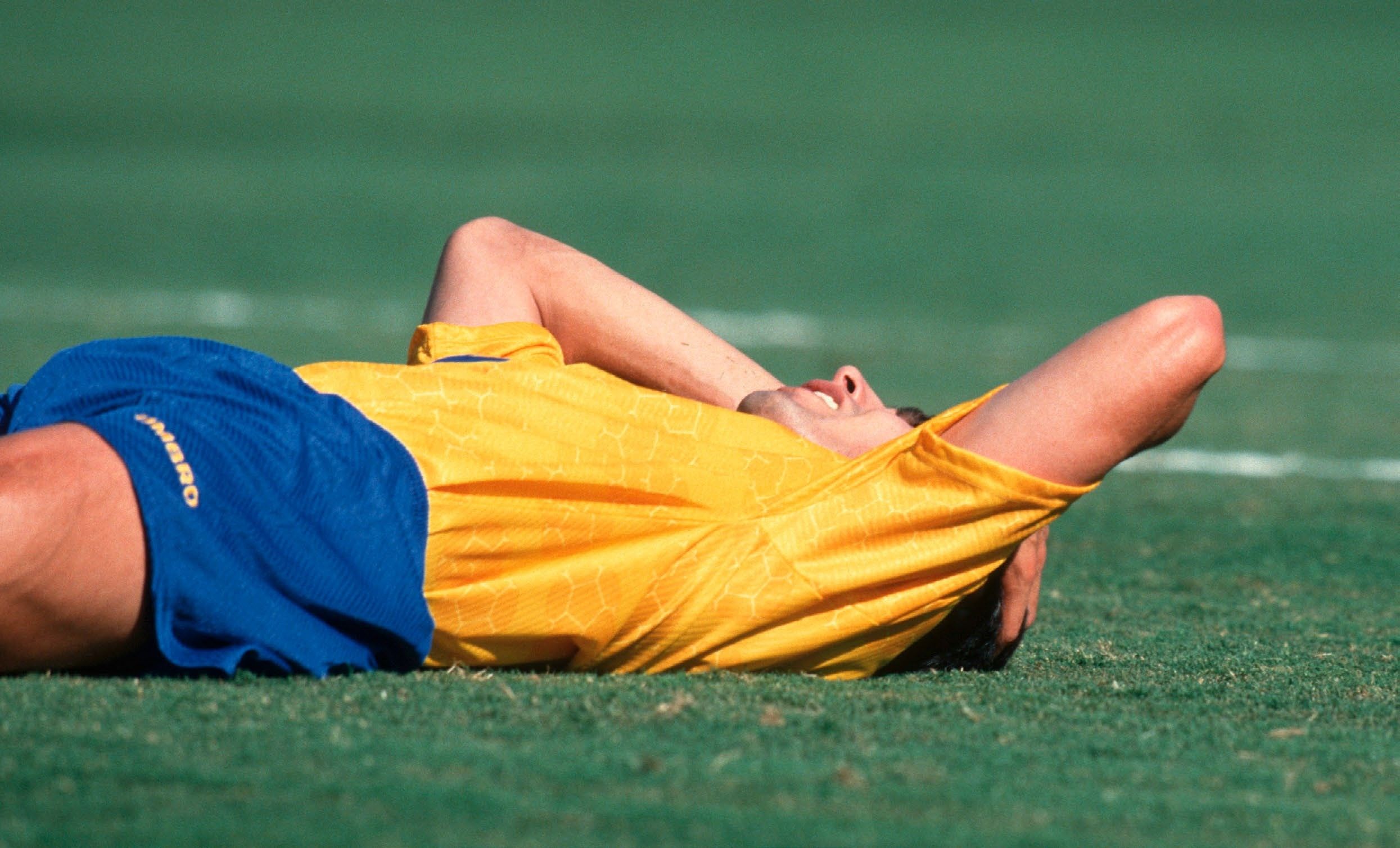
A week after his own goal at USA 94, Andres Escobar was murdered. Ten years on, Sjef van Hoof travelled to the scene of the crime to meet the people whose lives were affected by his death.
June 22, 1994. A crowd of 93,689 watched Colombia face World Cup hosts USA in their second group match of the tournament, inside the vast Rose Bowl in Los Angeles. Colombia had come through qualifying unbeaten, capped by a remarkable 5-0 victory over Argentina in Buenos Aires, and their supporters had begun to dream of a world title. But a 3-1 loss to Romania had already dealt a major blow to their hopes of reaching the second round. The pressure was immense.
Colombia started brightly, with Carlos Valderrama controlling the tempo while Faustino Asprilla and Freddy Rincon hunted for the goals that could revive their campaign. Then, after 35 minutes, USA's John Harkes sent in a cross towards striker Ernie Stewart. Trying to intercept, 26-year-old centre-back Andres Escobar could only turn the ball beyond a stunned Oscar Cordoba and into his own net for a crushing own goal.
Early in the second half, Stewart scored again, and although Adolfo Valencia pulled one back in the final minute, the Americans won 2-1. Four days later, Colombia beat Switzerland 2-0, but by then it was too late. Their World Cup journey was over.
Fearing a hostile reaction on their return, many of the squad remained in the USA for a holiday. Escobar's family urged him to spend some time in Las Vegas or Disneyland, but he insisted on flying back to Bogota with manager Francisco Maturana and assistant Hernan Dario Gomez so that he could face the Colombian public.
Matters deteriorated further during a press conference at El Dorado airport in the capital. As reporters gathered around them like vultures around a fresh carcass, Gomez leaned towards Maturana and whispered: “Look around this room, soon I will take some of these sons of bitches.” What Gomez did not realise was that his microphone was already live. The whole Colombian press corps heard the remark, and the next day's newspapers took revenge by savaging the coach and his team without mercy.
Seven days after the lowest point of his football career, Escobar returned to Medellin trying to focus on what lay ahead. He wanted to fix a wedding date with his fiancee Pamela, and there was also the matter of signing for Italian giants Milan, who had been impressed by his elegant performances for Colombia and Atletico Nacional.
“When we heard Andres had been killed, everyone kept silent for the whole morning”
On the evening of Friday, July 1, he visited the home of his friend Juan Galeano and persuaded him to go out. Pamela preferred to rest, so Escobar and Galeano met at the Palmitas restaurant before heading to the Padua disco, where they drank the popular Colombian spirit aguardiente with two other friends, Eduardo Rojo and Rojo's wife.
The night passed peacefully until around midnight, when a group of men began mocking Escobar. “You scored a beautiful own goal,” one shouted, before the others joined in with: “Own goal, own goal!” Another asked: “How much did they pay you to score?” Escobar responded only weakly to the taunts aimed at him.
At 1.30am, Rojo and his wife left the disco, but Escobar and Galeano stayed on, finally settling their bill at about 3am. Although both had been drinking, each went in search of his car so they could drive into the city centre for a hot dog.
As he walked towards his grey Honda Civic on the far side of the car park, Escobar encountered the same group who had mocked him earlier. Among them were the notorious Gallon brothers, known to local police as Medellin mafiosi.
Again the abuse continued: “Own goal, own goal, own goal!” This time Escobar reacted, swearing at those tormenting him and refusing to move his car so that the brothers could get their Toyota Land Cruiser out.
Some in the group tried to calm the situation. “It's OK, you're a good guy, let's go home now,” they told him. But Escobar would not leave. Eventually, he reached his vehicle and got into the driver's seat.
Having lost their opening match, Escobar's own goal against the USA had left Colombia in grave danger; his death stunned the football world; Humberto Munoz Castro was later sentenced to decades in prison; and huge crowds lined the streets as the funeral procession passed.
“Perhaps you don't know who you're dealing with,” he said. One of the brothers, Juan Santiago, quickly answered back. “Do not look for trouble with my brother, dumbo, son of a bitch,” he said. The argument woke the brothers' bodyguard, Humberto Munoz Castro. Believing his bosses were in danger,
Castro stepped out of the Land Cruiser and moved towards the car. He bent down to the side window, shouted, drew his gun and fired six times at point-blank range. One bullet pierced the footballer's heart. In the immediate aftermath, police examined two possible explanations.
The first was that the shooting had been carried out by gamblers enraged that Escobar's own goal had cost them large amounts of money they had staked on Colombia.
The second was that it was simply one of the many “daily incidents” in crime-ridden Medellin — on that same night alone, another 36 murders were recorded in the city. The first theory spread rapidly around the world, but the second appeared more plausible. There was no serious evidence to suggest it had been a contract hit. In 1994, the country was estimated to have around 3,000 sicarios — men who would kill on request in the same way others deliver pizzas.
“After his death, I quit professional football for five years. I couldn't take the hypocrisy”
For the Gallon brothers, it would have been easy to hire a sicario to do the job on a stolen motorbike and remove any direct link to themselves. Yet as Escobar's body was taken to the Coliseo Ivan de Bedout indoor arena so that thousands could pay their respects, the players and coaches of the Colombia national team were placed under round-the-clock police protection.
They were also barred from attending Escobar's funeral out of fear that more violence might be directed at them. More than 120,000 people accompanied Escobar's coffin to the Campos de Paz cemetery. A year later, Castro was sentenced to 43 years and three months in prison for manslaughter. The Gallon brothers each received 15-month jail terms for incitement.
From his cell in Itagui prison, Castro continued to insist that he did not know who he had shot.
Almost 10 years later, FFT were in Colombia when a chant rang around Atanasio Girardot stadium during the city derby between Independiente Medellin and Atletico Nacional.
“Andres Escobar, you went away but keep alive in my heart,” the crowd sang. Amid tropical rhythms and the harsher sounds of football chanting, the singing of Escobar's name had something of a church service about it. Off to the left, behind one goal, a banner was raised carrying the message: “Andres Escobar is still alive.”
All around the stadium, Escobar's image was as ever-present as it had been in 1994, when he was still wearing the Atletico Nacional shirt. His face looked out from photographs printed on green Nacional jerseys, while street sellers offered badges, CDs and sun hats bearing his portrait. Nacional supporter Elisa Tamayo wore a badge of Escobar pinned to her green top every time she attended a match. She had been only seven when he died. “I was having breakfast with my parents and my little sister when we heard on the radio that Andres had been killed,” she told FFT. “Everyone kept silent for the whole morning. Then, in the evening, my father agreed to let me go with him to pay tribute to Escobar at the Coliseo Ivan de Bedout. The grieving crowds left a deep mark on me. I still get goosebumps when we sing his name before matches.”
It was in Medellin, the city of his birth, that Escobar built his reputation. Between 1987 and 1994 — apart from a brief spell with Swiss club Young Boys — he anchored the heart of Nacional's defence and was one of the central figures in a team still remembered as the most successful in Colombian football history. In 1989, Nacional won the Copa Libertadores, becoming the first club from the northern Andes nations — Colombia, Venezuela, Peru and Ecuador — to be crowned champions of South America. By the tragic summer of 1994, Escobar, along with Asprilla and Valderrama, formed the backbone of the national side.
As a footballer, Escobar was nicknamed ‘Calidad (Quality) Escobar' because of his fairness and sportsmanship. “Andres was a very intelligent player with a good overview of the pitch,” said Victor Marulanda, once his defensive partner at Nacional. “He proved that a Colombian player can be intelligent instead of a dumbo. For us, he was irreplaceable. For five years, we played without a number two because nobody wanted to wear his shirt. Only when Ivan Cordoba was performing exceptionally well did we ask him to take that number.”
Years after his death, the club and the city council put up a sculpture of Escobar near the stadium. A few hours after Nacional's 2-1 victory over Independiente, the club's new assistant coach took training for those who had not played.
That assistant was Santiago Escobar, Andres's elder brother. He had promised to speak to FFT after the session, but as soon as training ended he skipped the usual shower, got into his car and drove off. Lina Gomez, who lived in Calasanz in southern Medellin, where the Escobar family had grown up, understood why he wanted to avoid talking about his brother. “The family had to go through many difficulties after what happened,” she told us.
“Even in the cemetery, Andres could not rest. His grave became a place of pilgrimage for Nacional supporters. That is why they moved his relics to the parish church in Calasanz. He has a small block in a wall in the crypt.” Gomez had known the Escobars from games in the schoolyard. “Andres was shy and was usually looked after by Santiago, who was the first to play for Atletico Nacional,” she said.
“But Andres followed him a few years later. We were so proud of them in Calasanz. When he reached the first team, I began going to all of Nacional's home matches. I simply could not believe the news that he had been shot. It only started to feel real when I saw the funeral procession pass through our neighbourhood, and then I became very angry. The bad people in Medellin ruin everything for the good people. Why a committed, intelligent player like Andres? If Rene Higuita were shot tomorrow, it would not surprise me, he mixes with the wrong people. But Andres Escobar? Since his death, I have never gone back to the stadium. I have no interest in going any more.”
She showed us a stack of newspaper clippings. On top was a piece headlined ‘Nacional, futbol y Gloria', from a special edition of El Colombiano devoted to Nacional's Copa Libertadores triumph. As she spread the other cuttings across the kitchen table, they formed a collage of grief. “Antioquia bursts out crying,” read one, referring to the region around Medellin. “Unforgivable,” said another. “I cannot throw them away, but it will be good if you take them,” she said. “They are of more use to you now.”
“He was the best defender we ever had,” local resident Edison Gallego told us. “But they just got him.” “You must be a journalist,” waiter Oscar Salcedo said with a smile when we visited the El India restaurant, next to the car park where Escobar was shot. “Journalists come from everywhere to visit this place — Japan, the USA, Africa. After the shooting, I placed a small memorial stone in the car park so people would have somewhere to leave flowers. But when they built a petrol pump, it was removed.”
After Escobar was killed, Gonzalo Medina, a professor at the University of Antioquia, had just completed a book about football in Medellin.
Quickly — some said cynically — he changed the title to Una Gambeta a la Muerte (A Challenge of the Death) and dedicated it to Escobar. Medina had his own theory about why the killing of Escobar had such a profound effect on the people of Medellin.
“Escobar was an Antioquian, and a descendant of Spanish immigrants — we Antioquians see ourselves as the pioneers of the Colombian nation,” he explained. “The Antioquian is a hard-working entrepreneur and a good Catholic, someone who wants to achieve something and improve his family's future.
“Andres Escobar was an example of those traditional Antioquian values and virtues. The other famous Escobar, the drug lord Pablo, represented the other Antioquia — people driven by ruthless self-enrichment and by the use of violence to achieve their aims.
“Antioquians are people of enormous contrasts. Nowhere else in South America will you find as many Catholic priests per head, but nowhere will you find as many witches either. The killing of Andres showed us more clearly than ever that the Antioquia we love so much is made up of two worlds living back to back. But the bad world oppresses the good one, and we were forced to confront that.”
“How did you get this number?” a surprised Santiago Escobar asked when FFT called him. “All right,” he finally said, “come to our hotel on Saturday and we will have time for a brief chat.” Two weeks later, we finally spoke to him. “After Andres died, I left professional football for more than five years,” he told us. “I could not bear the hypocrisy any more; I was angry and disappointed. I only played football with children. That was my therapy. Along with my family, I set up a football school for children from poor areas of Medellin.
“I named it after Andres and companies from Medellin supported it. But after a short while, the sponsors' interest faded and we handed the school over to the parish of Santa Domingo. As the years passed, friends and family kept urging me to return to football, so in 1999 I became assistant coach at a Second Division side, and that was where I finally lost my antipathy towards the professional game. Andres was a victim of football, but it was also his passion. The same is true for me. Now that I am back, I hope to become coach of Atletico Nacional.”
Over the 20 years that followed that conversation, Santiago fulfilled that ambition. He had two spells in charge of the club where Andres made his name, leading them to two Apertura titles in the Colombian league, and he also managed 13 other clubs across South America, including Independiente Medellin. When we spoke to him a decade after his younger brother's murder, the tragedy still hung over Santiago like a dark cloud, but time had also brought a measure of consolation.
“Andres's death still makes me sad, but I am proud as well,” he said. “Proud because there are people here in Medellin who never knew him when he was alive, yet they still shout his name in the stadiums and are inspired by the example he set as a sportsman. Every year, on the anniversary of his death, our family receives condolences from all over the world. It is strange — it makes me sad and happy at the same time.”
This feature first appeared in the August 2004 issue of FourFourTwo magazine
-
Top 10 | ABP LIVE Morning Bulletin: Top News Headlines from 3 August 2026 to Start Your Day - Morning

-
Bayern Munich keep long-term interest in Manchester United’s Benjamin Sesko
-
Tim Krul opens up on Newcastle United exit: ‘Rafa Benitez wanted a different goalkeeper and I had to leave through the back door’
-
IIM Indore Study: Rural YouTubers Are Building Thriving Digital Businesses Through Local Content

-
Commonwealth Games 2026: India concludes campaign with 39 medals