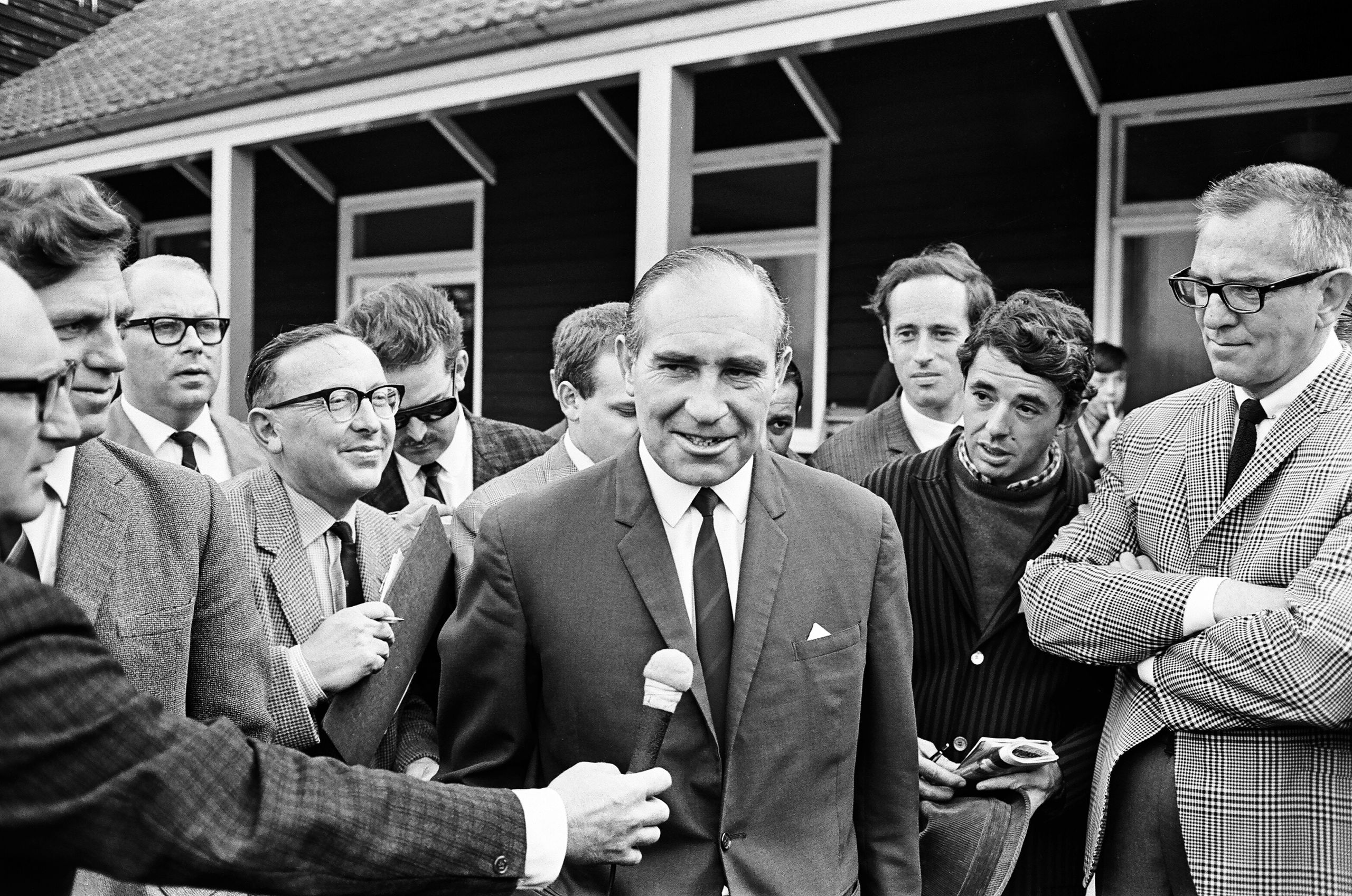
Sixty years ago today, he guided England to the World Cup, yet Sir Alf Ramsey remains one of the most misunderstood figures in the game. Despite the image of a middle-class establishment man, the Three Lions manager came through racism, hardship and war before becoming a national legend.
Queen Elizabeth II’s New Year Honours list was published on the first day of 1967. It featured only two men who had helped take England to World Cup glory six months earlier. Bobby Charlton had to wait until 1969 and Geoff Hurst until 1979, but Three Lions captain Bobby Moore received an OBE, while the mastermind behind it all, manager Alf Ramsey, was awarded a knighthood. When the England boss collected the honour at Buckingham Palace, the public response was overwhelmingly warm, but Ramsey himself remained so reserved and difficult to read that newspapers labelled him ‘The Silent Knight’. Apart from his wife and mother, many people found Ramsey distant and aloof, and he had very few close friends. That natural reserve had hardened during 11 years wrestling with what was often called ‘the impossible job’ as England manager from 1963 to 1974. So what lay behind the life and success of this enigmatic figure?
With West Ham’s trio of Moore, Hurst and Martin Peters all having played decisive parts in England’s victory over West Germany, it is fitting that Ramsey’s own story began in east London — in Becontree Heath, where he was born in January 1920. Today the area falls within the borough of Barking and Dagenham, but at the time it was very different. Ramsey was not, as is often wrongly believed, an East End Londoner. He was a country boy whose parents and grandparents lived and worked in rural South Essex.
Soon after his birth, that landscape of cottages, small farms and market gardens was transformed by 15 years of relentless building work, with more than 25,000 new houses added and places such as Barking and Dagenham effectively absorbed into London. That change mattered in Ramsey’s life because, on that vast new estate, he came to be marked out as ‘other’. The first barrier he encountered may seem startling to those used to seeing images of him in the 1960s. On television, he appeared a white, middle-aged, middle-class man. But as a child he was subjected to a racist nickname tied to his darker skin tone, and was referred to thereafter as ‘D****e’. Ramsey never used that nickname for himself and never acknowledged it publicly, which strongly suggests it felt as vile to him then as it is regarded now. Even so, that did not stop Jimmy Greaves, a member of England’s 1966 squad, from mentioning it openly while Ramsey was still alive in his 1993 book. Ramsey’s childhood nickname had already appeared in a national newspaper in 1952, when he was still a leading England player, and it was also mentioned on television in 1969. From the late 1940s to the 1980s, it was also widely known — though often only in whispers — among footballers and journalists.
The reason the nickname stuck was linked to a second form of prejudice. Throughout his football life, there were strong rumours that Ramsey came from a GRT (Gypsy, Roma, Traveller) family. During his lifetime, the nickname was frequently used to demean, insult and label GRT people, just as it was used against people from other ethnic minorities. Greaves referred both to Ramsey’s nickname and to the rumoured background. Bobby Moore even once alluded to the rumour in public.
One prominent sports journalist recalled travelling through Central Europe on a team bus in 1973 with Ramsey, England’s players and the country’s leading football reporters. As the bus slowed to pass a convoy of Romani Gypsy caravans, Moore called out: “Alf, there’s some of your relatives over there.” The journalist wrote that Ramsey went “crimson with fury”, adding that “it was always accepted in the football world that Alf was a Gypsy”. Details like these challenge the long-established idea that England’s 1966 World Cup triumph was uniformly ‘white’. Certainly, the squad largely came from urban, industrial working-class communities, in the years before the children of Windrush-generation migrants had reached the top level of English football. Yet the 1966 side was managed by a man who had, since childhood, been burdened with a nickname reflecting his darker skin tone and whose family were harmfully rumoured to be Gypsies. In 1978, the multicultural strands of English football became publicly and proudly visible when Viv Anderson became England’s first black senior international. But Ramsey had won his own first cap in 1948, three decades earlier, and played 32 times for the Three Lions, including at right-back in the infamous defeat to the USA at the 1950 World Cup. As England manager, he also handed senior caps to Paul Reaney, a player now often described as being of biracial background.
Racially charged nicknames were only one of the obstacles Ramsey had to overcome on his way to greatness. He grew up in financially strained circumstances, at times close to poverty, and his family tree included many traders in hay, straw and other agricultural produce.
His father, grandfather, and many great-uncles and cousins were shrewd businesspeople whose work was precarious and involved travelling all over south Essex and east London using horses, carts and wagons. At the same time, his mother and other female relatives were resilient and frugal, both in paid employment and in the unpaid work of keeping family life together.
No wonder Ramsey drove his players so hard, something perfectly illustrated by the way he handled Gordon Banks, England’s goalkeeper in 1966. Banks was famous for his work ethic and tireless approach in training, but on only his second England appearance in 1963, he let in a goal from a long-range Brazilian free-kick. Because Ramsey had specifically coached against exactly that situation, he calmly but ruthlessly dissected Banks’s mistake after the match.
The message to the goalkeeper and to the team-mates listening was crystal clear: nothing short of total effort, complete concentration and absolute ambition would ever be enough.
In September 1962, during a carefully stage-managed newspaper interview, Ramsey declared that with home advantage in 1966, England could, and perhaps should, win the World Cup. Such a bold statement seemed entirely at odds with his usual caution, and at that point he had not even been interviewed for the manager’s job, which had become vacant after Walter Winterbottom resigned following defeat to Brazil at that summer’s World Cup in Chile.
But calculating odds, through dog racing, was part of Ramsey’s family DNA. In the early 1950s, the family’s tiny cottage was listed as the registered address for racing greyhounds owned by Ramsey, his parents and two siblings.
In 1949, Ramsey moved back home at the age of 29 after his transfer from Southampton to Spurs, where he played a major part in helping the club win promotion in his first season and then, remarkably, become champions of England for the first time in the following campaign.
Back home, his elder brother Albert trained and raced many dogs. Alf was known among his team-mates as an excellent greyhound gambler. In fact, his appointment in 1955 as manager of Third Division South club Ipswich Town came about after the owner of the Ipswich greyhound stadium heard, through the dog-racing grapevine, that Ramsey would be available when his spell at Spurs ended, by which time he had become club captain.
Ramsey took charge at Ipswich at the age of 35, and in just seven years he led the club to the Third Division South, Second Division and then First Division titles. As in his playing days at Spurs, the latter two league titles came in successive seasons. Within months, he would be confirmed as England’s new manager.
Just as with greyhounds, when Ramsey put together his squad for 1966 he knew how to back a long shot. Leeds defender Jack Charlton, for instance, was an unglamorous and uncompromising centre-half — the brother of the world-famous Bobby Charlton, but almost 30 when Ramsey first gave him an England cap against Scotland in April 1965. How many players of that age have gone from an international debut to winning the World Cup only 15 months later? The manager’s willingness to trust the defender reflected another truth: Ramsey himself had developed unusually late as a player. Between the ages of 14 and 16, he played no football at all. From 16 to 20, Saturday work in shops meant Sunday football was his only serious route. Officially, however, Sunday football remained banned by the FA until 1960.
As if that were not obstacle enough, Ramsey entered six years of military service in 1940 at the age of 20. The British Army helped develop him both as a footballer and as a leader, and from 1943 he played a handful of wartime matches for Southampton. But Ramsey was nearly 27 before he appeared in his first full professional game in a competitive peacetime league. His England debut came at 28, just one year younger than Jack Charlton was when he first played for the national side.
The British Army shaped him as both a footballer and a leader, and from 1943 he played several wartime games for Southampton. It was not until Ramsey was almost 27 that he played his first full professional match in a competitive peacetime league.
Another key figure in the 1966 run whose story was forged from similar toughness was Nobby Stiles. The Manchester United midfielder was one of the first professional footballers to wear contact lenses, but poor eyesight was not to blame for his savage challenge on France’s Jacques Simon in England’s final group match at the World Cup.
Stiles was not booked, but the controversy caused by that tackle, and Ramsey’s reaction to it, revealed more of the manager’s deeply rooted qualities — he demanded loyalty and rewarded it, while stubbornly refusing to be cowed either by FA hangers-on or by loud voices in the press.
Stiles’s brilliance in defensive midfield, and his ability to judge and deliver flawless, apparently simple passes, allowed Ramsey to create balance and connection between two of England’s truly world-class footballers — Moore at the back and Bobby Charlton further forward. Yet after Stiles’s challenge, influential figures within both the FA and the media wanted him dropped.
Ramsey’s response was simply to ask his player: “Was that tackle accidental or deliberate?” When Stiles, predictably, insisted it had been mistimed rather than malicious, Ramsey continued to select him.
In the sterner examinations that followed — against a combative Argentina in the quarter-final and the flair of Portugal in the semi-final — Stiles’s impeccably disciplined displays were central to England’s progress.
Where did Ramsey first learn that strong leadership is built on trust? In his six years in the army, where he rose from private to company quartermaster sergeant. That military experience made him clear-headed and unyielding.
Across their international careers, he disciplined eight members of England’s starting line-up from the 1966 final. Anyone who had to be told the same coaching point more than twice, or who repeatedly broke Ramsey’s strict code — early bedtimes, shared leisure periods, limited alcohol and a smart appearance — simply was not picked again.
England’s 1966 squad gathered at Lilleshall in early June for intense pre-tournament training. On the opening evening, Bobby Charlton later recalled that Alan Ball, who had only just turned 21, “slipped out for a pint” with Stiles. When Ramsey discovered them, Charlton said: “Alf simmered for a moment, then rasped, ‘All of you, get out of my sight.’”
Ramsey’s anger can also be understood through another detail Charlton noticed — the date itself. “We reported for duty – a phrase that I do not use lightly – on June 6, which was the 22nd anniversary of the D-Day landings in Normandy,” the Manchester United star explained. “Our lives were not at risk, but Alf made it abundantly clear that our reputation for competitive honour and patriotism was.”
On that date in 1944, Ramsey, then 24 — the same age Stiles and Hurst were in 1966 — was helping prepare hundreds of fellow soldiers to land on French beaches and crawl into a storm of bullets. He knew many of them would be killed or maimed.
To modern eyes, much of Ramsey’s story can seem old-fashioned and, given that he lived from 1920 to 1999, he was undeniably a man of the 20th century. His conservative style of dress — suit, shirt and tie — along with his attempted but unconvincing ‘BBC English’ accent, reinforced the image of someone fusty and emotionally repressed.
And yet his origins were anything but conventional. How many football careers have been rescued from obscurity by four years of ‘illegal’ Sunday football in adolescence, sustained through six years in the army, then gone on to include more than 30 international caps as a player before ending with lifting the World Cup as a manager?
Ramsey’s conservative suit, shirt and tie, together with his attempted but inauthentic ‘BBC English’ speaking voice, only strengthened that fusty, repressed image.
The real Ramsey was a classic English underdog from a diverse background. His childhood was shaped by inter-war poverty, his early adult years by post-war austerity, and his managerial career unfolded within an English class system that pushed him to conceal his roots rather than celebrate them in the way footballers might today.
In important ways, Ramsey was also a modernising reformer rather than an obedient servant of the establishment. As England manager, he ended the absurdity of an FA committee of elderly men choosing the team. In fact, he refused to accept the job unless he was given complete control over selection.
He also trialled bold tactical ideas, using the youthful energy and open-minded football intelligence of Alan Ball and Martin Peters in roles midfielders had not really played before. The two would shift between attack and defence, and between central and wide areas, not according to rigid pre-match positions but according to the flow of the game.
Ramsey startled many by selecting no wingers during the decisive knockout rounds of the World Cup. Instead, he relied on Ball and Peters, along with full-backs George Cohen and Ray Wilson, to provide enough varied attacking width to unsettle opponents.
In such a system, it was also vital that attackers such as Bobby Charlton, Roger Hunt, Jimmy Greaves or Geoff Hurst obeyed instructions, understood the wider strategy and thought defensively when required. That was why Ramsey chose Hurst ahead of Greaves — a call condemned by many journalists but ultimately vindicated when the West Ham forward scored a hat-trick in the final.
Tactical innovation was not the only unexpected side to Ramsey. While winning the league as a player with Tottenham, he also devoted himself to coaching adult amateur teams twice a week at the Eton Manor Boys Club.
In 1955, when he was beginning his managerial career at club level, homosexuality was both viciously persecuted and aggressively prosecuted. Yet over the following 18 months, Ramsey’s management helped save the career of a young player threatened by both.
That player had been pressured in court to admit to what was then an illegal homosexual act, but Ramsey judged the footballer not by the court case, but by his ability on the pitch and his character away from it.
Sir Alf Ramsey was not only a football genius; he was a hero in his own era and deserves to remain one in ours. Sixty years after his greatest triumph, the achievements of the Silent Knight still endure.
-
Massive Fire Breaks Out at Footwear Factory in Kozhikode, Kerala

-
Friendship Day Brunch at Sheraton Grand Bangalore Hotel at Brigade Gateway, Where Great Food Meets Great Company

-
PM Surya Ghar Scheme: Over 18 lakh families receive 'zero' electricity bills; find out who is eligible and how to avail the benefits..

-
Tragic Loss: Young Cricketer Aditi Chaukhand's Untimely Death

-
Clarification on Indian Passport Eligibility and Citizenship Proof