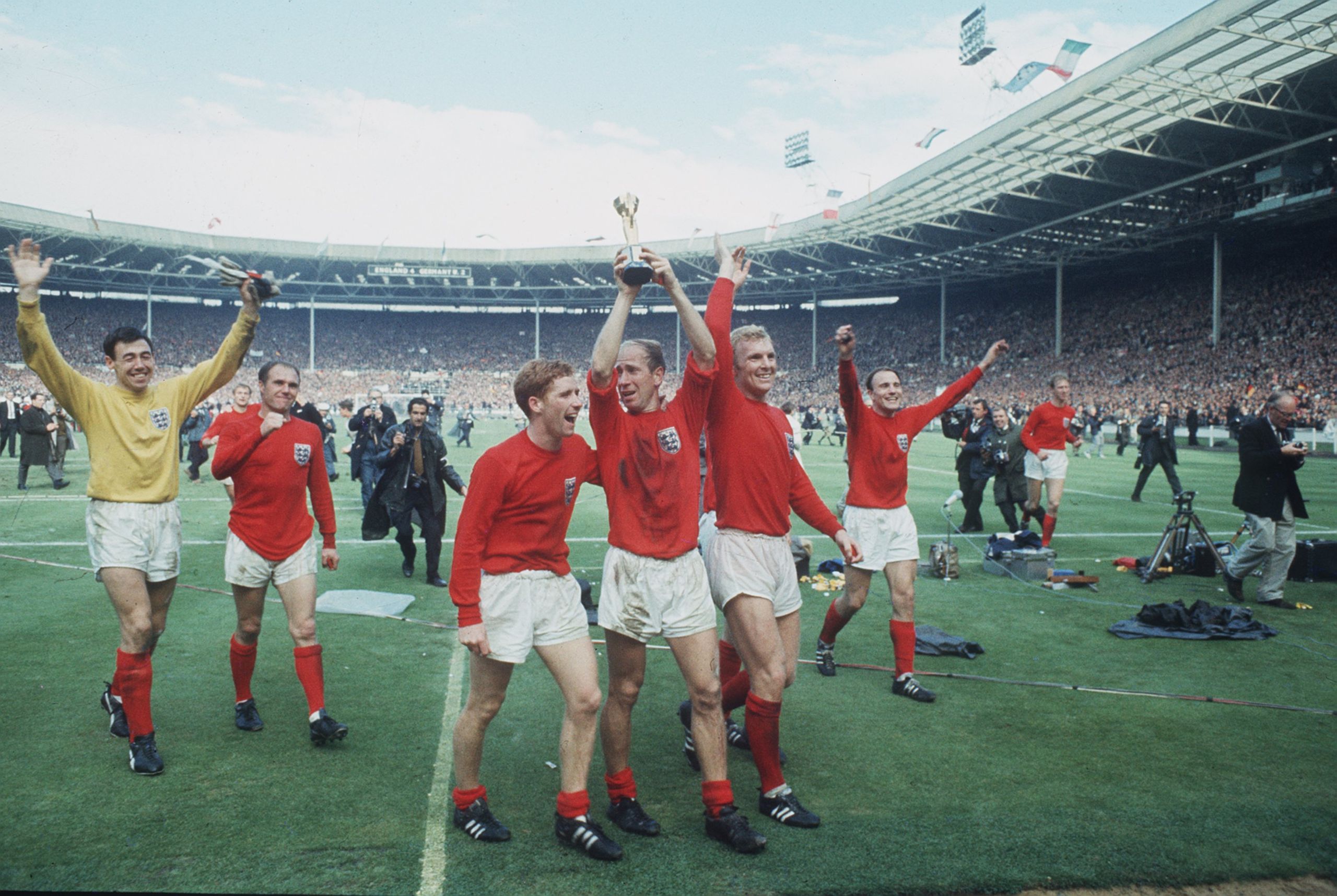
It is a team etched into football memory, but was it always meant to take shape that way? Sixty years after that triumph at Wembley, Paul Simpson looks at how chance played a major part in shaping Sir Alf Ramsey’s legends of 1966.
Banks, Cohen, Wilson, Charlton, Moore, Stiles, Ball, Charlton, Peters, Hurst and Hunt remains one of the most celebrated line-ups in English football history. Yet the route by which Sir Alf Ramsey assembled the side that defeated West Germany 4-2 on July 30, 1966 at Wembley was anything but simple. England’s scorers in that final – Geoff Hurst and Martin Peters – did not even make their international debuts until 1966.
To grasp how dramatically matters changed, look at the first team Ramsey picked as England manager: the side beaten 5-2 by France in a European Championship qualifier in Paris on February 27, 1963. That XI is far less familiar: Ron Springett, Jimmy Armfield, Ron Henry, Bobby Moore, Brian Labone, Ron Flowers, John Connelly, Bobby Tambling, Bobby Smith, Jimmy Greaves and Bobby Charlton.
Seven of those players went on to be part of the 1966 squad: Springett, Armfield, Moore, Flowers, Connelly, Greaves and Charlton. It would have been eight, but centre-half Labone pulled out to concentrate on his forthcoming wedding. Even so, only Moore and Charlton played in the final.
Ramsey unquestionably examined every possible option. From that disastrous first game to the final friendly before the World Cup, he used 50 players. And the XI that entered history had appeared together in only three matches – the quarter-final, semi-final and final.
The first member of that side to establish himself as indispensable was Bobby Charlton, the finest English footballer of his generation. With his speed, instant control and precise passing, Charlton could alter a match in an instant, and he had already scored 25 goals for England before Ramsey arrived.
Moore, meanwhile, was a born leader; a calm, ball-playing centre-half of such quality that it is difficult to imagine Ramsey leaving him out. Yet Jimmy Greaves – in what remains a minority opinion – believed the West Ham captain was not much superior to Wolves stalwart Ron Flowers, whose sequence of 40 consecutive England appearances ended in April 1963. It is entirely possible that, had it not been for the Munich disaster, the wonderfully versatile Duncan Edwards would have captained England in 1966 rather than Moore.
The relationship between Moore and Ramsey was a complicated one, resembling in part that of a disapproving father and an errant son. Moore had infuriated Ramsey by breaking curfew during a 1964 tour of America.
The relationship between Moore and Ramsey was complex, resembling, in part, that between a disapproving father and a wayward son. Moore had angered Ramsey by breaking a curfew on a 1964 tour of America. As the World Cup approached, his place was further threatened by his failure to agree a new contract with West Ham. As a gentle reminder that even the greatest could be dispensed with, Ramsey used Norman Hunter at centre-half in three friendlies in 1966. He was not merely resting Moore for the finals, despite what he smilingly told Brian Glanville.
Ramsey began reshaping the side in only his second match in charge, a 2-1 defeat to Scotland in April 1963, when he replaced Springett with Gordon Banks, the outstanding goalkeeper in a Leicester team that came close to winning the league in 1962/63. Banks could not be faulted for either Scotland goal and prevented at least two more. Ramsey did look at other keepers – notably Blackpool’s Tony Waiters and Chelsea’s Peter Bonetti – but Banks became his first choice.
Conceding five goals was hardly the way Ramsey wanted to launch his reign. As England left the pitch, he asked captain Jimmy Armfield: “Do we always defend like that?” The expected changes in defence began in May 1963, when Ray Wilson played at left-back in a 1-1 draw with Brazil.
A fiercely competitive full-back who was comfortable on the ball, Wilson was warned by Ramsey not to get above himself. “You’ll play exactly how I want you to play,” said the Dagenham-born manager. The only real danger to Wilson’s place was injury – he tore his groin muscles off the bone in 1964 and did not return until the spring of 1965.
Another injury – this time to Jimmy Armfield’s knee – opened the door for Fulham right-back George Cohen. He made his England debut in that position in a 2-1 win over Uruguay in May 1964 and, as he modestly described it, had a “steady game; nothing heroic”, while doing exactly what Ramsey required. In time, Cohen’s pace and stamina would become a weapon at both ends of the pitch.
Telling Jack Charlton he was “quite good”, Sir Alf said: “And I know you won’t trust Bobby Moore.” Seeing Charlton’s confusion, Ramsey explained that, when Moore surged forward, he had to cover the space left behind.
Yet another injury upset Ramsey’s plans in central defence. Maurice Norman, who played in 17 of England’s 20 matches between April 1963 and December 1964, would have been in the 1966 squad but suffered a leg break in five places while playing a friendly for Spurs in 1965 and never returned to competitive football.
Fortunately for Ramsey, he had already turned his attention to Jack Charlton, and gave him a typically direct pep talk: “I don’t always pick the best players, you know. I have a system, and I look for players to fit that pattern.”
Telling Charlton he was “quite good”, Sir Alf said: “And I know you won’t trust Bobby Moore.” When Charlton looked puzzled, Ramsey explained that whenever Moore drove forward, he must fill the gap behind him. Strong in the air and strong in voice, Jack was one of England’s most vocal defenders, constantly organising, warning and reprimanding. He won his first cap in April 1965, in a 2-2 draw with Scotland. In midfield that same day was another debutant, Nobby Stiles.
Stiles remains the most debated figure among the boys of ’66. He was far better with the ball than he was ever credited for, but he was also uncompromising in the tackle. One dreadful challenge on France’s midfield leader Jacques Simon in 1966 led the FA to instruct Ramsey to leave him out against Argentina. Ramsey’s answer was to threaten resignation. By then, Stiles had become central to England’s plans and had altered the shape of the midfield.
Ramsey’s World Cup winners are often labelled a 4-3-3, but in truth the system was closer to 4-1-3-2, with Stiles sitting deep in what later became known as the ‘Makelele role’. That screening position might have gone to the combative wing-half Tony Kay. Ramsey admired Kay, saying that picking him was “like putting a tiger in midfield”. The Everton player made his debut in June 1963 in an 8-1 thrashing of Switzerland and would have been in the squad had he not later been banned for life from football – and sent to prison – for helping to fix a match in 1961.
The FA ordered Ramsey to drop Stiles against Argentina. Ramsey’s response was to threaten to quit.
With Stiles recovering possession, it made perfect sense for Bobby Charlton to move infield from the left and operate centrally, in the hole, where he could influence matches more directly. Alongside Charlton, Ramsey eventually settled on Alan Ball, who debuted in May 1965 in a 1-1 draw away to Yugoslavia, and Martin Peters, who won his first cap in a 2-0 victory against the same opponents in May 1966.
Why did Ramsey take so long to settle on Ball and Peters? During 1963/64, he experimented with attack-minded ball players George Eastham and Johnny Byrne. Eastham, an elegant midfielder blessed with close control and subtle use of possession, made the 1966 squad but did not play. The Arsenal man may have paid for missed chances in a 2-0 win over Spain in December 1965. Nine of the team that beat Spain would later start the World Cup final. The only other absentee was Joe Baker, who, although born in Liverpool, was every bit as Scottish as haggis and did not make the squad.
Despite the ‘Wingless Wonders’ label, Ramsey did not abandon wingers straightaway. Blackburn’s Bryan Douglas was unfortunate. He scored three goals in three games as an outside-right under Ramsey but was considered defensively unreliable. Ramsey later turned to Connelly, Terry Paine, Ian Callaghan and Derek Temple.
Peters entered the picture almost as late as Marcus Rashford did before Euro 2016. The West Ham midfielder’s excellent debut, when he nearly scored twice and created numerous openings, helped him force his way into the squad.
The England manager was never quite sure what to make of Liverpool winger Peter Thompson. Gifted enough on the ball to earn the nickname the ‘white Pele’, Thompson was, tactically, as Bill Shankly put it, more of a “white Nelly”, and he missed out on the squad. Even so, three wingers were selected: Paine and Callaghan, both capable of moving into midfield, and Connelly, a more traditional wide player. All three were used before Ramsey returned to 4-1-3-2 against Argentina, with Bobby Charlton, Alan Ball and Peters in midfield.
Ball’s discipline, endless running and passing quality impressed Ramsey. The concern was his temperament – he was booked frequently and, in one Under-23 international, even threw the ball at the referee – but he kept his composure throughout the finals.
Peters came into contention almost as late as Marcus Rashford before Euro 2016. The West Ham midfielder’s superb debut, in which he nearly scored twice and fashioned many chances, helped him burst into the squad. Hard-working, two-footed and an intelligent reader of opportunity, Peters scored England’s opening goal in the final from a move begun by Ball.
Greaves was virtually assured of his England place. He had scored 21 goals in 29 appearances under Ramsey and would probably have started the final had his leg not been gashed against France.
From February 1963 to July 1966, Greaves was almost certain to be selected by England. He had scored 21 goals in 29 matches for Ramsey and would most likely have played in the final had his leg not been cut open against France. Even so, striker and manager never truly saw eye to eye. Sir Alf believed Greaves was disrespectful, a poor influence on Moore and suspected him of mocking his accent, about which he was extremely sensitive. Yet even Ramsey would have found it difficult to leave out a fully fit Greaves in favour of Hurst, who had played only five times for England before the finals.
After Ramsey recalled Roger Hunt in June 1963, the Liverpool forward looked the most likely partner for Greaves. Other strikers – Tambling, Fred Pickering, Frank Wignall, Barry Bridges, Alan Peacock and Mick Jones – were all tried and found wanting. Spurs’ Bobby Smith dropped out of contention after putting on so much weight following injury that the Daily Express dubbed him “Blobby Smith”. When Hunt was handed the No.21 shirt for the 1966 finals, he feared he would not play, but like Hurst – who had thrust himself into the frame with 23 goals for West Ham in 1965/66 – he was the kind of industrious goalscorer Ramsey admired.
Hunt and Hurst’s movement without the ball gave England greater attacking variety and opened spaces for Bobby Charlton to drive into from deeper areas. England no longer had to thread their way patiently through defences; they could go over them or around them, delivering crosses for Hurst either to finish or to hold up. That approach eventually broke Argentina in the quarter-finals, when Peters crossed and Hurst slipped in to head the only goal.
For all of Greaves’s dazzling talent, his style did not fit Ramsey’s 4-3-1-2. Despite intense debate in the press, Ramsey never seriously considered bringing Greaves back. It was a brave, if typically uncompromising, decision. As Hurst later said to Dave Bowler, author of Three Lions On The Shirt: “What would have happened if we’d lost 3-0 and Roger and I had missed a couple of sitters each?”
With hindsight, building a team can appear inevitable. In reality, the process is often complicated, winding and heavily shaped by chance. It is not too far-fetched to suggest that, but for fraud, injury and tragedy, the England side that made history against West Germany might instead have been: Banks, Armfield, Wilson, Norman, Edwards, Kay, Eastham, Charlton, Ball, Greaves and Hunt.
-
The Traitors 2: Mallika Sherawat, Rhea Chakraborty join the game

-
MKTX Stock Headed For Biggest Single-Day Gain In Nearly 18 Years – What’s Driving Today’s Super Rally?

-
Why Friendship Band Is Tied: Why is friendship band tied on Friendship Day? Know the interesting story and unheard facts behind it. Friendship Day Why Friendship Band Is Tied Interesting History Unknown Facts
-
Taipei Open: Prannoy out in second round, 4 Indians including Unnati Hooda in quarterfinals. Taipei Open 2026 HS Prannoy Out In Second Round Four Indians Advance
-
Is President Gianni Infantino Selling FIFA? Or Trying to Transform the Future of Football?