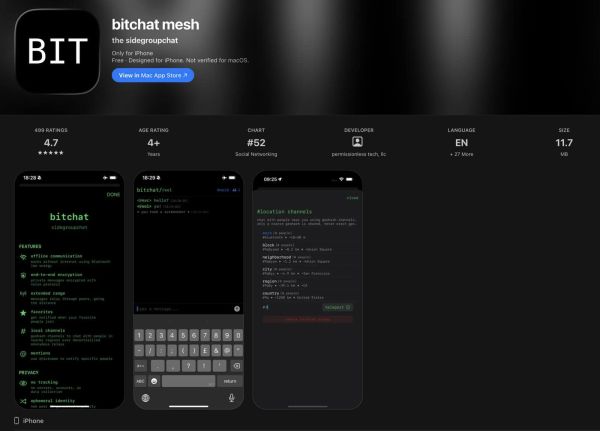
Hyderabad: Late on July 23, the Indian Cyber Crime Coordination Centre (I4C), an arm of the Union Home Ministry, sent GitHub an ultimatum: remove three repositories of the messaging app Bitchat within three hours or lose your legal protection and face criminal proceedings.
As someone who has followed technology for years, I have seen governments do foolish things online. But this takedown order deserves its own category of absurdity and its implications should worry every Indian.
What the Bitchat GitHub takedown order demands
Bitchat is a free, open-source messaging app backed by Twitter founder Jack Dorsey. It lets phones talk to each other over Bluetooth, passing messages device to device – no internet, no servers, no phone numbers, no accounts. It became popular in Delhi this month for an obvious reason: the government suspended mobile internet within a 1.5-km radius of Jantar Mantar, where students protesting under the banner of the Cockroach Janta Party (CJP), have been demonstrating against the National Eligibility-cum-Entrance Test (NEET) paper leak scandal since June 20.

The I4C order, issued under Section 79(3)(b) of the Information Technology Act, 2000, read with Rule 3(1)(d) of the Information Technology Rules, 2021, does not accuse Bitchat of hosting a single unlawful message. It cannot, because the app keeps no logs and runs no servers. Instead, the order complains about how the software works, that it functions during internet shutdowns and “significantly impedes lawful interception, attribution and investigation.” The Ministry of Home Affairs has not publicly commented on the notice.
Think about what that means. The government is not banning content. It is banning architecture. It has declared the design of a tool, mere mathematics and code, to be the crime.
Why deleting code fails technically and legally
Here is the part that should embarrass whoever drafted the order. Bitchat’s code is open source. Thousands of copies exist on laptops, mirrors and forks around the world. Deleting three GitHub repository does not remove the app from a single phone or stop one Bluetooth message. The mesh network has no headquarters to raid and no switch to flip.
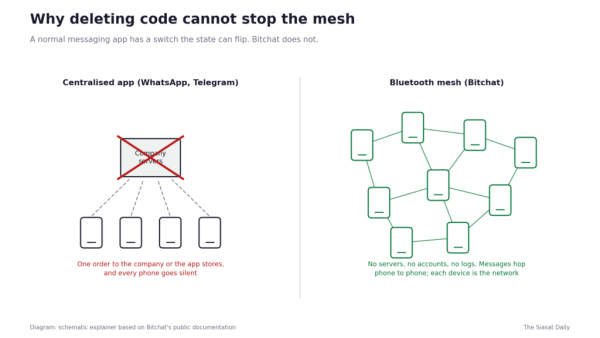
As the Internet Freedom Foundation (IFF) put it, “The order also fails on its own terms as deleting a repository does not delete the application from any phone that carries it, and the mesh keeps functioning without servers. What the takedown actually prevents is scrutiny of the underlying code.”
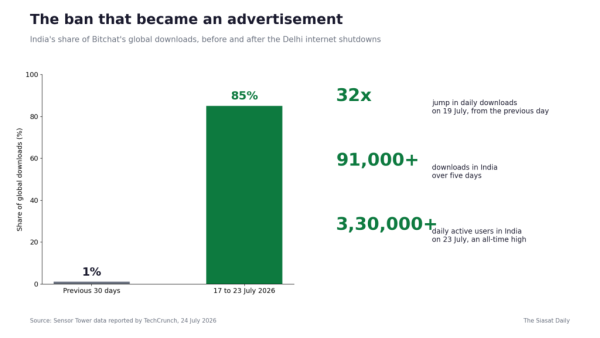
Downloads of Bitchat jumped 32 fold in a single day on July 19. India went from about 1 per cent of the app’s global downloads to 85 per cent within a week, with over 91,000 downloads in five days, according to Sensor Tower data reported by TechCrunch. One viral post on X summed it up: “India just gave the whole internet a free lesson on the power of FOSS,” that is, free and open-source software. The order did not bury Bitchat. It advertised it.
The law fares no better. Section 79(3)(b) is not a blocking power; it is a “safe harbour” rule that shields intermediaries like GitHub from liability for what users post. The Supreme Court settled this in Shreya Singhal v Union of India (2015), the same judgment that struck down the notorious Section 66A, making clear that Section 79 cannot be used as a shortcut for censorship. The proper route for blocking content is Section 69A, which demands a reasoned written order, a hearing and review by a committee. The government bypassed all of it, late at night, with a three-hour fuse.
Mishi Choudhary, founder of the digital rights law group SFLC.in, told Moneycontrol that Section 79 does not allow the government to declare a full software project illegal or punish GitHub merely for hosting its code.
The Constitution is equally clear. Article 19(1)(a) guarantees freedom of speech and expression and courts worldwide recognise computer code as expression. Article 19(1)(b) guarantees peaceful assembly, which today includes the ability to coordinate that assembly. Article 21 guarantees privacy, as nine judges of the Supreme Court unanimously held in Justice KS Puttaswamy v Union of India (2017), requiring any state intrusion to pass tests of legality, necessity and proportionality.
And in Anuradha Bhasin v Union of India (2020), the top court ruled that shutting down the internet is a drastic measure that must be necessary, proportionate, published and reviewable. Consider the sequence in Delhi: first suspend mobile internet within a 1.5-km radius of the protest, then bring in mobile jammers, then, when citizens switch to an offline app, order that app’s code deleted. This is not law enforcement. It is the engineering of a communication blackout and it fails every test the court has laid down.
Surveillance at Jantar Mantar
The blackout is only half the story. The other half is watching.
A petition before the Delhi High Court, filed by former Jawaharlal Nehru University (JNU) Students’ Union (JNUSU) president Aishe Ghosh, alleges that protesters at Jantar Mantar have been under continuous surveillance since June 20 – a permanent camera tower at the site, round-the-clock photography and videography of everyone present regardless of suspicion and police allegedly threatening students that their images would be sent to their parents and colleges. The plea says this violates Articles 14, 19 and 21 and has no disclosed legal authority.
The matter is pending before the High Court.
Separately, Delhi Police sources have told reporters that facial recognition system (FRS) cameras were deployed at the protest site and one report citing police sources claimed the system flagged around 400 people with alleged criminal backgrounds near Jantar Mantar between July 20 and 24. AI-powered surveillance vehicles with number-plate recognition have also been reported around the site.
The police, for their part, told the High Court that the filming is “not surveillance” but routine law-and-order work, and by July 24, Solicitor General Tushar Mehta had gone further, telling the court that video-recording the protest was in “legitimate state interest.”
Pause on the picture this creates: citizens protesting a rigged examination are filmed by AI, identified by face, threatened with exposure to their families and then told their last private channel of communication must be erased from the internet. The state sees everything; the citizen may whisper nothing. That is not the balance the Constitution promises.
The company India keeps now
This is where the international damage comes in. In April, Bitchat was pulled from Apple’s App Store in China on the orders of the Cyberspace Administration of China. The app has been adopted during unrest and shutdowns in Iran, Nepal, Uganda and Madagascar.
These are the precedents India has now joined. When the “world’s largest democracy” issues a midnight takedown of open-source code, it does not look like China with better intentions. It simply keeps China’s company. Every speech India gives about Digital India, about exporting its digital public infrastructure, about being the technology hub of the Global South, now has to be answered with a question: is this the country that tried to delete Bluetooth communication?
And what comes next? GitHub is not a fringe platform. It is where millions of Indian programmers, from Hyderabad’s IT corridor to Bengaluru, the backbone of our IT economy, keep their work. The repositories are still online as of July 25. Will the government now block GitHub itself, as The Week asked, and cut off India’s own developers to win a fight it has already lost?
Jack Dorsey wrote on X: “The government of India does not like technologies like Bitchat and wants it taken down.” He is right and that is precisely the problem. A government may not like a technology. Dislike is not a legal standard. Fear of how citizens might talk to each other is not a ground for censorship in a republic whose Constitution begins with “We, the People.”
-
Vietnam’s banh ram it goes viral, sending foreign food lovers on culinary hunt

-
Rajkummar Rao’s courtroom drama ‘Prahaar’ faces postponement

-
Rajkummar Rao’s courtroom drama ‘Prahaar’ faces postponement
-
Threat of new variant of Corona BA 3.2: Will the vaccine survive against this variant? Know complete details

-
Threat of new variant of Corona BA 3.2: Will the vaccine survive against this variant? Know complete details