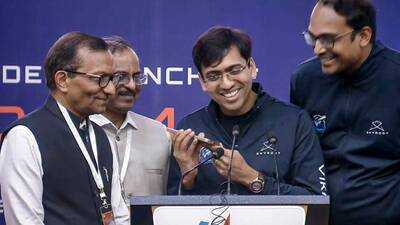
For Pawan Kumar Chandana , the phone call he made after watching Vikram-1 disappear into the sky wasn't to a colleague, an investor or even his co-founder.
He called his father.
And on the other end of the phone, there were no big words, no carefully prepared speech and no attempt to hide the emotion of the moment. His father simply cried.
Chandana cried too.
After all, this was the same boy who had once scored just 51 marks in Maths and even failed another subject in school. A boy who, by his own admission, wasn't exactly what anyone would have called a brilliant student.
Years later, that very boy had helped build a rocket that had just made history.
Skyroot Aerospace's Vikram-1 successfully reached orbit on Saturday, July 18, marking a huge moment for India's private space sector. The achievement made Skyroot the first Indian private company to successfully deploy an indigenously developed rocket into orbit.
But for Chandana, 29, the achievement was about more than just rockets, technology or a historic launch. It was also deeply personal.
Because somewhere behind the roaring engines and the celebrations was a father who had believed in his son long before the world had any reason to.
'I was a bad student'
Looking back at his childhood, Chandana doesn't paint the picture of a naturally gifted student who always knew he was destined for something extraordinary.
In fact, his story is almost the opposite.
"Until my 8th standard, I was a bad student," Chandana recalled in a personal note shared on X, formerly Twitter.
He remembered scoring 51 marks in Maths and failing another subject.
At that age, he couldn't have imagined that his life would eventually take him to one of India's premier engineering institutions, let alone into the country's rapidly evolving space industry.
He certainly couldn't have imagined that one day, he would be standing at the heart of a mission that would put India among just three countries to achieve such a feat with a privately developed rocket.
But life, sometimes, has a way of taking people much further than they ever dared to dream.
Chandana went on to study at IIT, and in 2018, he and Naga Bharath Daka founded Skyroot Aerospace. It was an ambitious decision at a time when India's space sector was still largely dominated by government institutions and private companies had not yet been given the kind of access they have today.
The two founders were essentially trying to build something that didn't have an obvious roadmap.
And yet, they kept going.
The first person he called was his father
When Vikram-1 finally completed its journey into orbit, Chandana's first instinct was to call the person who had been there long before the rocket, the company or the dream.
His father.
"As everything slowly begins to sink in, and after finally getting some sleep last night, I wanted to share a small personal note," Chandana wrote.
He said his father had given him dreams that were much bigger than the ones he had for himself. More importantly, he had never stopped believing in him.
That belief meant everything.
Chandana said that when he called his father after the launch, the man simply broke down.
"He just cried. And cried. He couldn't speak a single word," Chandana recalled.
But his son didn't need an explanation.
He understood.
"I understood every word he couldn't say," he wrote.
It's the kind of moment that says more about a person's journey than any award or achievement ever could. Because behind every headline about a successful launch, there are often years of doubt, uncertainty and people who quietly keep believing when success still feels impossibly far away.
For Chandana, his father's faith was one of those things.
From 51 marks to India's space story
Perhaps the most moving part of Chandana's story is that he himself once found it difficult to imagine this version of his life.
A child who struggled in school.
A student who scored 51 in Maths.
Someone who failed a subject.
And then, years later, an IIT graduate and the co-founder of a space company that helped achieve a milestone for India's private space industry.
"Back then, I could never have imagined that I would one day make it to an IIT," Chandana said.
He also never imagined that he would have the privilege of contributing to India's first privately developed rocket reaching orbit.
That contrast is what makes his story so powerful.
It is a reminder that a bad report card doesn't always predict a person's future. Sometimes, children who struggle early simply haven't found the thing that makes them want to push themselves. Sometimes, they need time. Sometimes, they need someone to believe in them before they learn to believe in themselves.
For Chandana, perhaps it was a little bit of all three.
A historic flight for India's private space sector
Vikram-1's successful launch was a major milestone for Skyroot and a significant moment for India's growing private space industry.
The rocket took off from the Satish Dhawan Space Centre in Sriharikota carrying customer payloads and in-orbit experiments as part of its maiden orbital mission, called "Mission Aagaman".
Around 15 minutes after liftoff, the rocket successfully placed its payload into a 450-kilometre orbit.
The mission was designed to test and validate several critical systems, including propulsion, avionics, telemetry, guidance, navigation and control. The data collected during the flight is expected to help Skyroot prepare for future commercial missions.
Founded in 2018, Skyroot belongs to a new generation of Indian space startups that emerged as the country gradually opened its space sector to private participation. The company has since attracted support from global investors and has been working towards making space launches more accessible and commercially viable.
But while the launch itself was a technological achievement, Chandana's personal reflection offered a different way of looking at the milestone.
It wasn't just about a rocket reaching orbit.
It was about a boy who once struggled in school reaching somewhere he had never imagined he could.
And somewhere, watching all of it unfold, was the father who had believed in him all along.
Chandana said he managed to hold back his tears when Vikram-1 reached orbit.
But writing about his father was different.
"Somehow, writing this, I can't," he admitted.
And perhaps that's the most human part of this extraordinary story.
Because sometimes, the biggest achievements aren't measured by how high a rocket flies. They're measured by how far a person has travelled from the version of themselves they once thought they would always be.
-
France Leads Europe with Nationwide Ban on Social Media for Children Under 15

-
Trump Proposes FIFA President Infantino for UN Secretary-General Role

-
US Defense Secretary Reveals Rising Costs of Iran Conflict Amid Funding Requests

-
Trump Administration Suspends Over $1 Billion in Medicaid Payments Amid Fraud Allegations

-
United Airlines Flight Diverts to Luke Air Force Base Due to Severe Weather