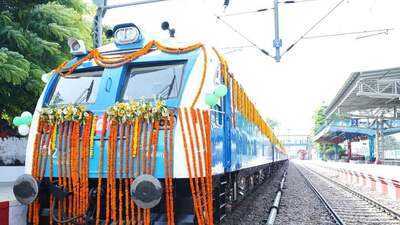
Prime Minister Narendra Modi has flagged offIndia's first hydrogen fuel cell powered passenger train, running between Jind and Sonipat in Haryana. The launch marks the country's entry into a small group of nations, including Germany, Japan, China and the US, that operate hydrogen powered trains, and Indian officials say the ten coach configuration makes it the largest capacity hydrogen trainset running anywhere in the world.
Which route will the first hydrogen train run on?
The train was flagged off by Modi at Jind railway station, with the debut service running on the Jind Sonipat section of Northern Railway. Modi described the launch as setting a new global benchmark for clean rail technology, noting that India's ten coach formation surpasses the smaller hydrogen trainsets currently being tested in other countries. The service will initially operate as a pilot project, with Indian Railways using the run to study real world performance before deciding whether to expand hydrogen trains to additional routes.
India's first hydrogen train: Key features of the train
The train has been designed, engineered and integrated entirely in India under the guidance of the Research, Design and Standards Organisation. It consists of two hydrogen powered Driving Power Cars positioned at either end of the train, along with eight passenger coaches, giving it a total capacity of close to 2,600 passengers. The train runs on a propulsion system rated at approximately 3,200 horsepower, translating to roughly 2,400 kilowatts of power, and has been approved to operate at a maximum speed of 75 km per hour during this initial phase. The only by product of its operation is water vapour, since the fuel cell system converts hydrogen into electricity without any combustion emissions.
India's first hydrogen train: The technology behind it
The train draws its power from hydrogen fuel cells, which generate electricity through a chemical reaction between hydrogen and oxygen rather than by burning fuel. The electricity produced is stored in onboard batteries, and from there it is routed through rectifiers and other electrical systems to the traction motors mounted on the train's axles, which drive the wheels. This is fundamentally different from diesel or electric traction, since there is no direct combustion and no need for overhead electrification along the route.
To fuel the train, Indian Railways has built its largest railway hydrogen storage and refuelling facility at Jind, capable of storing around 3,000 kgs of hydrogen. The hydrogen at this facility is produced through electrolysis, a process considered central to green hydrogen generation, and the plant is supported by a stable, dedicated power supply to ensure uninterrupted operations. Both the train and the refuelling station are fitted with multi layer safety systems, including hydrogen leak detectors, flame and smoke sensors, automatic shut off mechanisms and continuous ventilation, with real time monitoring in place and technical experts accompanying the train during its early phase of operation.
India's first hydrogen train: Hybrid power system and additional safety thresholds
The train's fuel cell generates electricity continuously, and any surplus power that is not immediately needed is diverted into the onboard battery for storage. During moments of higher power demand, the fuel cell and battery work together to drive the train, a hybrid arrangement that officials say improves overall efficiency. On safety, Indian Railways has built in a wide margin around hydrogen's known flammability range.
While hydrogen is scientifically inflammable at concentrations between 4 percent and 75 percent, the railway has set its automatic shutdown threshold far more conservatively, triggering a complete shutdown of the hydrogen system if a leak of just 0.25 percent is detected.
Even in the event of such a shutdown, the train is not left stranded, as the battery retains enough charge to move the train to a safe location before power is fully lost.
India's first hydrogen train: Deployment plans for the coming years
The Jind Sonipat train is the first unit under Indian Railways' broader Hydrogen for Heritage initiative, under which the government has proposed rolling out 35 hydrogen trains for use on heritage and hill routes across the country. Each trainset is estimated to cost around Rs. 80 crore, with an additional Rs. 70 crore earmarked for setting up route specific ground infrastructure such as refuelling plants. Officials have acknowledged that running costs are likely to be higher in the initial phase but expect these to decline as the fleet expands and the supporting hydrogen ecosystem matures.
India's first hydrogen train: Why it matters?
Beyond the immediate rollout, officials have pointed to potential spin off applications for the hydrogen fuel cell technology developed for this project, including its use in powering heavy vehicles such as trucks and tugboats. For Indian Railways, the Jind Sonipat pilot is being positioned as a technology demonstrator that will help determine real world operational requirements before hydrogen trains are considered for wider deployment, with the government framing the project as a significant step toward reducing the network's dependence on fossil fuels.
-
Anthony Gordon expresses heartbreak after England’s World Cup semi-final loss, shares emotional note to fans

-
Official Ballon d’Or clarification keeps Lionel Messi in contention for ninth honour

-
Vijay's Jana Nayagan Ticket Prices Capped At ₹190 In Tamil Nadu Amid Massive Demand: Report

-
‘Doesn’t have to be the best player’: Is record-breaking striker Kylian Mbappe the right leader for France?

-
Meet Andy Burnham, Britain's next prime minister