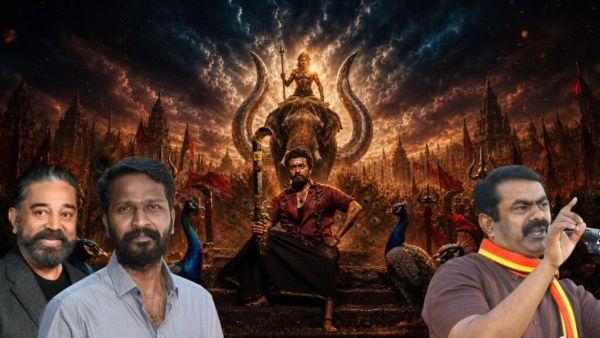
After a prolonged spell of box-office disappointments, Lord Murugan has emerged as Tamil cinema’s most reliable box-office bet. A wave of films centred on the deity is now hitting theatres, driven as much by commercial calculations as by the growing political battle over Murugan’s place as a symbol of Tamil identity.
Telugu star Jr NTR’s mythological drama with director Trivikram, reportedly based on Lord Murugan, kicked off the trend. It was followed by Dhanush teaming up again with filmmaker Vetrimaaran for “Thamizh Murugan,” and Sivakarthikeyan’s upcoming “Seyon,” which is riding on the momentum of Suriya’s Rs 300-crore hit “Karuppu.”
Devotional cinema, once considered a risky proposition at the Tamil box office, is suddenly back in focus.
Political flashpoint
The trend is not confined to cinema. Actor-politician Seeman has threatened protests over the Telugu film’s claims about the deity’s origins.
The moment is also marked by an irony. Some of the biggest names behind this wave, including Vetrimaaran and Kamal Haasan, have long been associated with rationalist and Dravidian politics rather than overt religious themes.
To understand why Murugan has become Tamil cinema’s biggest trend, The Federal spoke to film professor Uma Vangal.
“Murugan is deeply special to Tamil Nadu because the culture has embraced him as Tamil Kadavul, the state’s own god,” said Vangal. “Contemporary Tamil cinema is grappling with a real contradiction. The state prides itself on rationalism, yet is home to some of the largest number of temples in the country.”
Cinema mirrors society
According to Vangal, Tamil cinema has often moved in waves reflecting developments in society. Films such as Kadaisi Vivasayi and Asuras echoed concerns around agriculture and farmer distress. The Murugan wave, she argues, similarly mirrors the current churn over faith, identity and politics.
Even the DMK, rooted in the Dravidian movement’s rationalist legacy and traditionally distant from overt religiosity, has had to acknowledge Murugan’s popularity among Tamil voters as the BJP seeks to expand its footprint in the state.
Faith, box office or politics
So is this wave being driven by faith, box-office logic or politics? According to Vangal, it is all three.
“There’s been a visible upsurge in faith post-COVID,” she said. “And with the political churn right now, the BJP is trying to make inroads, and the DMK is on the back foot; that old idea of Tamil Nadu as a secular, rationalist state has come back into focus. Cinema always responds to what’s happening in society, and that’s why this trend is dominating the conversation today.”
Reclaiming Tamil identity
When a filmmaker like Vetrimaaran, known for examining social and political fault lines, chooses to make a film on Murugan, the political reading becomes almost inevitable.
“The fact that Vetrimaaran is making something on Murugan automatically makes it a political statement, because he’s somebody who picks up social issues and pulls out the layers and nuances of that issue,” Vangal said. “Murugan often becomes a representation of the Tamil state versus the rest of the country, not necessarily in a contentious way, but as a re-establishing of a distinct Tamil identity.”
That contest over ownership is reflected in Seeman’s objections to the NTR film and the growing push by filmmakers to present Murugan as a distinctly Tamil deity.
So can a Murugan film today just be watched as cinema? Vangal’s answer is no. Tamil cinema, she said, is returning to its roots and its own audience.
With Vetrimaaran, Kamal Haasan, Dhanush and Sivakarthikeyan all part of this wave, devotion, box office and politics are no longer separable on screen. Together, they are defining Tamil cinema’s Murugan moment.
-
Argentina player ratings vs England: Messi inspires comeback as Fernandez and Lautaro fire champions into another World Cup final

-
England vs France gives Manu Kone the ideal opportunity to secure his £47m transfer to Manchester United

-
Liverpool and Arsenal challenge Manchester United’s move for Manu Kone

-
Severe Flash Flooding in Kerr County, Texas Claims Life and Triggers Emergency Rescues
-
Why Prince Harry can't make peace with King Charles without Queen Camilla