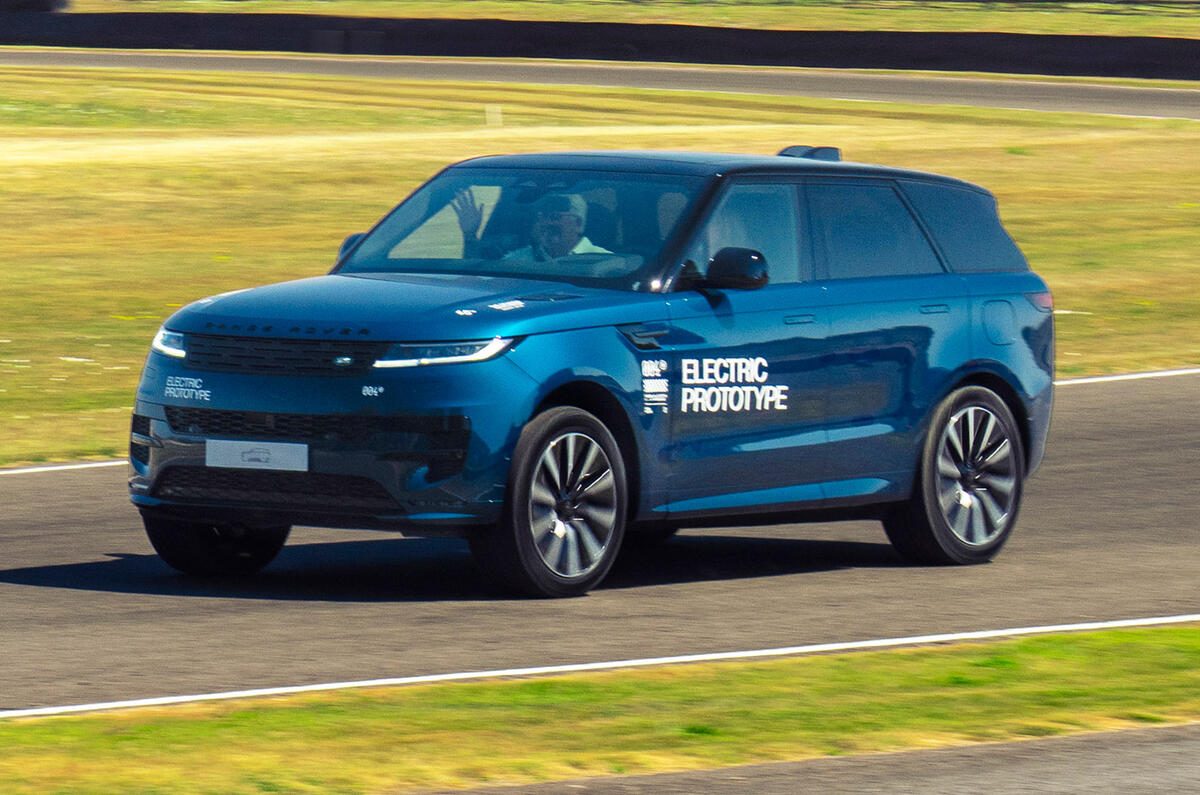
You might feel a sense of déjà vu reading this, because exactly one year ago, Matt Saunders shared his experience driving a near-production prototype of the fully electric Range Rover. That model was said to be close to launch at the time.
Now, I’ve had the opportunity to drive a late-stage prototype of its slightly smaller sibling, the Range Rover Sport Electric, on a mixed test circuit with a few off-road obstacles – again, just ahead of its own much-anticipated market debut.
Given that the full-size Range Rover and the Range Rover Sport share the same core mechanical architecture with only tuning variations, this test feels like a continuation of where we left off last year. Land Rover’s engineers insist that the delay was to conduct additional testing and ensure perfection, though it’s clear that demand for large, premium electric SUVs remains modest – especially in the United States, which is a crucial market for Jaguar Land Rover (JLR). However, with the Porsche Cayenne Electric entering the scene and BMW preparing to launch its iX5, it seems the timing is now right for such vehicles.
From a technical standpoint, the Range Rover Sport Electric closely mirrors the full-size Range Rover EV. Built on the MLA platform, which was designed from the outset to accommodate a large battery pack, the chassis still prioritises internal combustion engine compatibility. The EV’s battery control electronics occupy the transmission tunnel area, and the front motor is mounted in a cradle that replicates an engine’s crash profile. Nevertheless, the floor height remains unchanged, packaging compromises are minimal, and the EV’s overall weight is roughly equivalent to that of the plug-in hybrid variant.
The dual electric motors – producing either 444bhp or 542bhp depending on the model – are developed entirely in-house by JLR, as the company couldn’t find suitable third-party units that met its demanding off-road performance criteria, such as immediate high torque output from standstill. These motors are also manufactured in JLR’s own facilities alongside its traditional engines.
With its 800V electrical architecture, the Range Rover Sport Electric promises exceptionally fast charging speeds, although the exact kilowatt figure hasn’t been disclosed. The battery pack uses double-stacked cylindrical cells sourced from AESC, offering a usable capacity of 118.5kWh. While this is larger than the Cayenne Electric’s pack, it’s smaller than the BMW iX5’s massive 144kWh unit. JLR estimates a range of 330 miles under the U.S. EPA test cycle – a more conservative measure than WLTP – meaning it should compare favourably against its German rivals.
Engineers openly admit that efficiency was never the primary focus. The distinctive, upright Range Rover design and the use of all-season tyres – crucial for maintaining genuine off-road ability – naturally impose some aerodynamic and rolling resistance penalties.
Preserving the quintessential Range Rover DNA was the top priority: the commanding driving position, the refined ride, the off-road mastery, and the unmistakable styling. As a result, the Range Rover Sport Electric isn’t designed as an electric showcase but rather as an additional powertrain choice within the lineup.
Visually, the prototype I drove was entirely undisguised. Apart from a closed-off front grille, subtle EV badging, and slightly more aerodynamic wheels, it’s indistinguishable from any other Range Rover Sport.
During my test around the Goodwood circuit – which included gravel paths, cones, and even a section through a disused Airbus fuselage – the Range Rover Sport Electric delivered an impressively familiar experience, perhaps even improving on the standard model in some respects.
As previously noted by Saunders about the full-size Range Rover EV, the seamless and immediate power delivery is a huge advantage off-road. There’s no need to wait for revs to build or for a torque converter to engage – torque is available instantly and very smoothly. The sophisticated traction control system eliminates the need for locking differentials or a low-range gearbox, as the electronics precisely manage torque distribution between the motors.
The regenerative braking system complements this setup well. Instead of paddles, there are straightforward drive modes: D (with selectable ‘light’ or ‘standard’ regeneration) and S (for one-pedal driving). The calibration feels natural across all settings. Engineers highlighted that the one-pedal mode is helpful for moderate off-roading, though in more demanding rock-crawl scenarios, conventional brakes still offer better low-speed control and consistency.
On paved surfaces, the Sport benefits from its lower centre of gravity. Traditional Range Rovers can sometimes feel slightly top-heavy through corners, but the electric version feels well-planted, with precise and reassuring steering feedback. Despite identical front and rear motors, the torque distribution feels pleasantly rear-biased when accelerating out of bends.
One minor issue is the noticeable torque steer during full-throttle acceleration. Otherwise, the cabin remains serene and refined at high speeds – a testament to the absence of engine noise. The ride quality was smooth and composed over gravel sections, but the test route didn’t include more challenging, pothole-ridden surfaces, where Range Rovers have occasionally struggled.
Inside, the cabin layout mirrors other Range Rover Sport models. The materials are generally excellent, and the driving position is superb, though the large gloss-black centre console and the finicky touchscreen interface for climate and drive modes remain weak points.
Overall, with its enhanced off-road precision, improved refinement, and strong all-round performance, the Range Rover Sport Electric appears to elevate the Sport’s appeal even further. It may lack the visceral satisfaction of the V8, and towing will inevitably eat into its 330-mile range, but for most drivers, it delivers the smoothness, pace, and capability expected of a modern luxury SUV. The existing V8 and diesel options will continue for those who prefer them.
In summary, the Range Rover Sport Electric is refined, quick, enjoyable to drive, and impressively capable off the beaten path.
Range Rover Sport Electric 550PS
Verdict: The silent, seamless powertrain perfectly complements the Sport’s character. The user interface remains a weak spot, and the final judgment on ride comfort and real-world range will have to wait for a full production model test.
| Specification | Details |
|---|---|
| Price | £100,000 (estimated) |
| Engine | Two permanent magnet synchronous motors |
| Power | 542bhp |
| Torque | 627lb ft |
| Gearbox | 1-speed reduction gear, 4WD |
| Kerb weight | 2700kg (estimated) |
| 0–62mph | 4.4 seconds (estimated) |
| Top speed | 130mph (estimated) |
| Battery | 130/118.5kWh (total/usable, estimated) |
| Range, economy | 380 miles (estimated), 2.9 miles/kWh (estimated) |
| CO2, tax band | 0g/km, 4% |
| Rivals | BMW iX5, Porsche Cayenne Electric |
-
Exploring Europe's Exclusive Toyota Land Cruiser Commercial Cargo Vehicle
-
Tested: 2027 Ram 1500 TRX SRT – The Monster Pickup Returns with 777 HP Fury
-
Williams F1’s Overhaul Feels Like Piloting and Rebuilding a Plane Mid-Flight, Says Team Principal James Vowles
-
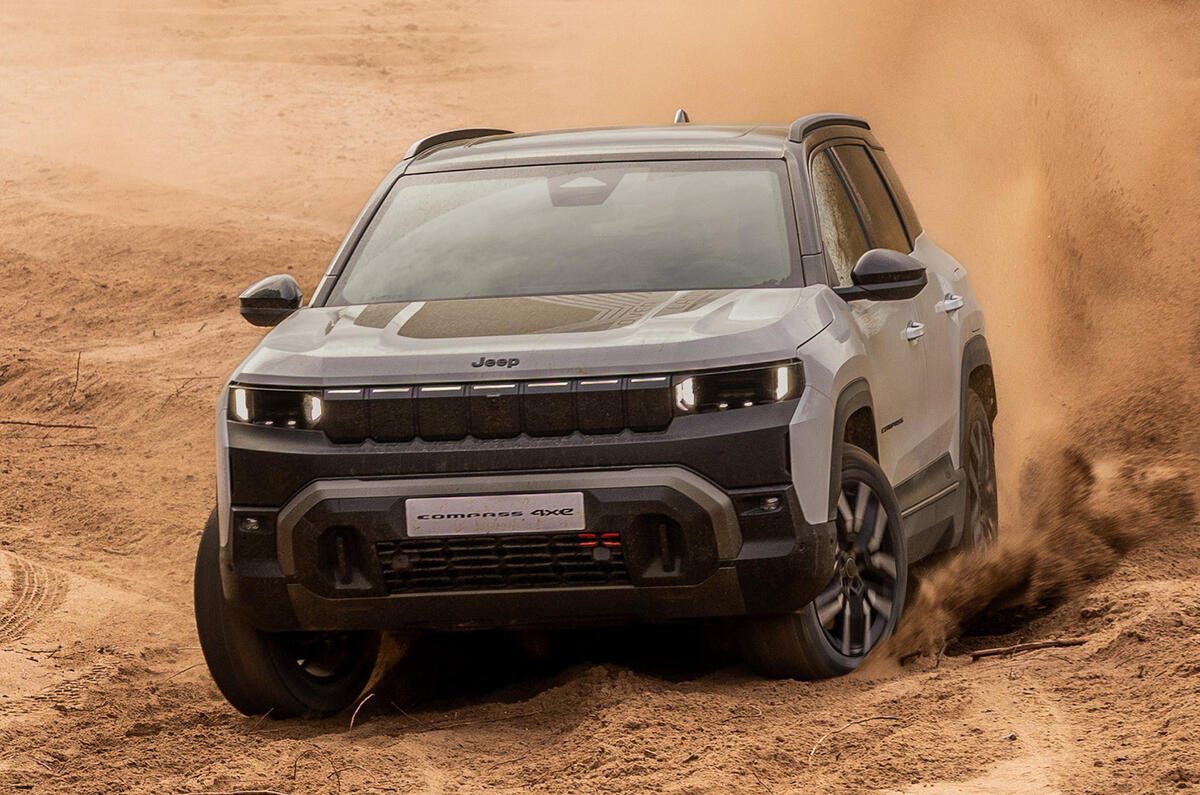
Jeep Compass 4xe: The Most Capable Electric Jeep Yet Gets Down and Dirty
-
Parents in crisis when children leave ‘the nest’