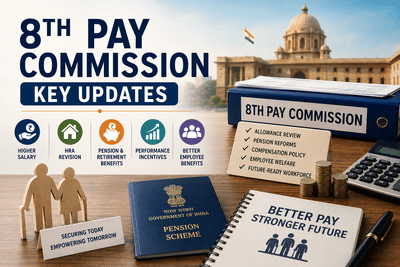
The Eighth Central Pay Commission is reviewing allowances, retirement benefits, performance incentives and compensation policies, signalling broader reforms for central government employees and pensioners.
The 8th Central Pay Commission (8th CPC) is expected to bring much more than a revision in basic salaries for central government employees. According to the official terms of reference issued through the government gazette, the commission has been tasked with examining several aspects of employee compensation, including allowances, pension benefits, retirement provisions and performance-based rewards.
The commission, constituted on November 3, 2025, has been given 18 months to submit its recommendations. As part of its consultation process, it has already held meetings with employee associations, pensioner groups and other stakeholders in multiple cities, including Bhubaneswar and Kolkata in July 2026.
While no official recommendation has been released yet, the commission's mandate suggests that significant structural changes could be proposed for the salaries and service conditions of central government employees.
Comprehensive Review of Employee AllowancesOne of the major responsibilities assigned to the commission is the examination of the current allowance structure.
At present, central government employees receive numerous allowances depending on their designation, location and nature of work. The commission has been asked to assess whether these benefits remain relevant and whether they should be simplified.
The review may include:
- Rationalisation of multiple allowances
- Revision of existing allowance rates
- Changes in eligibility conditions
- Easier claim and reimbursement procedures
- Possible merger of overlapping allowances
Among the issues being discussed by employee organisations is a demand for a higher House Rent Allowance (HRA), with some unions seeking an increase to 40% for eligible employees. However, no decision has been taken so far.
Performance-Based Incentives Under ReviewThe commission has also been directed to evaluate the current bonus system and explore a more performance-oriented incentive model.
The objective is to encourage higher productivity and greater accountability across government departments.
If such recommendations are accepted, future financial rewards may depend not only on periodic pay revisions but also on measurable work performance, efficiency and service outcomes.
This could mark a shift towards linking a portion of employee compensation with performance indicators instead of relying solely on fixed salary revisions.
Focus on Pension, NPS, UPS and Retirement BenefitsRetirement-related benefits are another major area under examination.
The commission has been asked to review provisions relating to:
- National Pension System (NPS)
- Unified Pension Scheme (UPS)
- Death-cum-Retirement Gratuity (DCRG)
- Other retirement-related financial benefits
The review is intended to address existing gaps and ensure greater consistency in retirement benefits across different categories of government employees.
Apart from employees covered under NPS and UPS, the commission may also examine pension and gratuity provisions applicable to other eligible categories to identify areas where improvements can be made.
Comparison With Private Sector CompensationUnlike previous pay revisions that mainly focused on government salaries, the commission has also been instructed to study compensation practices in:
- Central Public Sector Enterprises (CPSEs)
- Private sector organisations
The purpose of this exercise is to understand how government pay structures compare with those offered by other employers.
The findings may help the government design a compensation framework that remains competitive while maintaining fiscal discipline. A balanced salary structure could also improve talent attraction and employee retention in public service.
Interim Recommendations May Be SubmittedAlthough the commission has been granted up to 18 months to submit its final report, the government's notification allows it to present interim recommendations whenever necessary.
This provision gives the government flexibility to consider implementing specific recommendations before the complete report is finalised.
If required, certain proposals related to allowances or employee benefits could therefore be examined separately instead of waiting for the entire package of recommendations.
What Employees Should KnowAt present, the commission has not announced:
- A new fitment factor
- Revised salary matrix
- New HRA percentages
- Pension revision formula
- Effective implementation date
Employee unions have suggested different fitment factors ranging from approximately 2.86 to 3.80, but these remain proposals and have not received official approval.
Similarly, reports regarding revised salary figures or allowance increases should be treated as speculative until the commission formally submits its recommendations and the government takes a final decision.
Expected TimelineThe commission is expected to complete its work within the prescribed 18-month period after consulting stakeholders and reviewing existing compensation systems.
Following submission of the report, the central government will examine the recommendations before deciding which proposals to accept and implement.
ConclusionThe 8th Central Pay Commission is shaping up to be a broader reform exercise rather than a simple salary revision. Along with reviewing pay structures, it is examining allowances, retirement benefits, performance-linked incentives and compensation practices across sectors.
While central government employees and pensioners are awaiting the commission's final recommendations, no official decision has yet been announced regarding salary hikes, HRA revision, pension changes or the fitment factor. Until the government releases approved recommendations, all proposed figures and estimates should be considered indicative rather than confirmed.
-
Explained: The reasons behind Andrey Santos leaving Chelsea for a £50m switch to Manchester United

-
Celebrating 15 Years of Zindagi Na Milegi Dobara: Life Lessons from the Iconic Film

-
Besiktas sign Arsenal forward Leandro Trossard for £17m: Details here

-
Decoding England's ODI record and stats at Sophia Gardens, Cardiff
-
'It wasn't racism': Egypt boss finally breaks silence on viral 'X' gesture and claims Messi was left in tears