Pro. RK Jain “Arijit”
Recent question of Supreme Court — Can English be considered the indigenous language of India??—Not just a question of court, There is a knock on the linguistic consciousness of India. This debate is not about the pros and cons of English., It is of that mentality which has denied the language self-respect even after eight decades of independence., The scale of status has been maintained. English came with the East India Company and is used in universities today., the courts, Administration, Science, It is the main language of technology and corporate world. Crores of Indians have made it a medium of education and employment, Therefore, to call it completely foreign would be to turn away from reality. But does prolonged use make a language indigenous?? if yes, So the basis of Swadeshi will be history, culture or convenience? Supreme Court not language, The question of Indian self-confidence has been raised. The same confidence that once, shift, Prakrit, Tamil, Hindi, Bengali, Marathi, Oriya, Kannada, Telugu, Malayalam, Gave knowledge to the world on the strength of Assamese and hundreds of dialects, But today one seeks the help of a foreign language to prove himself in his own country.
The biggest court on this question is our justice system. articles of the constitution 348 Under this, the proceedings and decisions of the Supreme Court and most of the High Courts are still in English. The irony is that justice is written for the same citizen, Who does not understand his language. The court itself has accepted that translation of judgments and orders into Indian languages is necessary., Because justice is meaningful only then, When it reached the language of the people. Yet the dominance of English in the courts is undisputed. If the most important pillar of democracy remains away from the language of the people, So the distance between justice and citizen will remain. Will English become indigenous only with years of use?, Or will linking the justice system with Indian languages be a democratic reform?? This is not just a question of language, Has equal access to justice.
The harshest truth today is that English is not the only language in India., It has become a symbol of class power. This language is the door to opportunities for some, So the invisible wall for millions. expensive schools, IIT, IIM, Multinational companies and global organizations consider this as a prerequisite for eligibility. The talented student of the same village, Dalit-Bahujan youth and lakhs of students educated in mother tongue do not have the capacity, Are left behind due to the language barrier. The years-long debate on the three-language policy and the resistance of South India are indicative of the apprehension of this linguistic supremacy. If accepting English as indigenous language deepens this inequality, So aren’t we legitimizing a new slavery?? power was once wielded by the sword, Today it is based on language certificate.
History is the most honest witness to this debate. 1835 Lord Macaulay had clearly written that his aim was to prepare such Indians, who is Indian by blood and color, but the idea, ethics, Be English by taste and intelligence. This is not just education policy, There was a plan for mental colonization. Independent India achieved political independence, But the struggle for linguistic independence remained incomplete. The form of English has also changed with time. Today Hinglish, Tamlish, benglish Mixed languages like this show that India can give its own color to every language. English is also now enriched with Indian experiences. But the question is whether this change is our 22 happening at the expense of scheduled languages and hundreds of dialects? If the new generation starts thinking in English before the mother tongue, So it’s not just about language, This would indicate the erosion of cultural memory.
The world’s experience gives clear signals to India. Japan Japanese, germany german, france french, China learned on the strength of Mandarin and Israel on the strength of revived Hebrew, Strengthened science and national identity. These countries learned English, used it, But did not let it dominate his identity. India’s path is not confrontation, There should be balance. The new education policy emphasizes on mother tongue based education. artificial intelligence based translation, Technical terminology in Indian languages, Engineering, Treatment, Legal studies and multilingual digital knowledge resources show that knowledge is no longer captive to English. Then why the hurry to declare English as indigenous?? The real challenge is not to remove English., Indian languages have to reach that level, Where a student’s future is not his language, Determine talent.
This is where the Supreme Court question becomes most prescient. This hindi vs english, Not a dispute about North versus South or superiority of any language., The search for an India where every child can think in the mother tongue, Connect with the society through regional language and communicate with the world through English. This is the biggest strength of multilingual India. If Indian languages are neglected by calling English indigenous, so folklore, folk tales, Visit, ethnology, Regional literature and cultural memories of thousands of years will be marginalized. But if English becomes the language of global opportunities and Indian languages become the soul of national life, so they are not rivals, Will be mutually supportive. The future of language is not a competition., Will secure co-existence.
In fact, The biggest misconception is that Swadeshi means only origin. The history of India shows that it has assimilated many cultures., adopted ideas and languages, But never lost your soul. That’s why there is no solution to oppose English., No glorification. The real question is that decision, What will be the language of knowledge and dreams of the coming generation? If administration, Justice, Science, Treatment, Research and technical education will be available in Indian languages, So English will never be a challenge. But if Indian languages are home, reduced to poetry and celebration, and english power, became the language of knowledge and opportunity, then the same mental inequality will return, The foundation of which was laid by the colonial rule. Slavery doesn’t just come from foreign rule, she still comes, When a society loses confidence in its language.
Supreme Court did not give any linguistic decision, Rather, a fundamental question was put before India – will language be only a medium of convenience or the basis of national self-confidence?? English is a gateway to global opportunities, But Indian civilization, folk wisdom, Sensitivity and cultural consciousness are alive only in Indian languages. That’s why there is no solution to oppose English., Nor to consider it as indigenous and make it an alternative to Indian languages. There is a need for such a system, where justice is served in the language of the people, Education should be developed in mother tongue, Technology should give equal opportunity to every Indian language and become a bridge of communication with the English world., Not of dominance. Ultimately this debate is not about English, India has linguistic confidence. A nation that respects its languages, that’s your knowledge, Also protects culture and future. The real linguistic freedom of India does not lie in proving English as indigenous., Rather, it is to make Indian languages the natural basis of national life.
-
Transfer buzz: Arsenal target Tzolis as Trossard successor, Al Hilal enter chase for Summerville

-
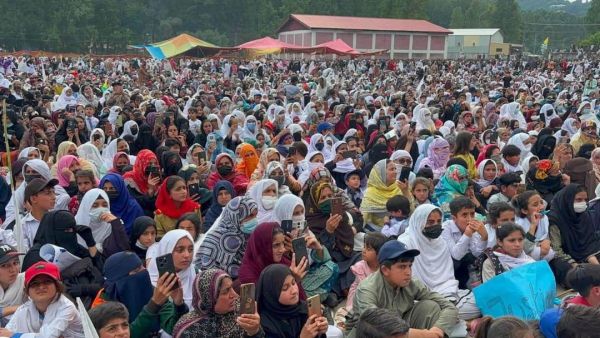
Pakistan Scrambles To Contain PoK Protests, Muzaffarabad March Deferred To July 21
-
Rayan Cherki reacts sharply to question on Lucas Digne after France’s World Cup semi-final defeat to Spain

-
BGMI 4.5 Update Rolls Out Tomorrow: Key Update Introduces Naruto To The Battlegrounds With New Map, Ninja Powers & Kurama Boss Fight

-
KGMU's Ban On Non-Veg Food In Hostel Messes Sparks Political Row