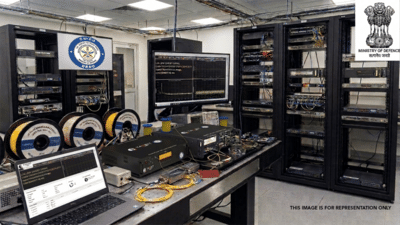
New Delhi: The Defence Research and Development Organisation has completed military field trials of a fibre-based Quantum Key Distribution system developed with Bengaluru-based Taqbit Labs. The system is meant to protect sensitive communication networks and detect attempts to secretly intercept encryption keys.
DRDO said the trial covered a scalable system that can support larger, multi-hop quantum networks. This matters for the armed forces, where orders, intelligence reports and other sensitive information often travel across several network points before reaching the intended unit.
What is Quantum Key Distribution?Future proofing India’s strategic communication networks with quantum technology, DRDO has successfully completed military field trails of a scalable and practically secure, fiber based Quantum Key Distribution (QKD) system.
Leveraging their lab level proof of concept and… pic.twitter.com/QaTaYNRax9
— DRDO (@DRDO_India) July 14, 2026
Quantum Key Distribution, commonly called QKD, is a method of sharing encryption keys using tiny particles of light.
The key is later used to lock and unlock regular digital information. QKD does not directly send an entire classified message through a quantum link. It helps both ends of a network create or exchange a secret key safely.
Here is the clever bit. Measuring a quantum signal changes it. If someone tries to copy or intercept the particles carrying the key, the system can spot unusual errors. The affected key can then be rejected before it is used.
I find the easiest way to understand it is to picture a sealed envelope that changes colour when somebody opens it. The sender and receiver immediately know that someone has taken a look.
Why is DRDO testing it now?Most common encryption systems depend on mathematical problems that current computers struggle to solve. Future quantum computers could weaken some of these methods.
This has created fears around a tactic known as “harvest now, decrypt later”. An attacker could collect encrypted defence data today and try to decode it years later using a more capable computer.
QKD is one option for protecting high-value links against this risk. It uses quantum physics to identify interception during the exchange of keys.
DRDO and IIT Delhi previously tested quantum communication over optical fibre and demonstrated entanglement-based secure communication over more than one kilometre of free space. A separate 2024 field test covered QKD across eight kilometres of optical fibre on the IIT Delhi campus.
What does scalable and multi-hop mean?Fibre-based quantum signals weaken with distance. This makes long routes harder to build.
A multi-hop network divides a longer route into smaller connected sections. Secure nodes pass the key across the chain, allowing the network to cover more locations.
This could eventually connect military headquarters, command centres and other critical facilities. DRDO has not publicly disclosed the distance covered during the latest field trials or details of the military network used.
-
ICC Announces Biggest ODI, T20 World Cup Format Changes In Years - Check Details

-
Supriya Sule Rejects Delimitation Bill Support, Denies NDA Joining Speculation

-
Yan Diomande reportedly open to multiple offers as Liverpool, PSG, Man City and Man United pursue RB Leipzig star

-
Kylian Mbappe points out France’s key tactical error in ‘sloppy’ World Cup semi-final loss to Spain

-
FIFA World Cup 2026: Assam Extends Guwahati Restaurant Hours Till 3:30 AM For Semifinals & Final