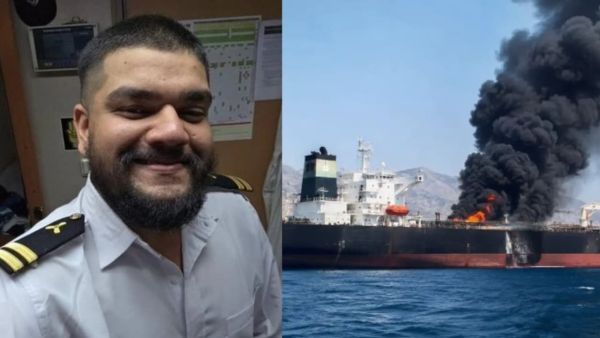
India launches 'Seafarer-First' mission after the death of an Indian sailor in the Hormuz attack. What happened that the government had to implement 24x7 surveillance, helpline and high alert?
Hormuz Ship Attack: Monday seemed to be a normal day as usual, but suddenly the smell of gunpowder wafted across the troubled waters of the Strait of Hormuz. The deadly attacks on two commercial ships shook the entire world. But this news was no less than a big shock for India - out of the total 46 crew members on board these ships, 30 were Indian sailors. When the smoke from the explosions cleared, a very sad news emerged; One Indian sailor had died in the attack and many others were seriously fighting for life and death. Following this horrific tragedy, the Indian government has taken a step that has created a stir in international maritime corridors. Union Ports, Shipping and Waterways Minister Sarbananda Sonowal has called an emergency meeting and sounded the alarm of 'seafarer-first' (seafarers' safety comes first) response.
Smoldering Gulf: That dreadful night on MT Al Bahia and MT Mombasa
This attack was not a normal incident. Two huge merchant ships came under the grip of this bloody conspiracy. One Indian sailor lost his life while another was seriously injured in the attack on 'MT Al Bahia'. On the other hand, the scene of devastation on 'MT Mombasa' was even more horrifying. Nine Indian citizens were injured there, out of which the condition of two is currently very critical. As Indian blood spilled on this most sensitive route of global trade, tensions reached fever pitch in the corridors of Delhi. This horrific attack proved that international waters are no longer safe for our brave sailors.
What is a 'seafarer-first' response?
The 'Seafarer-First' response is a coordinated emergency response aimed at ensuring the safety of Indian seafarers operating in sensitive maritime areas of the world. Under this initiative, the government has taken many important decisions. Ships passing through conflict-affected sea routes will be continuously monitored. Special Liaison Officers will be appointed for each affected ship, who will become a medium of direct contact between the sailors and their families. Apart from this, round-the-clock coordination will be maintained between the Ministry of External Affairs, Ministry of Petroleum and Natural Gas, Indian Navy, Directorate General of Shipping (DG Shipping) and Indian Missions in Iran and Oman.
'Operational Dashboard': Invisible radar that will keep an eye on every breath
The Government of India has used all its strength to deal with this unprecedented crisis. Minister Sarbananda Sonowal has given strict instructions to the Director General of Shipping to immediately create a state-of-the-art operational dashboard. This will not be a simple monitoring system, but a digital maze that:
- Will track every Indian sailor passing through the Persian Gulf, Strait of Hormuz and Gulf of Oman from moment to moment.
- Irrespective of the flag of which country the ship is sailing, the Government of India will get real-time data about its location and security situation from moment to moment.
- Ships will be alerted in advance as soon as any danger is detected.
24x7 helpline started, every complaint will be monitored
When missiles and drones are raining in the sea, it is not difficult to imagine what will be the mental condition of the families of the sailors sitting in India. Understanding this pain, the government has launched a 24x7 complaint helpline to help distressed families. It has the facility of a domestic toll-free number, international hotline, WhatsApp and email support. Apart from this, special Liaison Officers are being deployed for every affected family. These officers will become the only and fastest way to ensure medical updates to the affected families, safe repatriation of injured sailors and immediate financial help from the Welfare Fund.
The chessboard of global diplomacy: Will this bloody game of the sea stop?
This war could not be won only within the borders, so India has now played the biggest gamble of diplomacy. The Government of India has taken up this issue directly with the International Maritime Organization (IMO) and representatives of the countries concerned. Sarbananda Sonowal warned in strong words that these attacks have not only flouted international agreements but have also violated the basic right of 'innocent passage' of merchant ships. Now the Indian Navy, the Ministry of External Affairs and the Indian embassies in the Gulf countries are working under one command round the clock. It remains to be seen how India's aggressive 'Seafarer-First' response proves to be a safe shield for our brave sailors on this burning path of the sea.
-
SIP vs. Lump Sum: A ₹5,000 SIP or a ₹5 lakh lump sum investment—which yields higher returns?

-
Flight News: Relief for Mumbai travelers—fly abroad from this airport too; find out the destinations.
-
Chief Minister's 'Majhi Ladki Bahin' Scheme: 9.2 million women excluded; will no longer receive funds..

-
What has changed in the EPFO so far? First, get to know these 7 major new rules for 2026; otherwise, your claim could get stuck..

-
EPS Scheme 2026: Settlement within 20 days, PF withdrawal rules, and higher pension; know what has changed in 6 points..