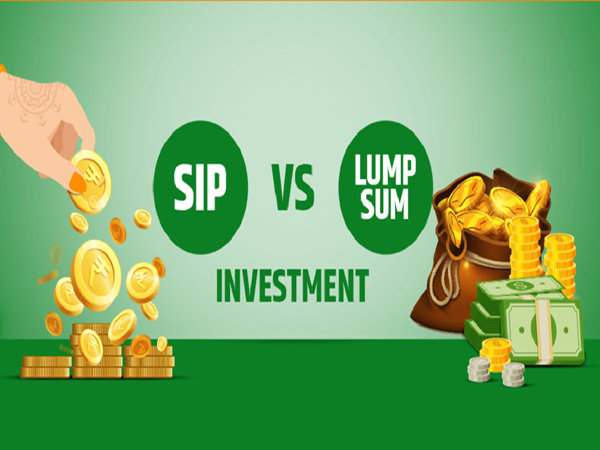
For mutual fund investors, the biggest question is often whether to invest a lump sum amount all at once or invest smaller amounts regularly through a Systematic Investment Plan (SIP). Let us explain—using a calculation—which option is better: a ₹5 lakh lump sum investment or a monthly SIP of ₹5,000.
How to invest?
Suppose an investor has ₹5 lakh. They could invest it all at once (lump sum), whereas another investor might opt for a monthly SIP of ₹5,000. With an SIP, money enters the market gradually, whereas with a lump sum, the entire amount starts working for you from day one.
Understanding the calculation (assuming a 12% annual return)
If investing a lump sum of ₹5 lakh:
* Investment: ₹5,00,000 (one-time)
* Tenure: 15–20 years
* Estimated return (12% CAGR):
* In 15 years, the corpus could reach approximately ₹27–30 lakh.
* In 20 years, the same amount could grow to over ₹47 lakh.
On the other hand, if investing ₹5,000 via monthly SIP:
* Total investment (15 years): ₹9 lakh
* Total investment (20 years): ₹12 lakh
* After 15 years, the fund would be around ₹25–27 lakh.
* After 20 years, the fund would grow to approximately ₹45–46 lakh.
Note that since money is invested gradually in an SIP, the benefit of compounding is lower during the initial years.
Which is better?
The duration for which compounding works determines which option is superior. With a lump sum, the entire amount is deployed in the market from day one, allowing it to benefit from compounding over the full tenure. In contrast, since SIP funds are invested gradually, the full amount is not in the market during the early years, limiting the impact of compounding.
Impact of market volatility
* With a lump sum investment, the entire amount is exposed to the market at once; consequently, a market downturn can have a significant impact on the value. * SIP: Gradual investment offers the benefit of 'buying cheap' even during market declines.
According to experts, SIPs can perform better in a falling market, whereas a lump-sum investment may outperform in a consistently rising market.
Disclaimer: This content has been sourced and edited from Dainik Jagran. While we have made modifications for clarity and presentation, the original content belongs to its respective authors and website. We do not claim ownership of the content.
-
The design of the sun, the shine of 3,000 year old gold and diamonds… What is the connection of Zendaya’s earrings with history?

-
FIFA WC: Spain reached the final after 16 years after defeating France, now one step away from the second title

-
From Andrew Flintoff to Shahid Afridi: Five Cricketers Indian Fans Love to Hate

-
AAIB Tells Supreme Court Draft Final Report On Air India Crash Likely By October

-
West Bengal: Fire breaks out in Haldia Refinery pipeline; About 15 workers suffer burns