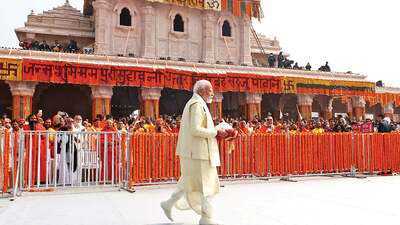
Barely two-and-a-half years after it was thrown open to devotees in January 2024, the Ram Mandir in Ayodhya is at the centre of a financial scandal. Allegations surfaced in June 2026 of embezzlement of donations to the temple. Two founding trustees resigned, a Special Investigation Team (SIT) was formed by the Uttar Pradesh government, eight employees were arrested. A search committee was formed to find a ‘professional’ CEO to manage the affairs of the temple.
The SIT’s interim report has been made public. Highlights include weak oversight of the handling of donations, ineffective security, revision of frisking rules and existing SOPs on pocketless uniforms, a cash-counting system that lacks traceability and surveillance that fell short.
The state government has fixed 15 July as the date when the SIT must submit its final report. We aren’t exactly holding our breath. But in this flurry of activity that looks like action is being taken against the wrongdoers, some questions have still not been vigorously interrogated.
Does the Ram Janmabhoomi Teerth Kshetra’s status as a private trust ringfence it from public scrutiny?
In its controversial Ayodhya judgment of 2019, the Supreme Court of India directed the Union government to set up a trust to build the Ram Mandir and manage its affairs. The directive did not specify that the trust should be ‘private’, yet the deed drafted by the ministry of home affairs (MHA) in 2020 chose to form a private trust, nominating founding trustees from the VHP, RSS and its affiliates.
The MHA maintains and the Central Information Commission (CIC) has ruled that Shri Ram Janmabhoomi Teerth Kshetra operates as an independent, autonomous body that receives no financial or administrative upkeep from the government. This ‘autonomy’ is why the Delhi High Court and CIC have argued that it lies outside the purview of the Right to Information (RTI) Act.
 Something is rotten in the land of Ram
While making a public show of “fully cooperating with the SIT”, trust officials have sought to leverage its autonomous, independent status to ringfence information. They have even tried to deflect administrative blame, and are using the ongoing SIT probe to stonewall nosey journalists.
In his statements to the SIT, trust general-secretary Champat Rai (who has since resigned) has reportedly sought to distance the trust hierarchy from the theft by blaming the State Bank of India (SBI), arguing that the arrested counting agents were under the bank’s operational chain of command, and that the theft occurred under ‘private agency supervision’ rather than trust oversight.
Backed by CIC rulings, the trust has consistently argued that because it is an independent body neither owned nor financed by the government, it is not a ‘public authority’ under the RTI Act. By maintaining this legal ringfence, they have successfully prevented citizens and journalists from filing RTI queries to inspect the temple’s daily internal balance sheets, ledger entries and procurement contracts.
On the other hand, legal experts have argued that when a public-facing religious institution operates under a private trust structure, outside the usual framework of statutory oversight, it must remain open to scrutiny through credible audit mechanisms. Because faith may be ‘private’, but funds collected in its name come from the public.
Indian courts have in the past stepped in when public temple donations were mismanaged by autonomous or hereditary trustees:
• In the Chidambaram Nataraja temple case (2014), the hereditary trustees (Podu Dikshitars) of the famous Nataraja temple in Tamil Nadu claimed absolute autonomous management. The Supreme Court ruled that while the state cannot permanently take over a temple, it does have the right to step in, audit accounts and criminally prosecute trustees if there is proof of systemic financial embezzlement or mismanagement of public offerings.
Is Yogi’s balancing act to save RSS the blushes?• In the Sri Padmanabhaswamy temple case (2020), the royal family of Travancore claimed private management over the temple and its massive vaults. The Supreme Court upheld their traditional rights but explicitly ruled that a public religious institution cannot be treated as a private fiefdom. The court established an independent, administrative committee to oversee the treasures and enforce strict, transparent auditing standards.
Under standard Indian tax and property law, when property is dedicated to an open, unidentifiable body of religious devotees, it automatically inherits the legal definition of a ‘public religious trust’.
Two trustees of the Teertha Kshetra — Champat Rai and member trustee Anil Mishra — resigned citing ‘moral responsibility’ while treasurer Govind Dev Giri didn’t, pleading innocence because he sits in Pune. Is this legally tenable?
Treasurer Govind Dev Giri has said in his defence that he sits in Pune and only reviews audited balances at the end of each month. Legal experts point out that under the Indian Trusts Act, 1882, a designated treasurer carries a fiduciary duty to safeguard the trust property. They argue that treasurers cannot legally absolve themselves by citing geographical distance or a lack of personal involvement.
If the standard operating procedures for cash management were fundamentally broken — allowing counting staff to repeatedly stash bundles of cash into their pockets and shoes — the treasurer is arguably liable for culpable negligence. While not criminally complicit in the theft itself, failing to enforce a secure internal control or auditing system constitutes a breach of civil fiduciary duties.
The resignations of Champat Rai and Anil Mishra on ‘moral grounds’ have been analysed as a sophisticated legal stratagem rather than an act of piety. By stepping down, citing moral responsibility, Rai and Mishra have insulated themselves from forced termination.
Under the trust’s constitution, once a trustee tenders a resignation, it must be processed and accepted. This allows them to exit the administration cleanly without the trust technically declaring them ‘guilty’ of any administrative failure.
The trust’s quick public defence of the duo — with some members publicly calling them ‘untainted’ and claiming they only committed ‘errors of negligence’ — has faced sharp legal pushback.
…and what explains Prime Minister Modi’s stony silence, given that he even presided over the temple inauguration as yajman?
Prime Minister Modi has been given credit for everything, real and imagined, to do with the Ram Mandir, even marshalling arguments for the Supreme Court’s Ayodhya verdict. It is common knowledge that it’s the long arm of the PMO that really controls the temple and who is on the board of trustees, even if it stays out of daily operations and keeps its hands officially clean.
Modi’s trusted aide Nripendra Mishra, who was his principal secretary during his first term (2014–19), is ex-officio member of the trust and chairman of the (Ram) Temple Construction Committee, and he surely keeps tabs for his boss.
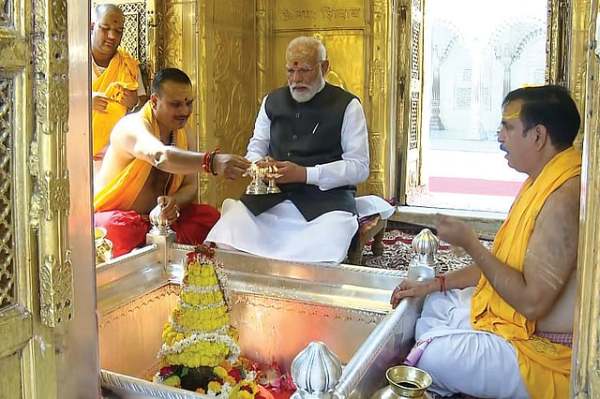
It was Modi who announced the formation of the trust in Parliament, who performed the bhoomi pujan in the presence of RSS chief Mohan Bhagwat and acted as the yajman (patron, host) at the consecration of the temple in January 2024. He knows very well the political worth of this religious edifice and is still maintaining an inscrutable silence on the scandal. What gives?
-
Trump says missiles aimed at Iran if Tehran targets him

-
Weather Update: Mild Temperature Rise and Rain Forecast in Delhi
-
If you wish to purchase land for a shop or house in the NCR, you can apply until July 13..

-
Rajnath Singh commissions INS Mahendragiri in Vizag
-
AAPSU Opposes Scheduled Tribe Inclusion for Kachari Community in Arunachal Pradesh