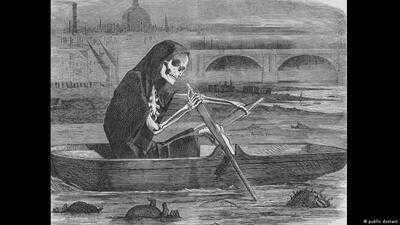
In 1858, London sweltered through an unbearable heat wave. The River Thames reeked so badly it left people gasping for air. "The Great Stink" went down in history — and ultimately gave London a modern sewer system.The river reeked so badly, it left Londoners gasping for air. Those who could afford to fled the city. Those left behind soaked their curtains in lime chloride to keep the stench at bay and pressed handkerchiefs over their noses whenever they ventured outside. "Whoso once inhales the stink can never forget it, and may count himself lucky if he live to remember it," the local press wrote. It was 1858. For weeks, temperatures hovered above 30 degrees Celsius (86 degrees Fahrenheit). Not a drop of rain fell to cool the city — or to wash away the filth choking the River Thames. London's lifeline became an open sewer: a murky, sludge-filled mix of human and animal waste, garbage and industrial pollution. The relentless heat drove the river to unusually low levels, exposing sewage and rotting refuse along its banks. Baking in the summer sun, the decaying waste fermented, blanketing the city in a suffocating haze. 'A deadly sewer' Between 1800 and 1850, London's population doubled to 2.5 million, making the capital of the British Empire the largest city in the world. But its outdated, hopelessly overwhelmed sewer system could not keep up. Waste from homes and businesses flowed directly into the Thames. The growing popularity of indoor flush toilets among wealthier households only made matters worse. Human waste was flushed straight into the river. In earlier centuries, cesspits had been emptied at night by so-called "night soil men." Now, at high tide, polluted water washed back onto the streets. Londoners were accustomed to the Thames smelling foul. But the Great Stink surpassed anything they had ever known before. "Through the heart of the town a deadly sewer ebbed and flowed, in the place of a fine fresh river," Charles Dickens wrote in Little Dorrit. Yet people continued to wash in the river — and even drink its water. A deadly misconception: Bad air causes disease During the summer of the Great Stink, outbreaks of dysentery, typhoid and the dreaded cholera spread rapidly. At the time, most people believed diseases were caused by breathing foul-smelling air — poisonous "miasmas," a theory dating back to ancient Greece. During earlier cholera epidemics between 1831 and 1854 that killed more than 30,000 people, physician John Snow noticed a pattern. In London's poor Soho district, about 500 people died after overflowing cesspits contaminated a neighborhood water supply. Snow became convinced the disease spread through polluted drinking water, not bad air. He famously had the handle removed from the neighborhood's Broad Street water pump, bringing the outbreak to an end. He later mapped cholera deaths near other public pumps and found the same pattern. But few politicians were ready to accept his theory. Snow died in June 1858 — just before the Great Stink reached its peak. A new sewer system For years, London's Metropolitan Board of Works had urged lawmakers to modernize the city's sewer system. Parliament repeatedly refused to fund the project. Grand monuments attracted far more attention than underground infrastructure. That changed when lawmakers experienced the terrible stench themselves. The recently completed Palace of Westminster, home to Parliament, stood directly next to the Thames. During the Great Stink, the smell became so overwhelming that lawmakers abandoned the building and fled to the countryside. Finally, they approved the decision they had delayed for years: London would finally be freed of the river's "noxious exhalations." Within just 18 days, Parliament passed legislation allocating £3 million to build a new sewer system. Engineer Joseph Bazalgette was chosen to solve the crisis. He designed nearly 1,800 kilometers (1,100 miles) of underground sewers that intercepted waste from streets and buildings before it could flow into the Thames. He also built embankments and riverside promenades that concealed the main sewer lines while protecting the city from flooding. Finally, he constructed two enormous pumping stations that lifted wastewater so it could continue through the system. Completed in 1868, the Abbey Mills Pumping Station became known as the "Cathedral of Sewage" for its striking architecture — but above all, it stood as a triumph over filth, disease and polluted streets. A system that lasted into the 21st century By 1875, the project was complete. Bazalgette had built what was then the world's most advanced sewer system. Remarkably, he planned for London's future, designing it to serve a population 50% larger than the city had at the time — about 4.5 million people. From then on, cholera was history. More than 150 years later, nearly 9 million people live in the city, and Bazalgette's Victorian pipes have struggled with the demands of modern life — clogged by everything from sanitary pads and diapers to condoms and food waste. Despite later expansions, his system remained the backbone of London's wastewater network until 2025, when the 25-kilometer Thames Tideway Tunnel opened to relieve pressure on the historic sewers. Because no one in London wants to experience the Great Stink again. This article was originally written in German.
-
Why Lionel Messi Cannot Carry Argentina to Another World Cup Title Alone

-
Potato Cheese Balls: Perfect for evening snacks! Make Crispy Potato Cheese Balls; Note the simple recipe

-
Excitement in the OTT world! Netflix is again offering a 30-day free trial subscription; New users will get ‘such’ benefit

-
Michael Edwards leaves FSG role after second Liverpool stint
-
Thomas Tuchel’s FIFA World Cup 2026 ‘Sex Rule’ Explained: England Stars Allowed Intimate Time With Partners Under One Strict Condition