New Delhi: Ferrari’s Hypersail project has revealed a new onboard energy system for its 100-foot flying monohull, and the idea is simple, at least on paper. The boat has to make, store and use its own electricity while racing across the ocean. No pit stop. No charging bay. No paddock drama.
The system has been developed by the Hypersail Tech Team in Maranello. Ferrari says the boat uses renewable energy and crew-generated energy to run key onboard functions. In normal language, the sailors, sun and wind all help keep this very fast marine machine alive.
Source: Ferrari
Ferrari’s race tech takes a sea routeFerrari Hypersail is not a normal yacht with a luxury deck and a chill Sunday mood. It is a foiling monohull, which means it is designed to lift itself on foils and reduce drag in water. That needs fast control, steady energy and smart hardware below the deck.
The energy setup has two big jobs. First, it must keep the boat self-sufficient on long-distance sailing runs. Second, it must manage different parts of the boat without wasting power.
For automobile fans, this is where things get interesting. Ferrari has pulled ideas from its road car and performance technology work. The project uses electric motors like those found in the active suspension systems of the Ferrari Purosangue and Ferrari F80. It also takes inspiration from the by-wire thinking seen in the Ferrari 12Cilindri Manuale.
Ferrari Hypersail Electrical Architecture | Source: Ferrari
How the crew helps make electricityOn deck, Hypersail uses a system called Winch by Wire. In old-style winch systems, crew members turn grinders and that force directly works through mechanical or hydraulic systems. Here, the crew’s muscle effort gets converted into electricity.
That power then goes into the onboard grid and can be sent where needed. It may help run sail winches or support hydraulic functions used for adjustments on deck.
The big change is rhythm. A grinder can keep a steadier movement, instead of fighting heavier resistance as the load builds up. Ferrari says this system can allow one crew member to manage loads of up to 9 tonnes. A big number for anyone who has ever struggled to pull even a stubborn rope on a small boat. We all have seen weekend sailors lose a wrestling match with a wet line. This is that problem, just at a wild racing scale.
What happens below deckBelow deck, the system has to manage the foils, control surfaces and ride height. These parts help the boat stay balanced while flying above the water on foils.
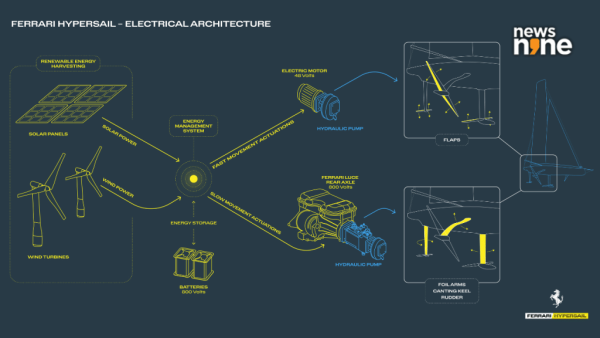
The boat uses electronic control units, sensors and four voltage levels ranging from 12V to 800V. The higher voltage system handles larger movements such as foil arms and the canting keel. Smaller 48V motors drive pumps for quick flap movements.
This split matters at sea. Big parts need heavy energy. Fast-moving small parts need quick response. Mixing the two badly would waste energy and slow down control.
Ferrari Hypersail Wich-by-wire | Source: Ferrari
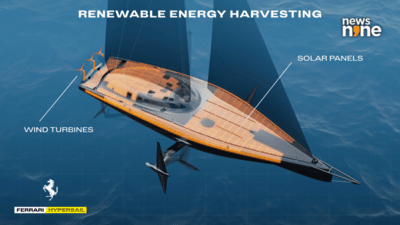
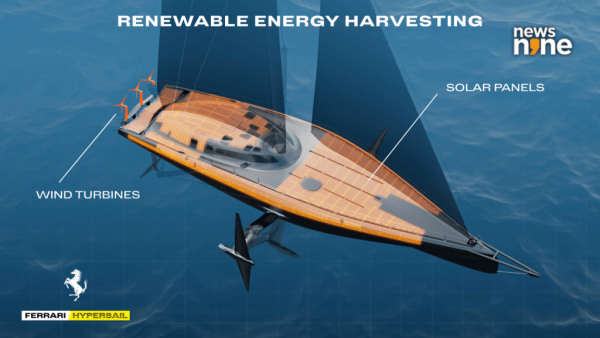
Solar, wind and batteriesFerrari Hypersail’s electronic and hydraulic systems are powered through renewable sources. The solar panels are built into the deck and topsides, covering 100 square meters. These panels can be walked on and include grip, which is useful because a racing deck is not a calm hotel lobby.
Ferrari says the panel placement came after simulations of sunlight exposure across possible routes and latitudes. The idea was to place panels only where they could give useful output without adding useless weight.
Wind turbines are fitted at the stern. These can be changed or removed based on sailing needs. The main challenge is balance. The turbine must make power without creating too much drag, mainly when the boat is moving fast.
Surplus energy is stored in two identical 800V batteries. These batteries then send power based on the boat’s needs at that moment.
Why this matters for marine techFerrari Hypersail is a marine project, but the bigger story is crossover engineering. Automakers are learning a lot from batteries, sensors, electric motors and software. Now that knowledge is moving into boats.
The project is still a specialist offshore racing effort, not something that will reach a regular marina soon. Still, the energy idea is worth watching. A boat that makes its own power, stores it and uses it to fly over the ocean does sound like science class got mixed with a Ferrari garage.
-
Zlatko Dalic resigns as Croatia head coach following World Cup elimination

-
Ruben Amorim Reflects on Manchester United Lessons, Allegri’s Criticism and Mourinho Comparisons

-
Monstrous garbage mound triggers Pune building collapse, 12 trapped

-
Bhatti demands all coal blocks in Godavari Valley to SCCL

-
Spanish media divided over Manchester United’s pursuit of Real Madrid’s Aurelien Tchouameni