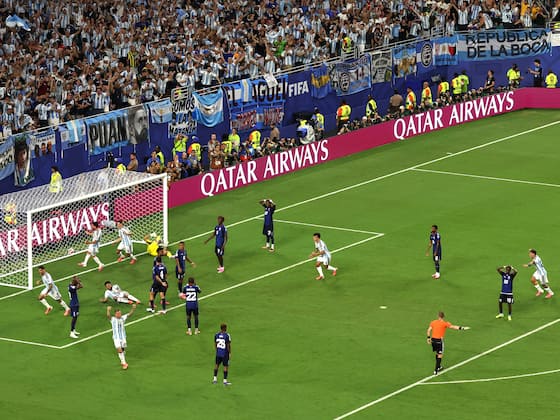
Argentina required 120 exhausting minutes to overcome World Cup debutants Cape Verde Islands 3–2 in a dramatic Round of 32 encounter at Hard Rock Stadium on 4 July 2026. Lionel Messi opened the scoring in the 29th minute with a superb finish, but Deroy Duarte’s equaliser on 59 minutes forced the reigning champions into extra time against spirited opponents making their first appearance at this stage.
All three goals in extra time came from defenders. Lisandro Martinez put Argentina back in front in the 93rd minute, Sidny Lopes Cabral levelled again at 103 minutes with a spectacular strike, and Cristian Romero sealed victory at 111 minutes with a powerful header from Messi’s corner. This contest was a real test of Argentina’s resilience as they narrowly advanced to the next round.
The Manchester United centre-back produced an outstanding all-round display, combining precise distribution with crucial attacking contributions. His superb long pass from the centre circle in the 29th minute set up Messi for the opener, demonstrating his exceptional vision and technical ability from deep positions.
Martinez then found the net himself in the 93rd minute of extra time, expertly controlling a loose ball inside the penalty area before unleashing a sharp left-footed drive into the top right corner to restore Argentina’s lead. Throughout the 120 minutes, his passing consistently opened gaps in Cape Verde’s defensive lines, allowing Argentina’s forwards to exploit space.
By contributing directly to two of Argentina’s three goals, Martinez underlined the tactical importance of defenders participating in attacking phases, both from set-pieces and build-up play. His composure in possession and willingness to step forward with the ball proved decisive in a game that could easily have ended Argentina’s title defence.
Messi once again delivered a masterclass on the World Cup stage, scoring one goal and assisting another while posing a constant threat to goalkeeper Vozinha. He broke the deadlock in the 29th minute with a sublime left-footed strike into the top corner after controlling Lisandro Martinez’s pinpoint long pass, extending his record as the tournament’s all-time leading scorer.
The Argentina captain then created the decisive goal in the 111th minute, curling in a perfectly placed corner that Cristian Romero headed home. Over the course of the match, Messi was engaged in a personal duel with Vozinha, who denied him brilliantly in a one-on-one at 63 minutes and made several remarkable saves from free-kicks and open play efforts.
Despite Vozinha’s heroics, Messi’s influence on both the opening and winning goals was crucial in ensuring Argentina’s progression. His precision from set-pieces underlined his creative importance, particularly when direct scoring opportunities were limited by Cape Verde’s disciplined defending.
Inter Milan striker Lautaro Martínez struggled to make an impact during his 63-minute appearance, as Cape Verde’s compact defensive shape restricted his involvement in attacking areas. At times he appeared isolated, with Argentina’s patient possession play limiting service into the final third.
Following Cape Verde’s equaliser at 59 minutes, Lautaro was substituted for Julian Alvarez as part of coach Lionel Scaloni’s tactical reshuffle to inject more energy and variation into the attack. The change sought to revitalise Argentina’s forward play and regain momentum.
The decision to withdraw the starting striker reflected a subdued performance. While Cape Verde’s disciplined defence contributed to his lack of influence, the contrast with Messi’s creative dominance highlighted Argentina’s reduced cutting edge when Lautaro led the line.
-
Who is Clement Turpin? The World Cup referee for the Colombia vs Ghana clash
-
Unstoppable Messi sets another record with 20th World Cup goal

-
Have a healthy breakfast in the morning! Make Crispy Khamang Appay from Masor Dal in 10 Minutes, Note Recipe

-
Microplastics: Plastic particles reaching the body even before birth! You too will be stunned to know the reality

-
Essential tips to deal with job crisis