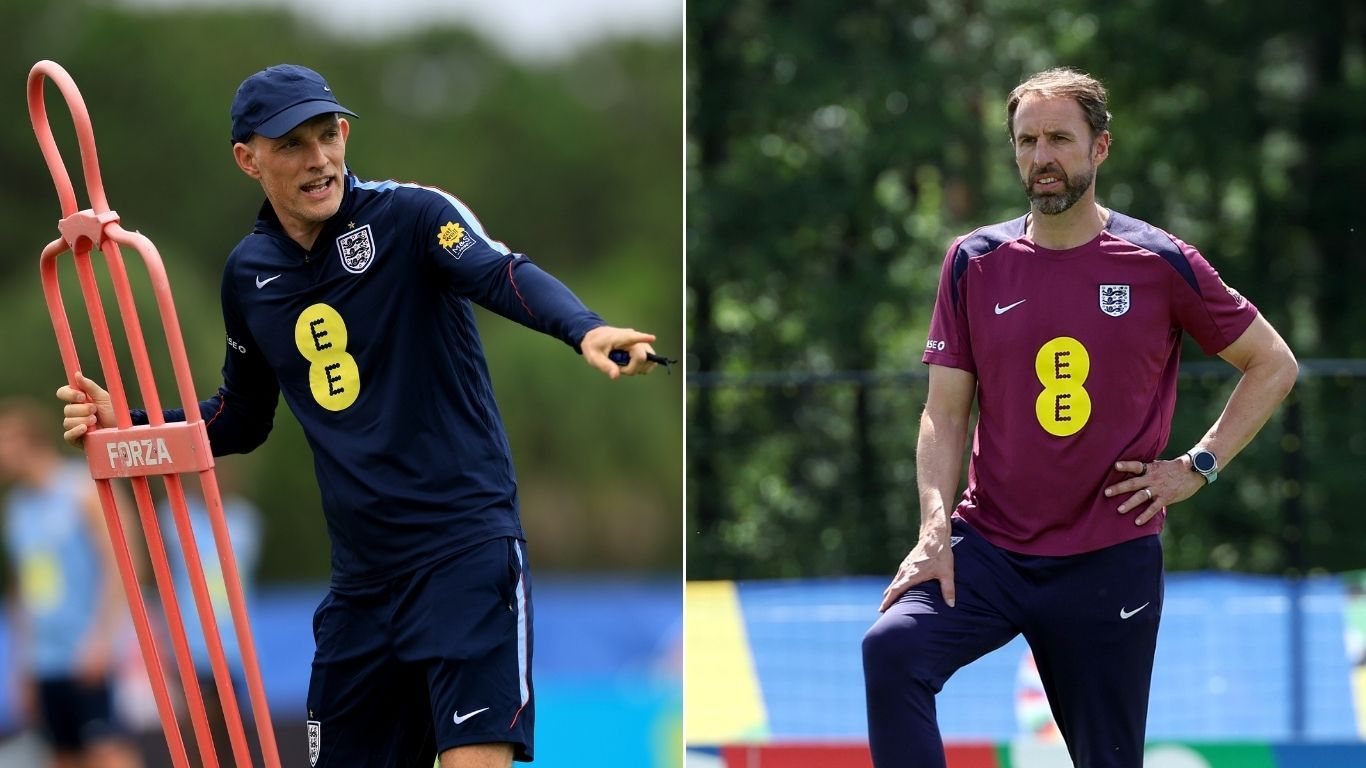
Gareth Southgate often faced criticism for England’s lacklustre displays even as the team made deep runs in major tournaments. Thomas Tuchel has taken a different route in an attempt to resolve those issues — though certain familiar problems continue to persist.
Tuchel’s England remain puzzling: brilliant on their best days, yet frustratingly flat on others.
This inconsistency feels reminiscent of Southgate’s later years as manager, but the underlying causes are quite distinct.
So what has Tuchel changed in his efforts to fix the problems he inherited — and why do we still see matches where his tactical plan seems to misfire?
This is a crucial question, and one only needs to look at the squads both managers selected for major tournaments to understand their differing philosophies.
At Euro 2024, Southgate’s options on the right wing included left-footers Bukayo Saka, Cole Palmer, and Jarrod Bowen. On the left, he relied on left-footer Phil Foden, alongside right-footers Anthony Gordon and Eberechi Eze.
During the previous World Cup, Southgate started against France with Foden to the left of Harry Kane and Saka on the right. Marcus Rashford and Raheem Sterling were introduced from the bench late in the game. In the Euro 2020 final, he deployed right-footed Sterling on the left of the attacking trio, with Mason Mount operating on the right.
Regardless of his selections or system, Southgate preferred players who could exploit the channels effectively. They were less like traditional wingers and more like dual playmakers supporting Kane. At times, that approach worked well — Sterling, for example, was England’s standout performer at Euro 2020.
However, Jude Bellingham’s meteoric rise changed the dynamics. His growing influence contributed to some of the disjointed attacking performances that became more frequent towards the end of Southgate’s tenure.
With the Real Madrid star in the side and Kane’s tendency to drop deep to create space, England often ended up with four players occupying the same small zone on the pitch.
Tuchel has sought to address this by preferring quick, unpredictable wingers who can stay wide or cut inside as needed, rather than midfield technicians like Palmer and Foden, who are more comfortable playing centrally.
But Tuchel’s commitment to this idea can be unyielding. It has shown promise — notably in the qualifying match against Serbia and the opening World Cup game against Croatia.
However, Tuchel’s decision to omit Foden and Palmer in favour of more specialised wide players such as Noni Madueke is a calculated gamble that depends heavily on the system functioning perfectly.
When it fails, frustration quickly sets in. Rashford and Madueke struggled to make an impact against DR Congo, and England only found their rhythm once Saka and Gordon replaced them. The substitutes played more within the width of the box and the channels, instead of merely hugging the touchline and cutting inside late.
Tuchel might cite Gordon’s display as proof of England’s tactical flexibility, but the squad lacks a creative specialist like Foden or Palmer who could make a true ‘Plan B’ come alive.
It is important not to overstate the point, as Southgate clearly valued Declan Rice immensely.
Yet due to limited options in defensive midfield, Southgate often tasked Rice with anchoring the midfield, particularly in the early years of his England career. The box-to-box duties were typically given to players such as Jordan Henderson, Kobbie Mainoo, or — controversially at Euro 2024 — Trent Alexander-Arnold.
Meanwhile, Bellingham frequently found himself competing for space in the number 10 role with his own teammates.
Tuchel has reshaped that dynamic. By creating more freedom for his attacking midfielder — whether it’s Bellingham or Morgan Rogers — he has made that position more influential. Bellingham’s goal-and-assist performance against Panama, and Rogers’ strong showings during qualifying, underline why Tuchel favours this setup.
Rice, too, has taken on a more advanced role since partnering with Elliot Anderson last year. Both players like to push forward, but Rice no longer defaults to the deeper, holding position.
The new wide-play structure also gives Rice more room to drive into the channels, linking up with Bellingham in orchestrating play near the edge of the penalty area.
Under Southgate, England frequently used a back three with wing-backs, with Kyle Walker tucking inside to form part of the defensive trio while two wing-backs provided attacking width. Luke Shaw and Kieran Trippier, both exceptional crossers, were often used in those roles, and Southgate occasionally experimented with Saka or Eze as alternatives.
Tuchel, however, already has enough attacking width and generally prefers a back four. This has resulted in a more traditional full-back–winger partnership throughout his tenure.
In Tuchel’s system, the winger is expected to deliver quality in the final third, while the full-back’s role is largely supportive — providing overlaps rather than a barrage of crosses. Tuchel has been visibly frustrated on occasions when Djed Spence has deviated from that structure.
This perhaps explains why Tuchel chose not to bring Alexander-Arnold to the World Cup, even after Tino Livramento’s injury opened up a potential recall.
Alexander-Arnold is naturally the focal point on his flank and has spent much of his career playing behind Mohamed Salah — the quintessential inverted winger.
Pairing him with someone like Madueke would disrupt Tuchel’s tactical balance. Yet critics argue that Spence offers similar weaknesses to Alexander-Arnold but with far fewer strengths. And when the wide-attacking plan falters, England are left with full-backs who lack the creative quality to compensate if Tuchel wants to introduce another advanced playmaker into the mix.
-
Manchester United confirm promising defender Scarlett Hill signs first professional contract

-
New boss, same old England: Thomas Tuchel still battling the same problems that haunted Sir Gareth Southgate’s era

-
Cristiano Ronaldo addresses retirement speculation after World Cup performance
-
Ranking the Greatest Forward Lines in World Cup History: How High Could France’s Kylian Mbappe, Michael Olise, Ousmane Dembele, and Bradley Barcola Climb After Their 2026 Heroics?
-
Manchester United Eye £77m Move for Tchouameni as Real Madrid Open to Sale