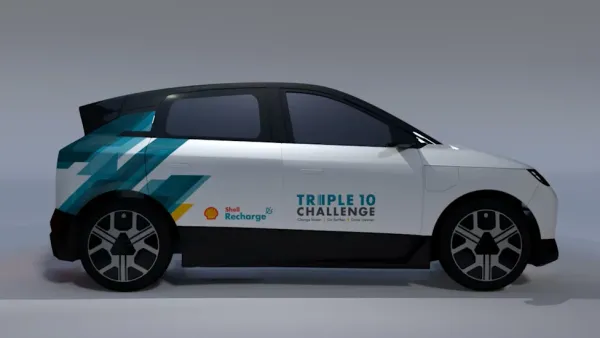
Shell is presenting a tiny electric concept car with a list of ambitious targets, saying it could charge quickly, deliver strong efficiency, and cut its carbon footprint in half compared with current European EVs.
As , though, the most notable part of the project is its unique battery setup.
What happened?
The Triple 10 Challenge Concept is essentially a city-sized EV testbed for a new approach to managing battery heat. As InsideEVs observed, Shell replaces the usual indirect battery-cooling arrangement with a nonconductive fluid that can be used safely around high-voltage components.
Shell describes that liquid as a "dielectric fluid," meaning it does not conduct electricity, per the outlet. Because it can surround the battery cells directly, heat can be pulled away faster. As InsideEVs notes, that matters most during fast charging, when rising temperatures usually cause charging speeds to taper off.
Shell says the setup could "reduce its carbon footprint by half" compared to today's European EVs while returning 6.2 miles per kilowatt-hour of efficiency, per the publication. The company also claims the concept can go from 10% to 80% charge in less than 10 minutes on a 175-kilowatt charger, adding 15 miles of range per minute, as InsideEVs noted.
Rather than signaling plans to build the car itself, the publication indicated Shell appears to be using the concept to demonstrate a cooling technology it wants automakers to adopt.
Why does it matter?
Battery cooling directly affects charging speed, driving efficiency, and battery longevity. If a battery pack stays cooler under heavy use, it can continue accepting high charging power for longer, which could make charging stops on longer trips shorter.
Electric vehicles can save owners money on fuel costs. If lighter, simpler cooling systems can push efficiency even further, those savings could grow.
For households , charging at home is also significantly cheaper than relying on public chargers. Qmerit provides free, instant installation estimates for faster Level 2 home chargers .
What are people saying?
Commenters on went back and forth on Shell's offering. While some were skeptical of how long the coolant would last or its potential flammability in a crash, others intimated they were being unfair without knowing all the details.
"If there was a severe collision that breaches the battery pack and exposes it to an external fire, the fluid would eventually combust once it reaches its fire point," one in reference to fire concerns. "However it is highly resistant to being the cause or catalyst of a fire itself."
"Battery coolant for modern EVs lasts for no less than 100,000 miles, often much longer," another as it pertained to durability. "I would expect no less from this, or no car company would use it."
-
Folarin Balogun joins rare World Cup club with goal and red card drama

-
Ronald Koeman steps down as Netherlands coach in heartfelt message; KNVB reports online abuse following World Cup penalty exit

-
Easy ways to take care of shoes and feet in monsoon

-
This private bank has changed the rules related to debit card, increase in DCC charges, will be applicable from August 1

-
There will be severe devastation in Maharashtra in the next 4 days! ‘Red Alert’ issued in these districts including Mumbai-Pune