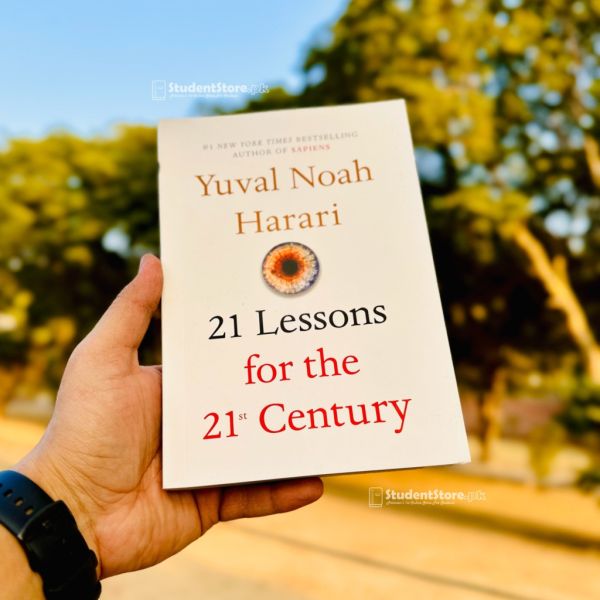
Summary
- 21 Lessons for the 21st Century was one of those books.
- At its best 21 Lessons for the 21st Century encourages readers to step from the daily flood of information and examine the deeper forces shaping contemporary life.
- 21 Lessons for the 21st Century sits at the centre of this journey concerned not with history or speculative futures but with the realities confronting us now.
AI Generated Summary
From Syed Tahir
After reading hundreds of books and reviewing many of them for newspapers I have learned that memorable books are rare. Most inform, some entertain and a few make you think. Occasionally does a book stay with me long after I have finished reading it. 21 Lessons for the 21st Century was one of those books.
As I read through its pages I found myself constantly connecting Harari’s arguments to events happening around the world. Discussions about misinformation made me think of election campaigns and social media controversies. When Harari talked about nationalism I thought of movements across continents. Questions about intelligence felt less like speculation and more like descriptions of a future that is already here. The book seemed like a collection of essays and more like a way to understand the world we live in.
By the chapter I realized what made the book so compelling. Harari was not looking back at humanity’s past or trying to predict its distant future. He was trying to make sense of the uncertainties of the present. That realization convinced me the book deserved a look.
We live in a time with a lot of information but often lacking clarity. News travels fast technology evolves quickly. Public debate is increasingly shaped by forces many people struggle to understand. It is against this backdrop that Harari explores some of the questions of our century.
The book occupies a place within his broader body of work. Sapiens traced humanity’s rise from a species to the dominant force on the planet. Homo Deus looked ahead imagining how technology and science might change life. 21 Lessons for the 21st Century stands between these works. Its focus is on the challenges we face today.
The book is made up of twenty-one essays that examine subjects ranging from intelligence and nationalism to religion, immigration, education and truth. Beneath this diversity lies a message: the major challenges of the modern world are deeply connected.
One of Harari’s concerns is the growing influence of data and algorithms. He argues that information has become the resource of the twenty-first century changing politics, economics and personal freedom. The issue is not simply that governments and corporations know more about us than before. It is what happens when technological systems begin to understand behaviour very accurately.
Readers of Homo Deus will recognize many of these themes. The difference is that ideas once presented as possibilities now feel very real. Artificial intelligence, algorithmic decision-making and digital surveillance are no longer prospects. They are already becoming part of life.
What has always distinguished Harari from contemporary thinkers is his ability to connect ideas that are rarely discussed together. He moves comfortably between history, philosophy, politics, economics and technology building arguments that’re both easy to understand and thought-provoking. Readers need not be specialists to engage with his work. Complex concepts are explained clearly allowing a broad audience to participate in debates that might otherwise remain confined to circles.
What impressed me most however was the books ability to trigger connections beyond its pages. Every chapter brought to mind a real event or controversy from recent years. A discussion of misinformation made me think of election campaigns and social media battles. Reflections on nationalism made me think of movements across continents. Again and again Harari encouraged me to see events not as isolated incidents but as part of larger patterns.
This perhaps is the books achievement. Than offering a list of contemporary problems Harari provides readers with a framework for interpreting the world around them. When one disagrees with a particular conclusion the questions he raises continue to resonate long after the chapter has ended.
The book also benefits from Hararis gift for storytelling. He has an ability to take abstract ideas and ground them in examples that make them easier to understand. As a result discussions that could easily become dense or overly technical remain engaging throughout. His writing is confident and often thought-provoking qualities that have helped him reach readers far beyond academic audiences.
At its best 21 Lessons for the 21st Century encourages readers to step from the daily flood of information and examine the deeper forces shaping contemporary life. In an age dominated by headlines, reactions and endless streams of data that broader perspective is one of the books most valuable contributions.
The qualities that make Harari such a compelling writer also reveal some of his limitations. His arguments often rely on synthesis and broad synthesis inevitably carries risks. Complex realities are sometimes compressed into narratives that leave little room for nuance. Critics have frequently argued that he moves quickly across contested intellectual terrain and occasionally presents debatable interpretations with greater certainty than the evidence may warrant.
There is also the challenge of relevance over time. Because 21 Lessons for the 21st Century is rooted in concerns some sections have aged better than others. Discussions surrounding intelligence, information networks and technological disruption remain remarkably relevant. Other chapters feel closely tied to the political atmosphere in which the book was written. This is perhaps unavoidable. Books about the present often face a shelf life than books about the past.
Still the book succeeds in what it sets out to do. Harari does not offer answers nor does he pretend that the worlds problems can be solved through simple formulas. Instead he encourages readers to accept uncertainty, question assumptions and develop the flexibility needed in a rapidly changing world.
Reading the book after Sapiens and Homo Deus and later reflecting on it alongside Nexus I came to see it as a part of Harari’s larger intellectual project. Sapiens explored the stories that shaped humanitys past. Homo Deus examined the possibilities that may shape its future. Nexus investigates the information networks through which power, ideas and influence increasingly flow. 21 Lessons for the 21st Century sits at the centre of this journey concerned not with history or speculative futures but with the realities confronting us now.
Ultimately this is not Hararis ambitious book nor is it his most original. It is, however among his timely and accessible. Its value lies less in the answers it provides than, in the questions it compels readers to ask about technology, truth, identity and power.
Whether one agrees with Hararis conclusions or not the world he describes feels unmistakably familiar. The book leaves readers with certainties but a deeper appreciation of the complexity of the age they inhabit. In a century increasingly defined by uncertainty that may be its enduring contribution.
We welcome your contributions! Submit your blogs, opinion pieces, press releases, news story pitches, and news features to opinion@minutemirror.com.pk and minutemirrormail@gmail.com
-
England’s Right-Back Crisis: From a Position of Strength to a World Cup Weakness — and How Thomas Tuchel’s Choices Sparked the Problem

-
4 Zodiac Signs Attract Lasting Abundance & Luck On Tuesday, June 30, 2026

-
How To Get To Titania In Nintendo Star Fox

-
Cursor now has a mobile app for guiding your coding agent on the go

-
Due to these 5 mistakes of yours, your phone’s battery is deteriorating rapidly, know the correct way of charging Gujarati