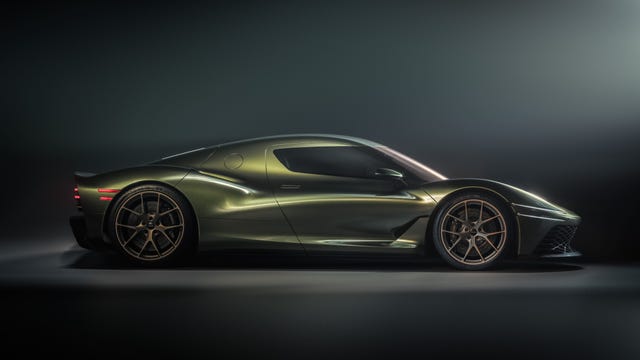
Officially, Genesis maintains that the fiery Magma GT remains just a concept—an exploration of how the South Korean luxury marque might realise its ambition to develop and produce a flagship halo car, an idea first teased towards the end of last year. Unofficially, however, the outlook appears quite promising. The Magma GT has now been showcased twice, most recently at the 24 Hours of Le Mans, where it appeared alongside a full-fledged GT3 racing concept. The most recent iteration of the concept, unveiled last week, featured a complete interior and functioning doors—details that raise intriguing questions about what the production version could look like.
Among the more interesting details seen in photographs are what appear to be dual ports located on either side of the roof. These could represent both a charging and a fueling port, implying that the Magma GT might be a plug-in hybrid. Such a configuration would distinguish it from traditional hybrid systems found in models like the Chevrolet Corvette and Porsche 911 Turbo S, aligning it more closely with plug-in hybrid supercars such as the Ferrari 296 GTB/GTS and Lamborghini Temerario.
The powerplant remains a mystery, but a large-scale display model positioned outside the Genesis hospitality suite at Le Mans depicted an eight-cylinder engine block. Considering the engine sounds heard when the Magma GT debuted on stage last year, a V8 configuration seems all but certain. Ideally, the production car’s engine would echo the rally-inspired V8 found in the GMR-001 race car, though that particular motor may differ significantly from what ultimately makes it into the road-going version.
Inside the cabin, the design language leans heavily toward luxury grand touring. Quilted leather upholstery and a prominent analog tachometer behind the steering wheel indicate that this car is meant to be a true grand tourer. Genesis Chief Creative Officer Luc Donckerwolke has previously mentioned that the brand’s halo model could mirror Porsche’s 911 lineup by offering a range of trims tailored to different tastes. If that’s the case, one of those trims could emphasise the driving experience and comfort over outright performance—similar to the 911 Carrera GTS or Turbo variants. The combination of a richly appointed interior and a possible plug-in hybrid system suggests that this particular concept may preview a mid-tier version focused on balance rather than pure performance.
Perhaps the most revealing design element lies in the doors. The large panels open forward and upward, exposing tall, reinforced sills set deep within the car’s wide bodywork. Observant enthusiasts might notice a resemblance to McLaren’s supercar lineup, which uses carbon-fibre monocoque construction. If Genesis adopts a similar architecture, the Magma GT would benefit from the same structural rigidity and safety advantages found in modern racing prototypes. Given the company’s previously stated intent to offer multiple trims, this could potentially become the highest-volume production model built around a carbon-fibre monocoque chassis.
While the GT3 race car doesn’t disclose much about the final road car, its debut does hint at Genesis’ overarching approach to the halo car project. Toyota took a comparable strategy when it introduced the GR GT3 concept in 2022, developing a competition-spec racer alongside its road-focused counterpart. That dual approach ensured its GT3 contender could genuinely rival entries from BMW, Ferrari, Porsche, and Mercedes-AMG. Toyota’s long-term plan culminated with the GR GT’s reveal in late 2025, a car that bore a striking resemblance to its original concept from nearly five years prior.
Despite the clues, Genesis declined to confirm any concrete details about either the Magma GT concept or its potential production plans during a brief Q&A following the unveiling. Hyundai Motor Company CEO José Muñoz commented that the GT3 car “was the vehicle that gave us direction to potentially develop the GT,” suggesting that the desire to compete in GT3 racing could shape the company’s supercar ambitions. He added, “Everything is under consideration.”
Muñoz elaborated, “It depends on your reaction—it depends on the public reaction. If we see a high level of interest, I’m sure we’ll move forward. For now, that’s all I can say. GT3 is what triggered GT, and GT, we’re doing the numbers as we speak. Everyone says they love it—I love it personally. We’ll share a bit more detail later.”
Genesis Magma Racing head Cyril Abiteboul added that the team “looked at different cars, looked at benchmarks” before creating the Magma GT3 concept, concluding that a brand “can be competitive with all sorts of different solutions.” While discussing the potential for a mid-engined car with a carbon-fibre monocoque, he noted that the team also observed the front-mid-engined Mercedes-AMG GT driven by Max Verstappen at the Nürburgring in May, acknowledging, “We’ve seen how competitive that car can be.”
Abiteboul further stated that no single layout is mandatory for a successful GT3 car, meaning Genesis hasn’t locked itself into one design philosophy. “I don’t think there’s an absolute requirement for a specific material or body configuration to be competitive,” he explained. “We are pragmatic—very pragmatic—with our first entry into this segment, so let’s see. We want to hear from you, from fans, from customers.”
In its press release unveiling both the Magma GT3 and the refined Magma GT concept, Genesis described the pair as “one potential pathway for connecting Genesis’ motorsport ambitions with its evolving performance portfolio, without confirming specific production or racing plans.” Judging by the level of development already visible, it seems Genesis is indeed progressing along that potential pathway.
-
Barcelona initiate talks with Harry Kane’s camp about potential move following the 2026 World Cup

-
Lamborghini Hints at a Fiercer New Urus Performance Model
-
What Lies Ahead for Fernando Alonso?
-
Historic Corvettes Recovered from Illinois Museum After Tornado Devastation

-
The facility of ‘Buy Now, Pay Later’ may become a problem, watch the video to know how the debt trap increases.